
How does 'greedy' decoding differ from 'sampling' in watsonx.ai?
Select an answer to reveal the explanation.
Short Explanation
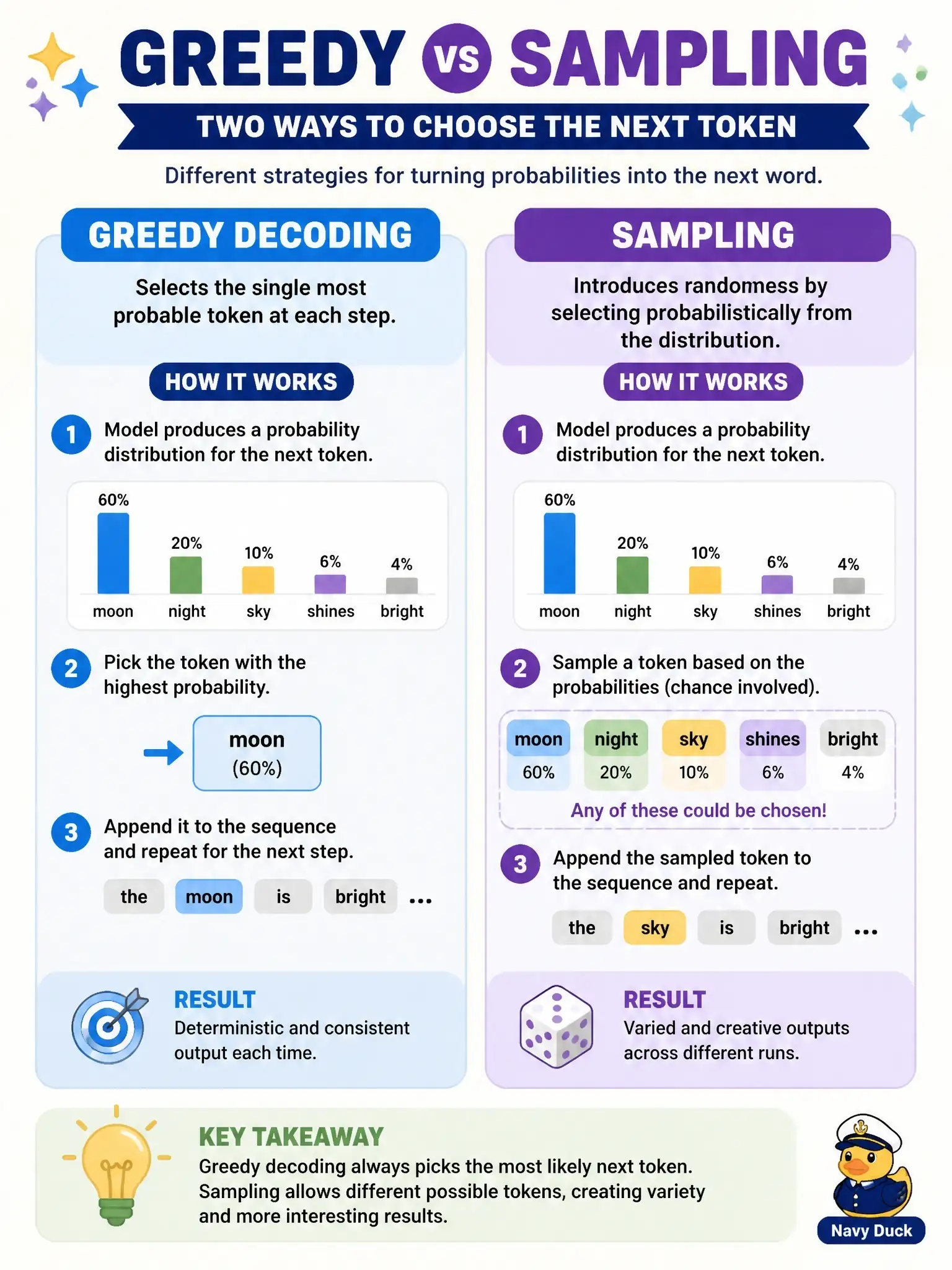
Think of greedy decoding as always grabbing the top card off the deck: at every step the model takes whichever next token has the highest probability, so you get the same answer every time. Sampling shuffles a little instead, picking from a pool of likely tokens so the output feels more creative and varied.
Full Explanation
In watsonx.ai, the decoding method controls how the foundation model picks each next token. Greedy decoding selects the token with the highest probability at each step, which makes output deterministic and predictable but sometimes repetitive. Sampling decoding narrows the candidates to a subset of likely tokens and then chooses one at random, which adds variability; temperature, top-k, top-p and a random seed shape that randomness. The claim that greedy produces several responses and keeps the longest describes nothing in watsonx.ai; neither method generates multiple candidates and ranks them by length, and each produces a single output stream. Decoding has nothing to do with the channel, so the idea that greedy is for voice and sampling is for text confuses model parameters with integration types; both apply to any text a model generates. Stop sequences are stopping criteria, separate from decoding, and they are honored whichever method you choose. On the exam, link greedy with deterministic, repeatable answers such as extraction or classification, and sampling with creative generation. To check it yourself, open the Prompt Lab model parameters panel, run the same prompt twice with greedy and then twice with sampling at a higher temperature, and compare how much the outputs change.