
After identifying and correcting a missing DHCP relay address as the cause of nurse-call controllers failing to get IP addresses, what is the last step that should be completed before considering the issue fully resolved?
Select an answer to reveal the explanation.
Short Explanation
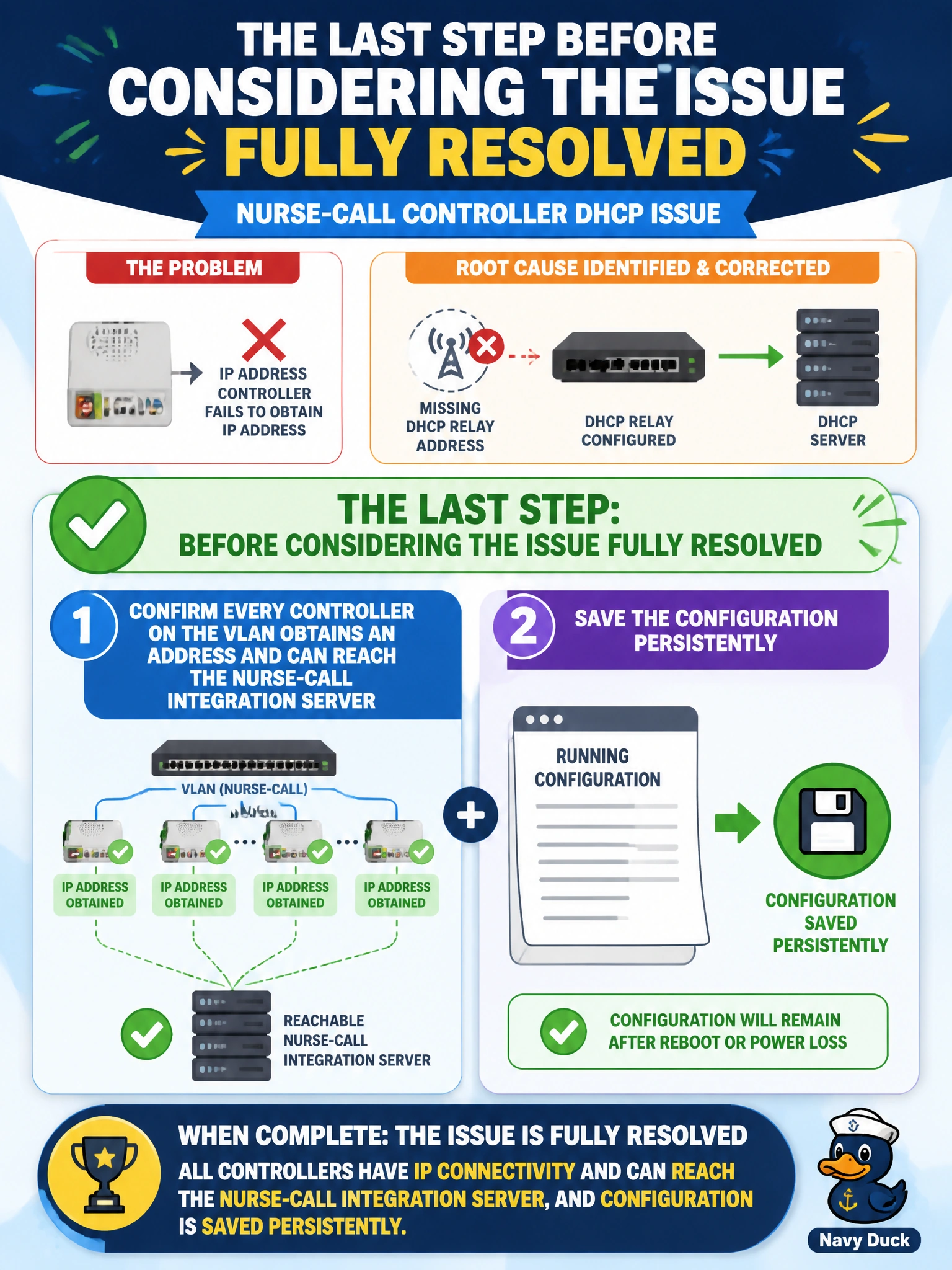
One controller getting an address is a good sign, not proof the whole ward is fixed. Confirm the whole set of devices comes up, that they can actually reach the system they report to, and that the fix is saved so it survives a reboot. Then, and only then, is the ticket really done.
Full Explanation
Implementing a fix and validating it are two distinct final steps, and skipping straight from applying the relay address to closing the ticket risks missing a partial fix, such as one controller working while others on the same VLAN still fail due to a separate issue, or the relay address being correct but only applied to the running configuration and lost after a reload. The complete closeout is to confirm that every affected device on the VLAN — not just a single test unit — successfully obtains an address, and then confirm actual application-level function by verifying the controllers can reach and successfully report to the nurse-call integration server, since IP connectivity alone doesn't guarantee the clinical system itself is functioning end-to-end. Recreating the VLAN from scratch is unnecessary and needlessly risky once the actual root cause (a missing relay address) has already been identified and corrected; it introduces new risk without addressing anything the current fix hasn't already resolved. Disabling 802.1X to 'simplify troubleshooting' removes a security control for reasons unrelated to the DHCP problem at hand and should never be done as a workaround. Increasing the DHCP lease time to its maximum has no bearing on whether the relay fix worked and doesn't belong in this resolution step at all. A caveat: for a life-safety-adjacent system like nurse call, documenting exactly what was changed and confirming persistence of the configuration change is especially important, since these devices cannot tolerate a recurrence.