
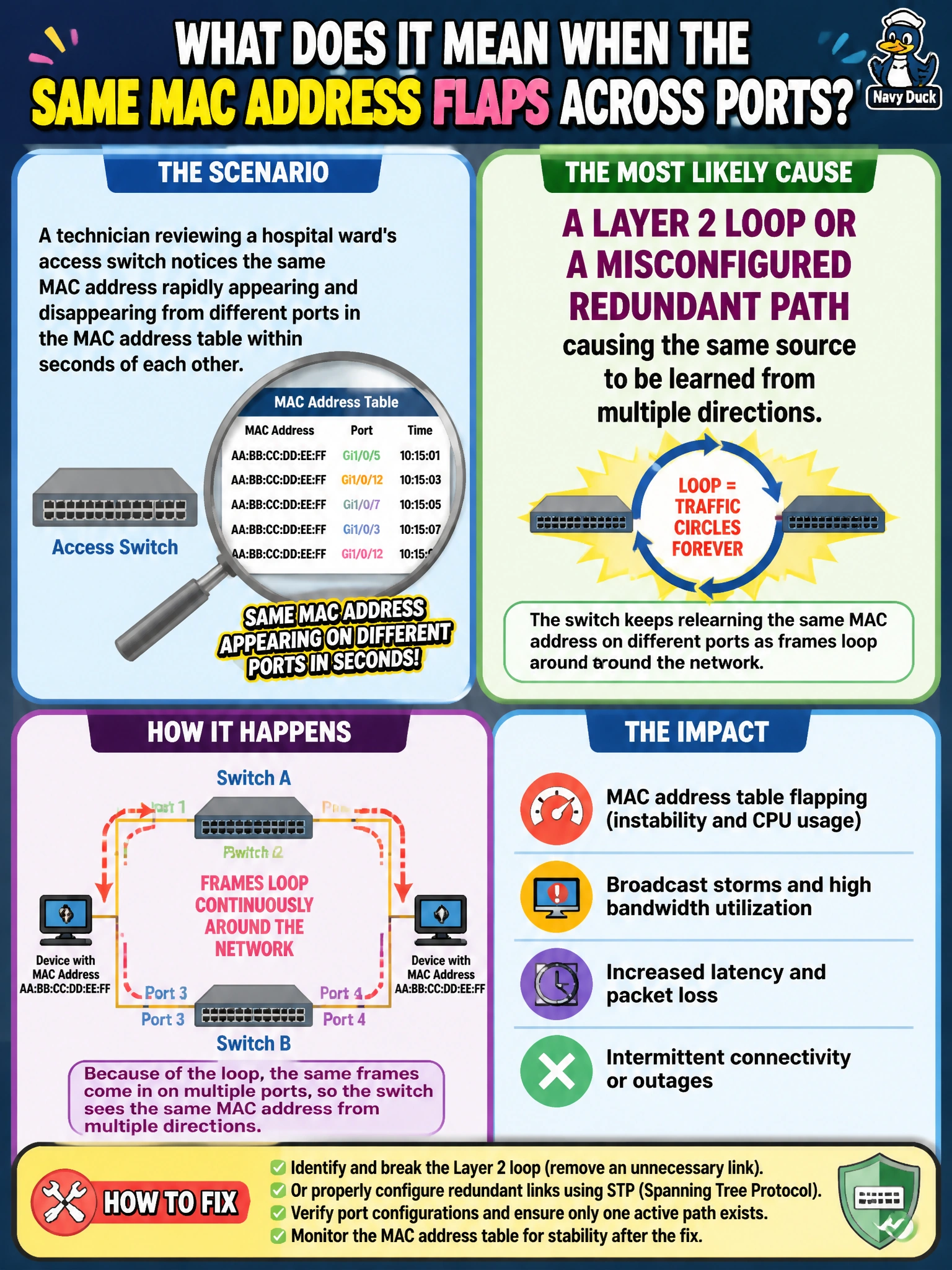
A technician reviewing a hospital ward's access switch notices the same MAC address rapidly appearing and disappearing from different ports in the MAC address table within seconds of each other. What does this behavior most likely indicate?
Select an answer to reveal the explanation.
Short Explanation
A MAC address bouncing between ports over and over in the same table is called flapping, and it's rarely a good sign. It usually means frames from that same source are somehow reaching the switch from more than one direction, which points straight at a loop or a redundant path that isn't being properly blocked. Healthy switches shouldn't need to keep relearning the same address like that.
Full Explanation
A switch's MAC address table associates each learned source address with the single port it was last seen on, and rapid, repeated relearning of the same address on different ports, commonly called MAC flapping, indicates frames carrying that source address are arriving from more than one direction within the switching topology. The most common causes are a Layer 2 loop or a redundant link that is not correctly blocked, since either condition lets the same frame, or frames from the same device, reach the switch by two different paths in quick succession. This is not the same as wireless roaming, which is a client's association moving between access points at the RF layer and does not directly cause a wired switch's MAC table to flap in this pattern; a wired switch's MAC table entry for a wireless client changes when the client's traffic path through the wired network changes, not simply because the radio association moved. Load balancing is not something an individual MAC address table entry does across two uplinks; a given source address is learned on one port at a time, so alternating rapidly is a fault indicator, not a balancing mechanism. A scheduled firmware update would typically cause a brief, one-time disruption during the reboot, not an ongoing pattern of flapping. A concrete check is tracing which two ports the address is flapping between and inspecting that path for an unblocked redundant link or a loop.