
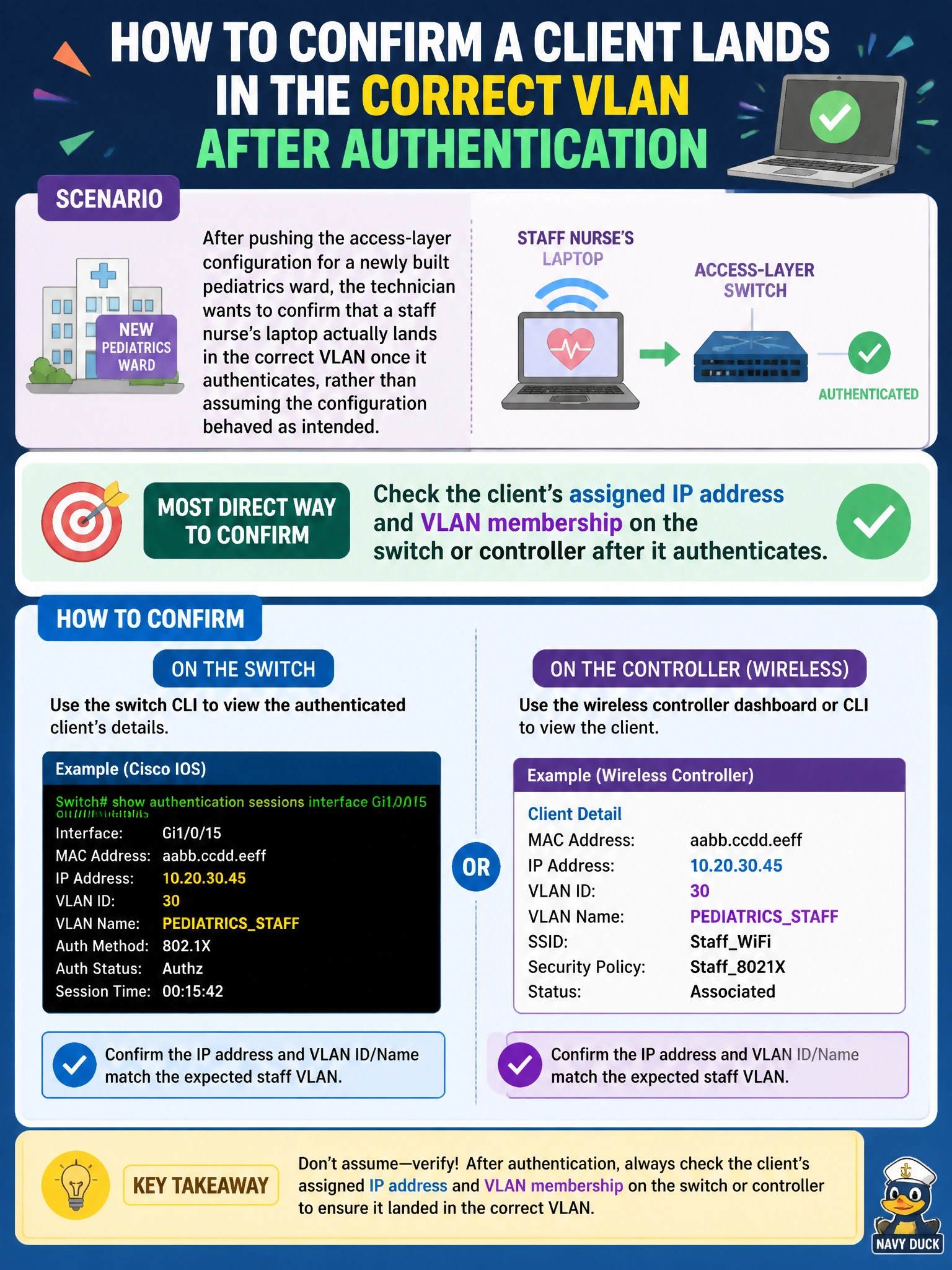
After pushing the access-layer configuration for a newly built pediatrics ward, the technician wants to confirm that a staff nurse's laptop actually lands in the correct VLAN once it authenticates, rather than assuming the configuration behaved as intended. What is the most direct way to confirm this?
Select an answer to reveal the explanation.
Short Explanation
Don't just trust the config file — watch the actual client land. Checking the nurse's laptop IP address and VLAN membership after it authenticates tells you whether the intended policy actually took effect, not just that it was written down somewhere.
Full Explanation
Post-deployment validation means confirming observed behavior matches intent, and for VLAN assignment that means looking at the client's actual state after authentication: its leased IP address, which VLAN or role the switch or controller shows it bound to, and whether that matches the design for staff on that ward. Configuration that looks correct on paper can still fail in practice due to a typo in a RADIUS-returned attribute, a missing VLAN on a trunk, or a stale client cache, so the only reliable confirmation is checking the live session. Reading an AP's radio power setting from a physical label tells you nothing about which VLAN a specific client landed in; it's an RF configuration detail, not an authentication or segmentation outcome. Confirming the switch's firmware version against release notes is a useful operate-phase hygiene check but doesn't verify anything about this particular client's session. Verifying link aggregation on the uplink port checks port bundling and redundancy, unrelated to which VLAN an individual client was placed into. A thorough validation also tries reaching an expected resource, like a clinical application server, from that session to confirm reachability, not just VLAN membership alone.