
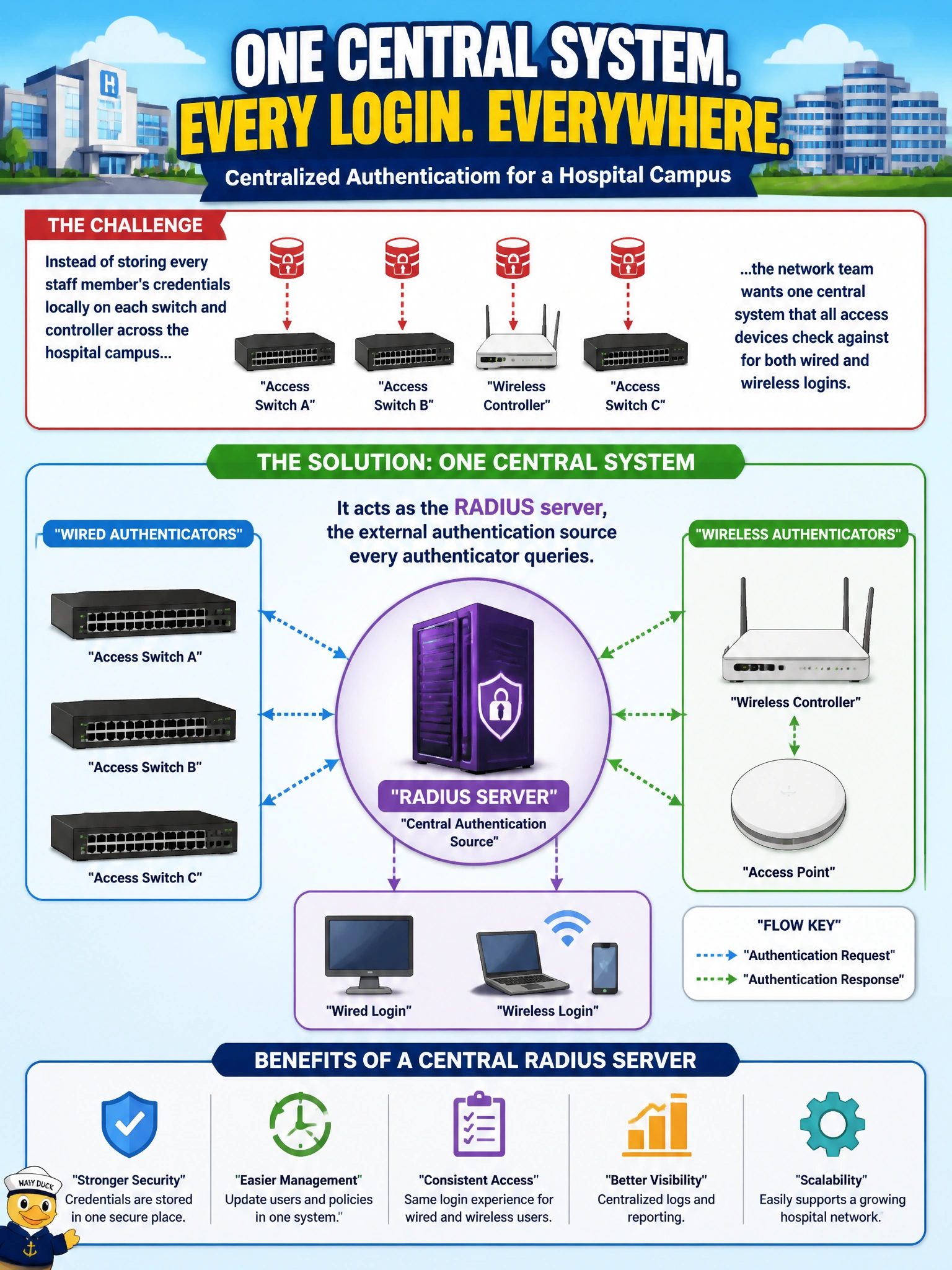
Instead of storing every staff member's credentials locally on each switch and controller across the hospital campus, the network team wants one central system that all access devices check against for both wired and wireless logins. What role does that central system play?
Select an answer to reveal the explanation.
Short Explanation
Picture one badge office that every door in the hospital calls to check an ID, instead of each door keeping its own list. That's what a RADIUS server does: switches and controllers forward the credential check to it instead of storing accounts themselves.
Full Explanation
A RADIUS server is the external authentication source in an AAA design: switches and wireless controllers act as authenticators that pass a client's credentials to RADIUS, which validates them against a central identity store and returns an accept or reject, often along with attributes like a role or VLAN assignment. Centralizing this way means a staff member's credentials, or their departure from the hospital, only need to be managed in one place rather than replicated device by device across every closet switch and controller on campus. A DHCP relay agent forwards address requests to a DHCP server, an entirely different function unrelated to verifying who a client is. A spanning-tree root bridge is a Layer 2 loop-prevention role that has nothing to do with authenticating users or devices. An NTP source keeps device clocks synchronized, which matters for accurate logging but plays no part in the authentication exchange itself. When validating this setup, confirm that a test login on both a wired port and a wireless SSID produces a matching authentication log entry on the RADIUS server, proving both paths are actually consulting it rather than falling back to local credentials.