
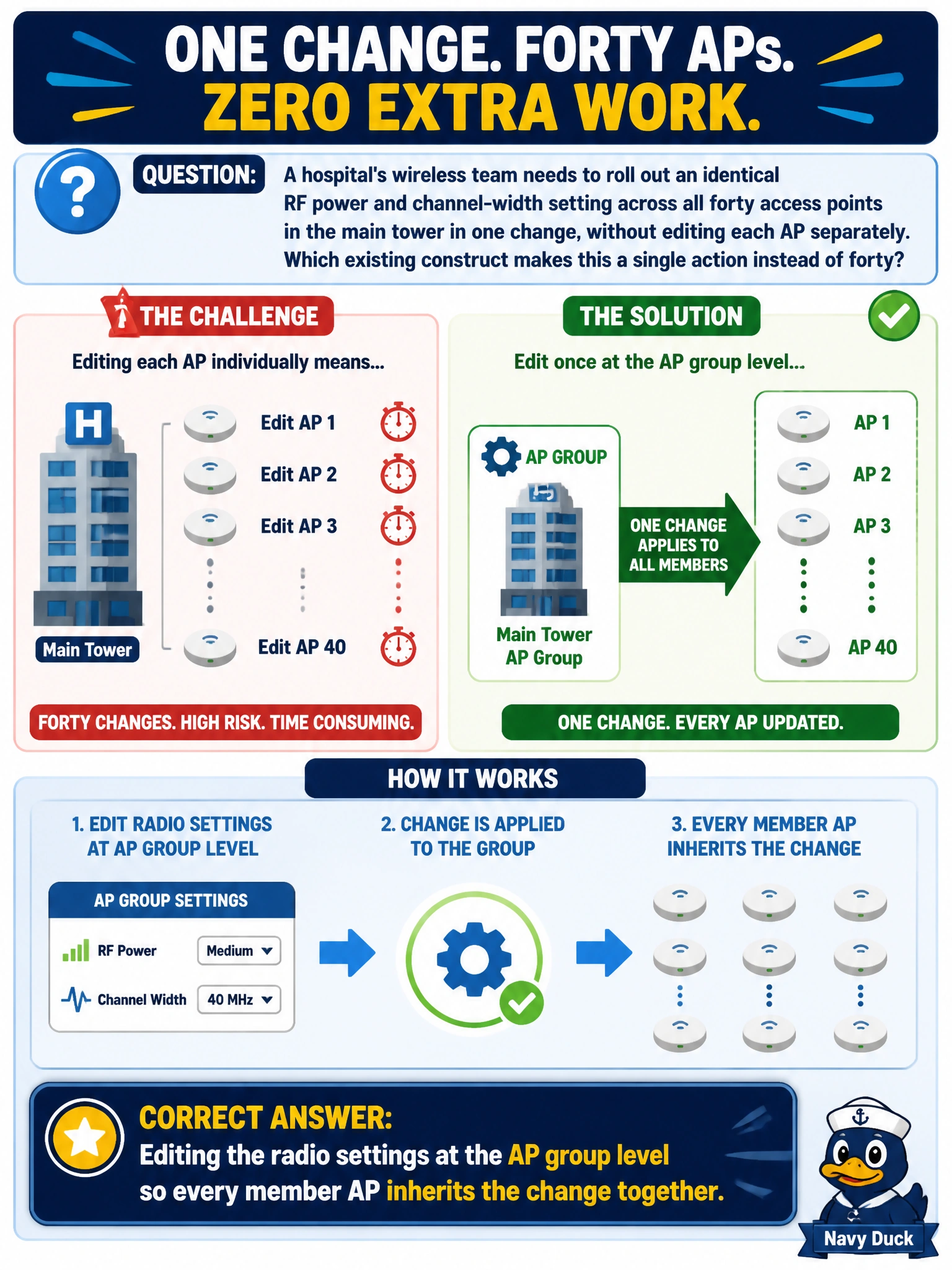
A hospital's wireless team needs to roll out an identical RF power and channel-width setting across all forty access points in the main tower in one change, without editing each AP separately. Which existing construct makes this a single action instead of forty?
Select an answer to reveal the explanation.
Short Explanation
Forty individual edits versus one group-level change — the whole reason AP groups exist is to collapse that into a single action. Change the setting once at the group, and every member AP picks it up together.
Full Explanation
AP groups hold shared configuration, including radio settings like power and channel width, so editing the setting once at the group level causes every AP that belongs to that group to inherit it automatically — this is precisely the 'one action instead of forty' outcome the scenario is asking for. Manually touching each AP individually technically achieves the same end state but is the labor-intensive, error-prone approach the group construct exists to replace, and cross-checking forty devices by hand doesn't make it efficient. Renaming devices identically has no effect on configuration inheritance or grouping logic — device names are just labels, not a mechanism for shared settings, and most systems require unique identifiers anyway. Rebooting APs only restarts them with whatever configuration they already have; a reboot does not reset radios to some new shared value and would not apply a change that was never actually configured anywhere. A caveat: group-level radio settings can still be overridden by allowing automatic RF management to adjust individual AP power/channel dynamically, so a static group setting and adaptive RF management shouldn't be fighting each other on the same radios. Operational check: after the group-level edit, spot-check a handful of APs' current radio settings to confirm they reflect the new value, not a stale per-AP override.