
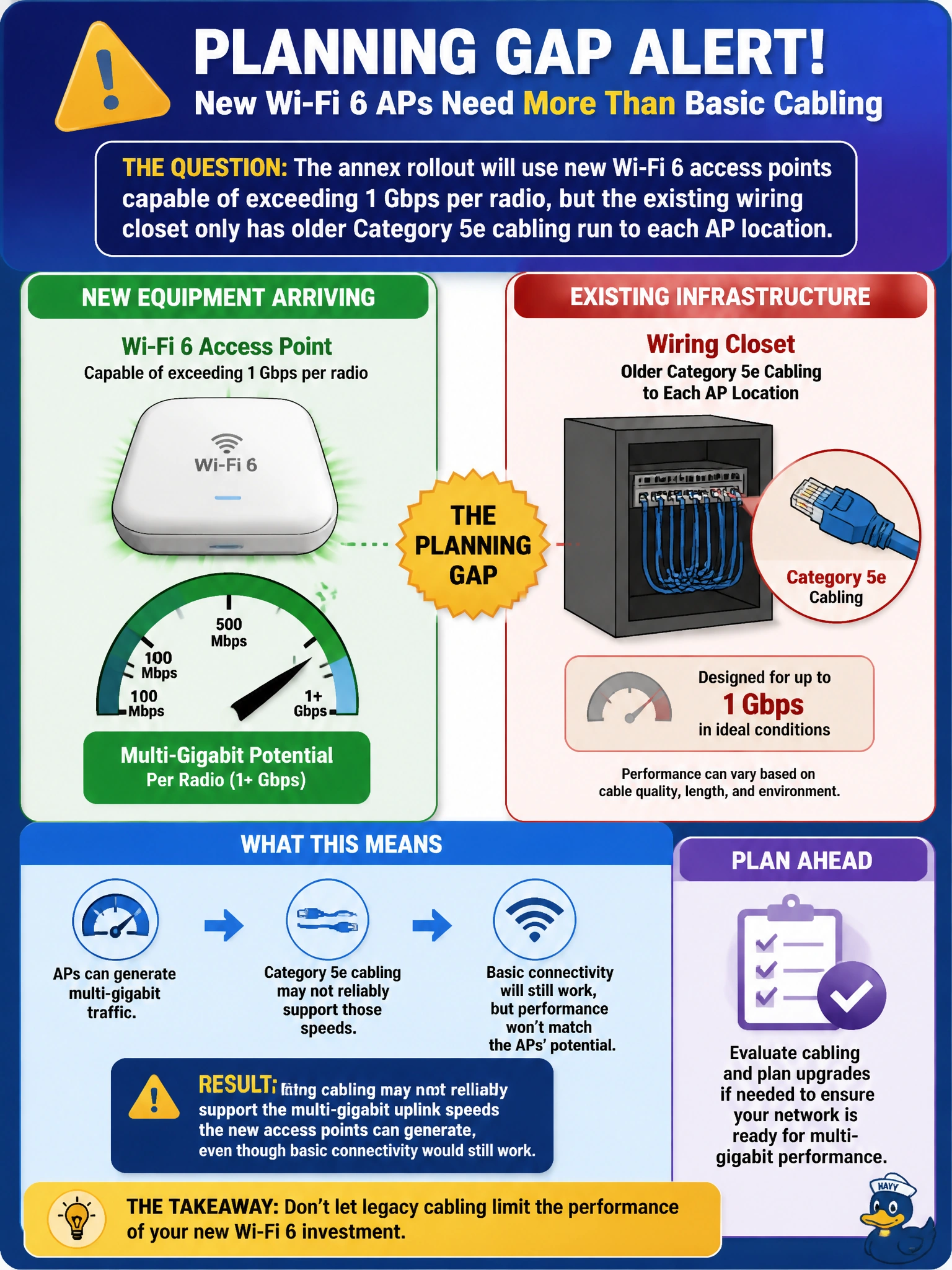
The annex rollout will use new Wi-Fi 6 access points capable of exceeding 1 Gbps per radio, but the existing wiring closet only has older Category 5e cabling run to each AP location. What planning gap does this raise before the access points arrive?
Select an answer to reveal the explanation.
Short Explanation
A cable that's fine for basic connectivity can still be the ceiling on speed. New Wi-Fi 6 APs can push well past 1 Gbps on a single radio, and older Cat5e runs weren't built to reliably carry that much throughput, so the wiring itself becomes the bottleneck even though the AP would technically still power up.
Full Explanation
Wi-Fi 6 access points can aggregate enough client traffic on a single radio to exceed a standard 1 Gbps Ethernet uplink, so getting the full benefit of the hardware requires a multi-gigabit-capable cable run and switch port; Category 5e is only formally certified for Gigabit Ethernet distances and reliability, so while it may pass some multi-gig traffic over shorter runs, it is not the planning-safe choice for guaranteed multi-gig performance across a full annex deployment. This is a cabling bandwidth question, not a power question, so claiming Cat5e carries no PoE power at all is incorrect — Cat5e supports standard PoE and PoE+ power delivery over its copper pairs, which is a separate concern from data throughput. Ethernet cabling standards do not dictate half-duplex operation; virtually all modern switch ports and endpoints negotiate full duplex regardless of cable category, so duplex is not the mechanism at risk here. Cable category also has nothing to do with which RF band an access point radio can use; the wired cabling only carries data and power to the AP; the client-facing 2.4 GHz and 5 GHz radios are entirely independent of the copper run behind the AP. A concrete check is confirming with the AP vendor's datasheet what uplink speed the model can actually generate under load and testing that specific cable run for multi-gig certification before committing to it for the whole annex.