
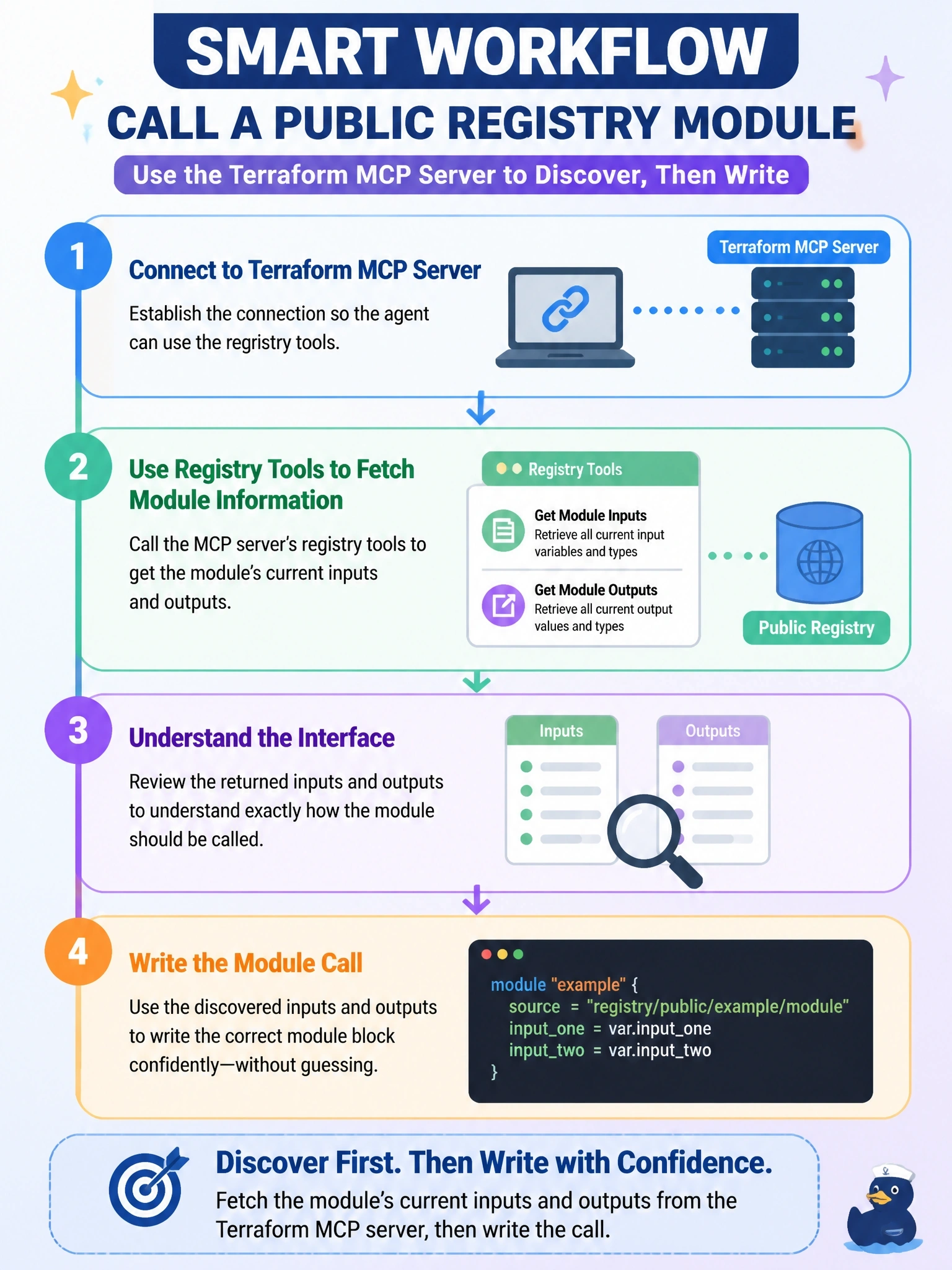
A team wants an AI agent to write a call to a public registry module without guessing its interface. The agent is connected to the Terraform MCP server. What workflow should the agent follow?
Select an answer to reveal the explanation.
Short Explanation
Before you plug something in, read the label on the socket. The MCP server lets the agent read the module's real inputs and outputs from the registry first, so it isn't guessing. The trap is relying on plan errors to discover the interface after the fact.
Full Explanation
A module's interface, its input variables, their types and defaults, and its outputs, is published with each version in the Terraform Registry. The Terraform MCP server exposes registry tools that let an agent search for modules and retrieve module details, so the agent can base the module block on the actual current interface, including which inputs are required and what outputs are available for downstream references. This replaces reliance on training data that may describe an older version. Writing the call from memory and waiting for plan errors catches only some mistakes, such as missing required inputs, while wrong types, misnamed optional inputs and incorrect output references can still slip through or fail late. The oldest example describes the oldest interface, which is the most likely to be out of date, and module versions can introduce breaking changes. State records resources that already exist, not a module's declared interface, and the agent should not need access to state just to write a call. Exam caveat: the agent should also set a version constraint on the module so the interface it looked up is the one that gets installed. Operational check: compare the generated module block against the module's registry page for the chosen version and run terraform validate.