
A program team lets a support agent draft refunds and update billing records in GitHub-connected systems. Routine cases run smoothly, but high-value refunds and repeated tool failures need oversight. Which escalation path based on tool usage should the designer configure for human review?
Select an answer to reveal the explanation.
Short Explanation
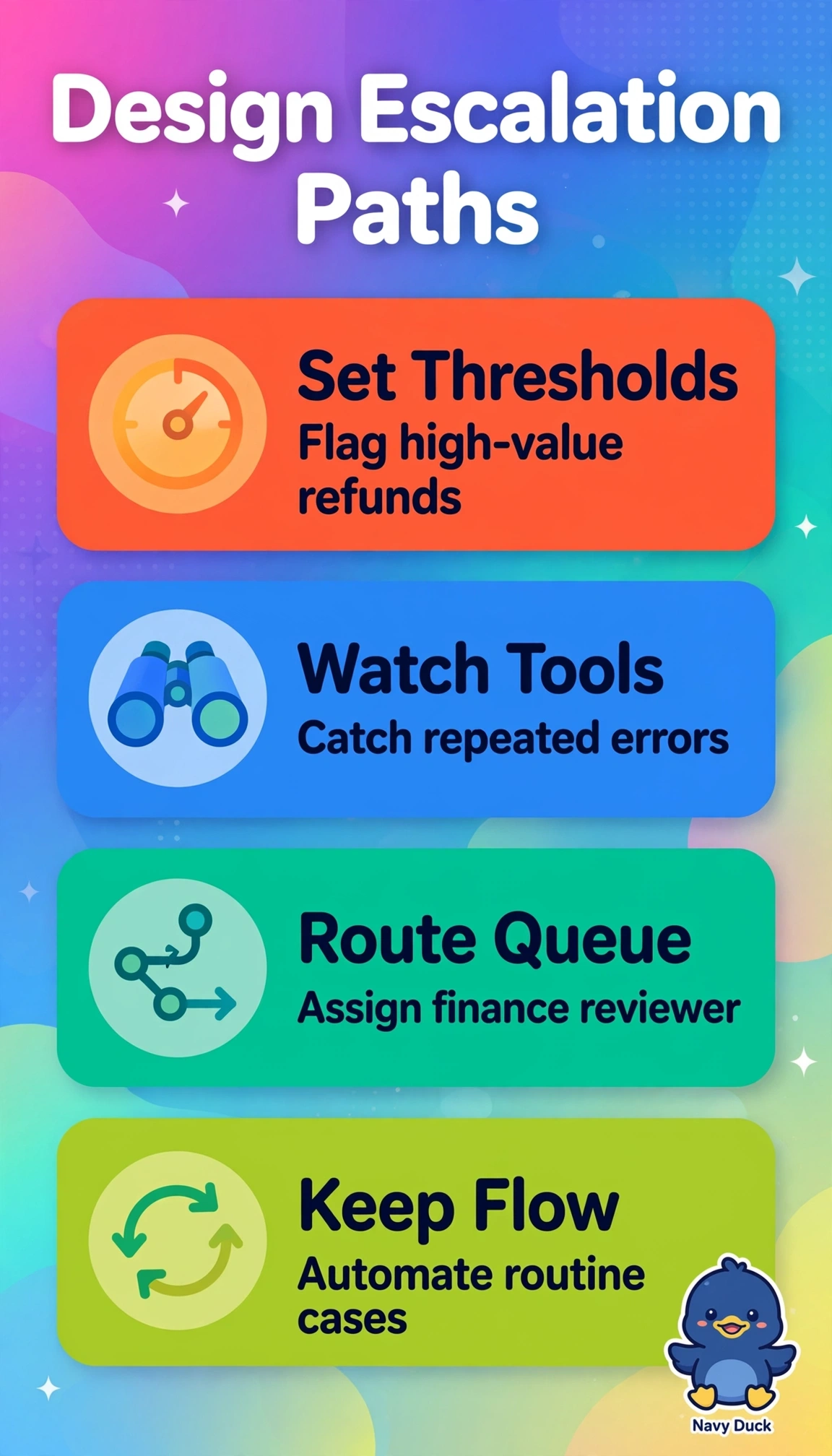
You set tripwires so risky moments ring a bell. Thresholds plus targeted escalation keep routine flow fast. Humans step in exactly where money or errors spike.
Full Explanation
The correct path is right because it enforces conditional oversight tied to tool usage, letting routine GitHub-connected billing updates proceed efficiently while requiring finance approval where financial and reliability risk concentrates; high-value refunds need segregation of duties and auditability beyond agent authority, and repeated tool errors signal integration, permission, or data issues that silent retries cannot safely resolve, so combining both triggers into a finance reviewer queue prevents unauthorized payouts and corrupted records. The alternative that escalates only high-value refunds while allowing failed calls to retry silently reflects standard threshold-based fraud control but fails on reliability by ignoring tool telemetry, letting loops continue without intervention and leaving billing state uncertain. The alternative that routes repeated failures to engineering while auto-approving refunds of any amount reflects standard reliability triage but fails on authorization by allowing material financial actions without qualified review. The alternative that sends both high-value and error signals to a general peer support inbox reflects sound collaborative triage for routine work but fails on accountability by bypassing finance ownership, weakening compliance and delaying proper resolution. Exam caveat: look for answers that satisfy both value-based and failure-based escalation to a qualified reviewer, not just one trigger or any human. Practical check: confirm thresholds and error counts create blocking finance tasks that pause billing writes until approval.