
A business analyst designs human review for AI-drafted release notes that may include code snippets and customer names. Policy requires no sensitive data leakage and clear accountability for published content. Which security consideration should shape GitHub Copilot human-review design for this workflow?
Select an answer to reveal the explanation.
Short Explanation
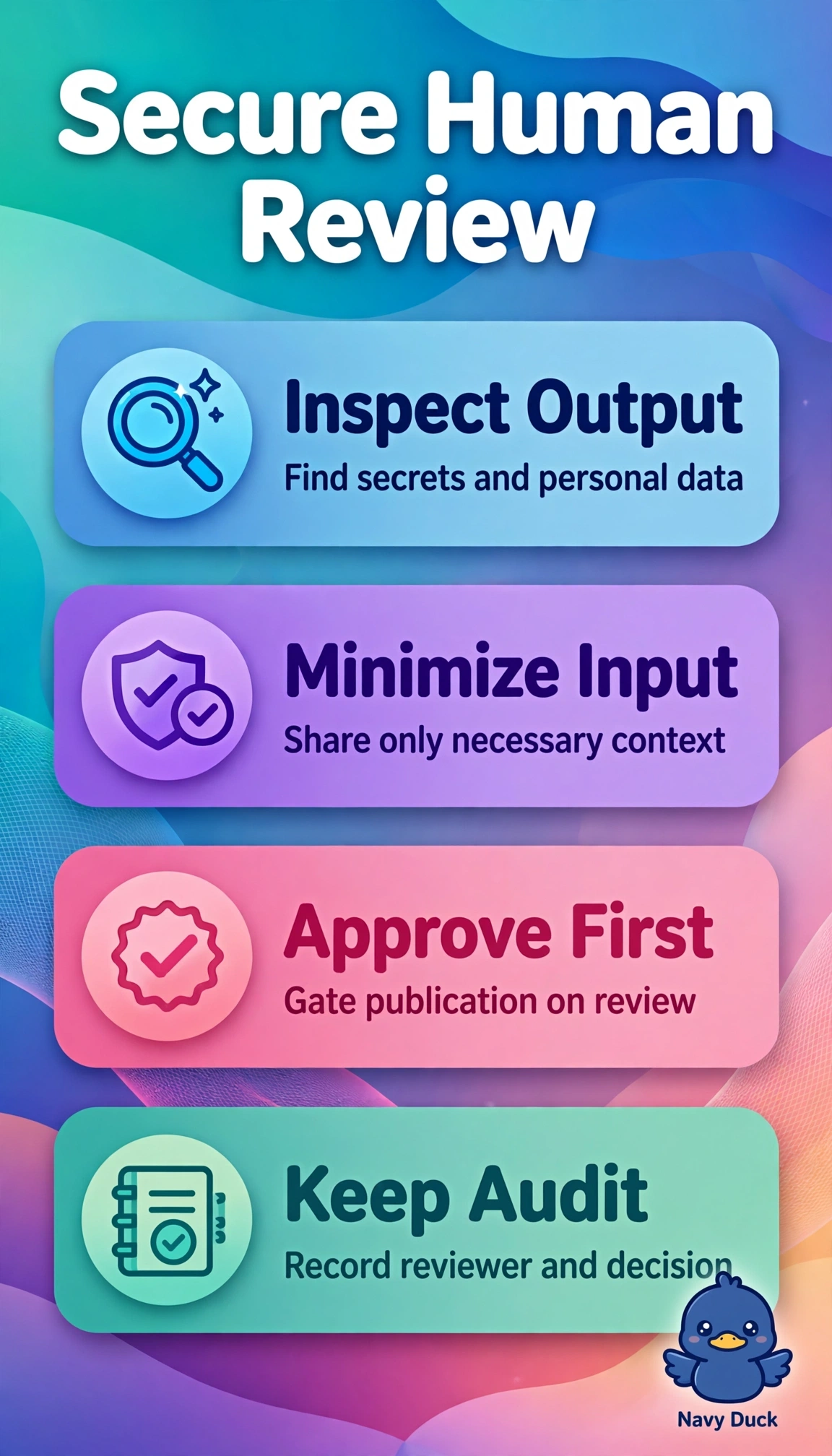
Publishing first and checking later is like mailing letters before proofreading addresses. You stay safe by making review the gate that catches secrets before anything goes public.
Full Explanation
The correct design enforces a preventative human gate where designated reviewers inspect AI drafts containing both risky data types and record explicit approval before anything goes live within the system of record, which directly satisfies the dual policy goals of preventing leakage and establishing who authorized what for code snippets and customer names. The licensing-focused code validation approach fails on scope because secrets scanning plus intellectual property review is a legitimate and commonly used engineering control, but it omits customer names and personal data, leaving a stated privacy risk unaddressed despite strong pre-publication governance in GitHub. The post-publication remediation model fails on timing because detective approval with rapid fix-forward is common in high-velocity delivery, yet once sensitive snippets or names are published the leakage has already occurred and rollback cannot satisfy the requirement for no sensitive data leakage and approval before publication. The separate-system approval model fails on traceability because centralized ticketing archiving is widely used for audits, but moving the approval record outside GitHub fragments accountability from the pull request, review, and publish event that must be demonstrably linked in GitHub. As an exam caveat, prioritize exact qualifier matching over apparent maturity, since a more enterprise-grade control that shifts when or where approval happens is still incorrect if it contradicts before publication or in GitHub. As a practical check, confirm the workflow blocks merging or publishing until a GitHub-logged required review is completed against a checklist covering tokens, keys, credentials in snippets and direct and indirect identifiers in customer names.