
A business analyst designs an agent that reads invoices, files expenses, and refunds customers up to $500 automatically. Finance requires a manager to approve larger refunds and any external payment tool use. Which escalation design best controls risk based on tool usage?
Select an answer to reveal the explanation.
Short Explanation
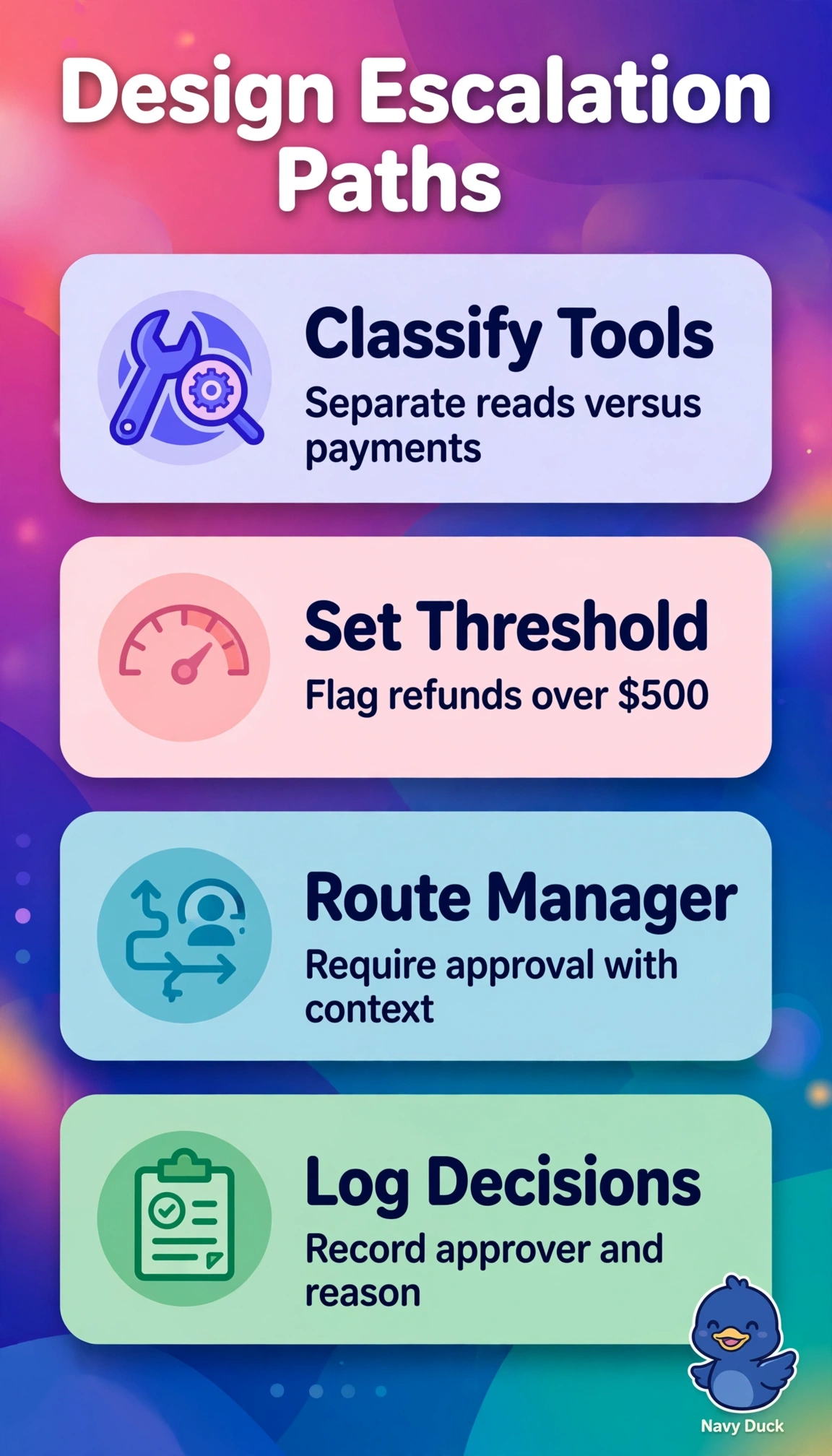
Not every action carries equal weight. You'll protect cash flow with threshold-based escalation that auto-handles reads but routes big refunds and external payment tools to a manager.
Full Explanation
The correct design applies tool-based thresholds that match Finance policy exactly, permitting low-risk invoice reads to auto-proceed while requiring manager approval for the two defined high-risk triggers of refunds over $500 and any external payment tool use. The logging-only variant fails on preventive control because recording external payment calls for later audit still allows the risky tool action to execute without prior authorization, which violates the explicit requirement for advance manager approval of any such use. The escalate-every-refund variant fails on threshold precision because it treats small and large refunds identically, contradicting the stated allowance to automate refunds up to $500 and creating unnecessary friction, delay, and alert fatigue that undermines the intended automation benefit. The user-confirmation variant fails on authority and segregation of duties because sending high-risk approvals back to the requester amounts to self-approval without independent oversight, whereas Finance specifically requires a manager as the approver. An exam caveat is to watch for dual triggers in the stem: when both an amount and a tool type are mentioned, the answer must enforce both rules and amount-only escalation is insufficient even if the dollar limit is correct. As a practical check, validate the policy matrix with four tests of a read, a $400 refund, a $600 refund, and a small external payment call to confirm only the first two proceed without manager intervention.