
Analysis of 500 agent runs reveals agents consistently misuse the search_issues MCP tool by passing full bug descriptions as the query parameter (e.g., 'The payment service is throwing NullPointerException when processing refunds for international orders'). The tool's description reads: 'Search GitHub issues by providing a search query.' The tool functions correctly when given proper GitHub search syntax but returns poor results for natural-language queries. Which tool refinement MOST directly addresses this misuse at the definition level?
Select an answer to reveal the explanation.
Short Explanation
If you see 500 agents all misuse the same tool the same way, the tool's instructions are the problem — not the agents. Rewrite the description and parameter docs with explicit format constraints, anti-pattern warnings, and a hard character limit. That'll close the ambiguity gap where the misuse lives.
Full Explanation
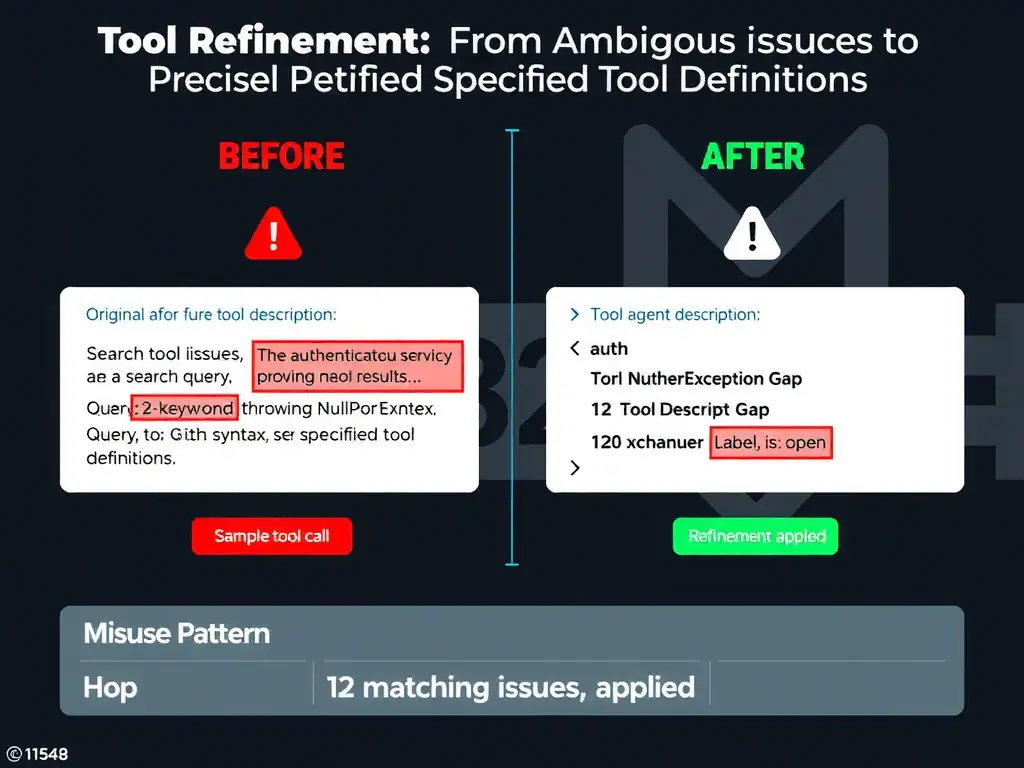
The most direct refinement is rewriting the tool description and parameter docs with explicit format constraints: 'Provide 2-5 keywords in GitHub search syntax (e.g., label:bug is:open). Do NOT pass full sentences — extract only key terms.' Add input validation rejecting queries exceeding 100 characters.
Tool misuse patterns at scale are almost always symptoms of underspecified tool definitions, not model capability failures. LLMs fill ambiguity with the most statistically plausible behavior from their training — which for a 'search' tool is natural language input, because most search interfaces accept it.
Effective tool definition refinement uses three mechanisms simultaneously:
1. Precise format specification: '2-5 keywords in GitHub search syntax' sets a quantified expectation. Mentioning GitHub search syntax (which uses structured operators like label:, is:, author:, milestone:) further constrains expected input beyond just 'fewer words.'
2. Explicit anti-pattern exclusion: 'Do NOT pass full sentences' directly counteracts the specific behavior 500 agents exhibited. LLMs respond strongly to explicit exclusion statements because they override the natural-language bias that the training distribution creates.
3. Runtime input validation: The 100-character limit enforced server-side creates a feedback loop — when an agent generates a long query, the tool returns a descriptive error ('Query too long — provide 2-5 keywords only') that the agent can act on immediately in the same run.
The pre-processing wrapper that extracts keywords from any query string before passing it to the underlying GitHub search API compensates for the bad input rather than fixing the root cause. The agent continues generating incorrect input; the wrapper hides this from visibility and never teaches the agent the correct behavior. Adding a natural-language companion tool called search_issues_natural_language that accepts full descriptions and converts them to keyword queries legitimizes the incorrect behavior pattern rather than correcting it. It also increases the agent's tool selection burden and creates ambiguity about when to use which tool. Fine-tuning the agent model on 1,000 examples of correct search_issues usage is disproportionate investment for a single tool's misuse — tool definition improvement is faster, more targeted, and immediately effective without model retraining. Fine-tuning is appropriate when the model lacks capability, not when the tool definition lacks precision.