
An agent is tasked with updating all references to a deprecated function calculateTax() to use its replacement calculateTaxV2(). In 8% of cases, the agent updates the function call but fails to update the import statement that imports calculateTax, causing a compilation error. The tool used to make the update (a find-and-replace tool) reports success, and the agent's reasoning correctly identifies that both the function call and import must be updated. However, the agent calls the tool only for the function call, not for the import. Which error class does this represent?
Select an answer to reveal the explanation.
Short Explanation
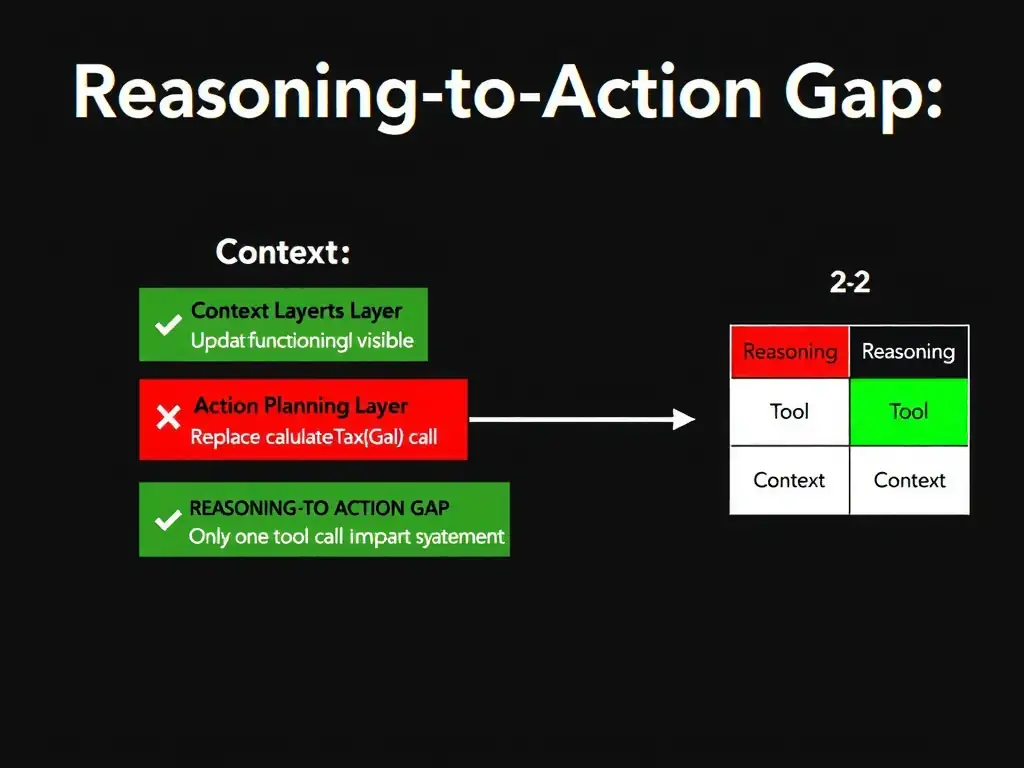
You're looking at a reasoning-to-action gap: the agent says the right thing, but it doesn't do the whole thing. The tool worked, and the import was in context, so the miss is between plan and execution.
Full Explanation
Error classification in agentic systems requires distinguishing where in the pipeline the failure originates. The key evidence in this scenario is that the agent's reasoning correctly identifies that both the function call and the import statement must be updated, so the reasoning is correct. The find-and-replace tool reports success when called, so the tool is functioning correctly. The agent's context includes the import section because it mentions it in reasoning, so the context is complete. The agent calls the tool for the function call but not for the import, so the failure is in translating complete reasoning into a complete set of tool calls.
This is a reasoning-to-action gap: the agent produces a correct analysis but generates an incomplete action sequence. This error class is distinct from the three more commonly discussed classes. Reasoning errors occur when the agent draws incorrect conclusions from available information. Tool errors occur when the tool returns incorrect, incomplete, or error responses. Context errors occur when the agent lacks necessary information to make correct decisions.
The reasoning-to-action gap is particularly insidious because it appears correct at every observable layer except the final action sequence. Traces will show correct reasoning and successful tool calls, and only comparison of the planned actions against the executed actions reveals the gap. The fix is typically to improve the agent's action generation prompt, require the agent to enumerate all planned tool calls before executing any of them as structured plan output, and validate that the action sequence covers all items identified in the reasoning phase before execution begins.
The reasoning-error explanation is incorrect because the agent's reasoning explicitly identifies the import update. The tool-error explanation is incorrect because the tool successfully performs the update when called; it is simply not called for the import. The context-error explanation is incorrect because the import section is present in the agent's reasoning context. The discriminating fact is that the reasoning was correct but the tool call coverage was incomplete.