
A coordinator agent is repeatedly assigning the same subtask to multiple worker agents simultaneously, causing duplicate work. Traces confirm the coordinator receives each worker's completion signal but continues dispatching. What is the most appropriate remediation?
Select an answer to reveal the explanation.
Short Explanation
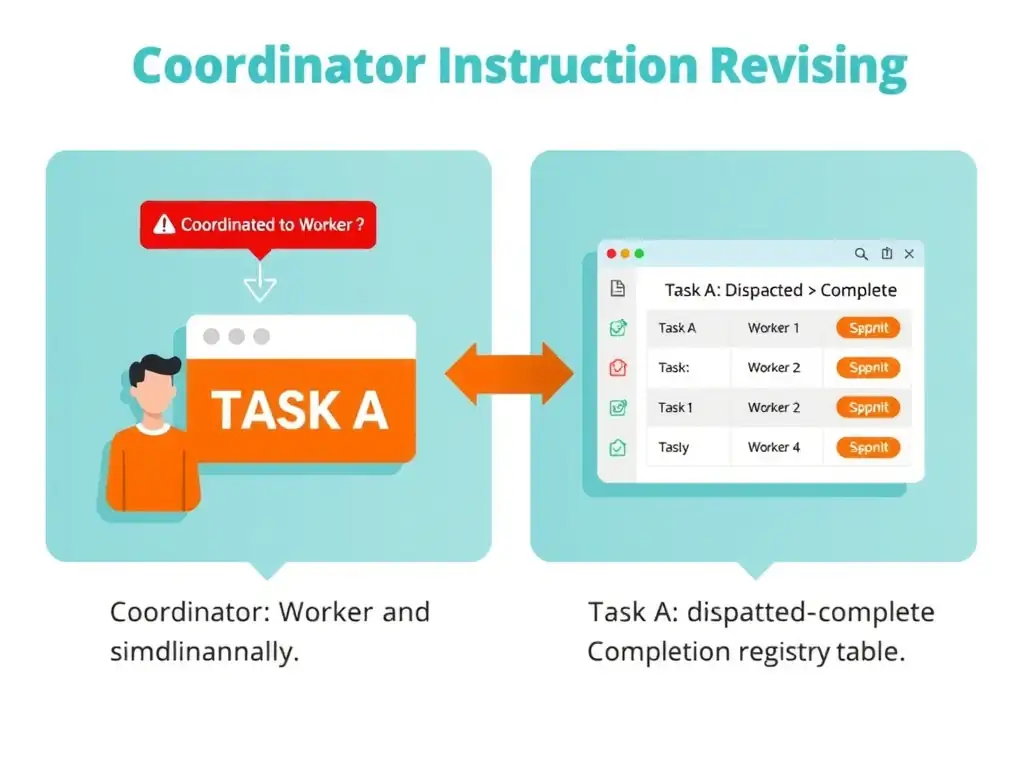
If the coordinator keeps assigning the same subtask because it isn't checking completion state, fix the coordinator's instructions. You need it to track dispatched and completed tasks before sending more work. On the exam, when a coordinator fails due to missing state tracking, the fix is instruction revision at the coordinator level.
Full Explanation
The traces confirm the coordinator is receiving completion signals — this rules out a communication or tool failure. The root cause is that the coordinator's instructions do not include logic to track task completion state before dispatching. The correct remediation is to revise the coordinator agent's instructions to explicitly track task completion state and check it before dispatching subsequent assignments. That means maintaining a completion registry: mark each task as 'dispatched,' update it to 'complete' when the worker signals done, and check this registry before issuing new assignments. This is an instruction failure at the coordinator level.
The approach of adding deduplication logic to each worker agent so they detect and discard duplicate task assignments is incorrect because it's the wrong layer for this fix. Workers should be pure executors — adding orchestration-awareness to them creates tight coupling and distributed coordination complexity. Responsibility for task assignment tracking belongs with the coordinator.
The approach of replacing the coordinator agent with a deterministic task queue that enforces single assignment per task is a valid architectural alternative but is an over-engineering response to what is fundamentally an instruction-level problem. A queue-based system has its own complexity and loses the flexibility of a reasoning coordinator. The question asks for the most appropriate remediation, which is instruction revision — not architectural replacement.
The approach of increasing the delay between coordinator dispatch cycles to give workers more time to report completion is incorrect because timing is not the issue. The traces confirm the coordinator receives completion signals in time; it just does not act on them correctly. Adding delay introduces unnecessary latency and does not fix the underlying state-tracking gap — after a longer delay, the coordinator will still dispatch duplicates.