
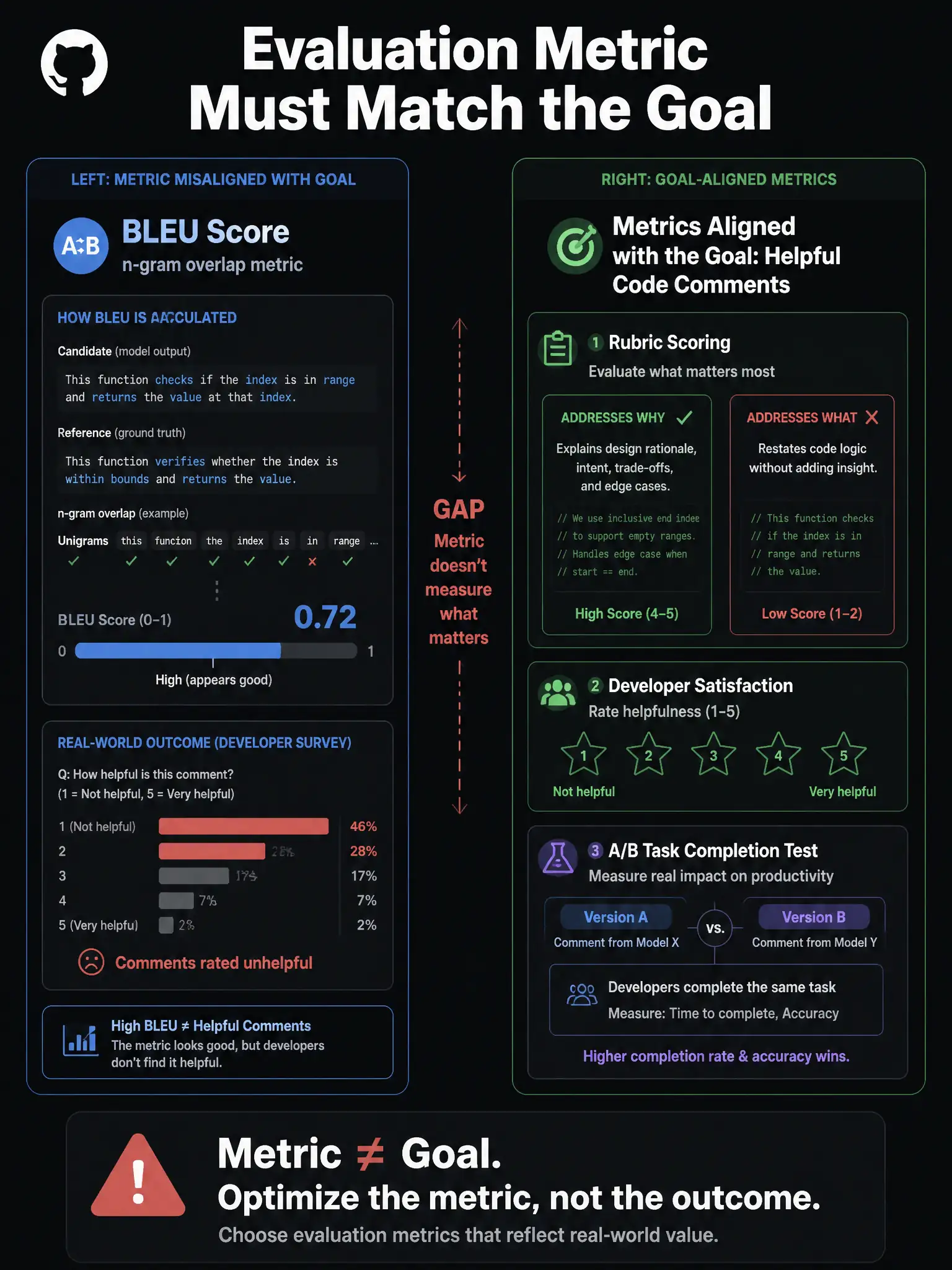
A team builds an agent that generates inline code comments. They evaluate it using BLEU score against a reference set of human-written comments, achieving a score of 0.72. When they deploy the agent, developers report the generated comments are technically accurate but unhelpful — they often restate what the code does rather than explaining why. The BLEU score does not capture this quality dimension. What does this reveal about the team's evaluation approach?
Select an answer to reveal the explanation.
Short Explanation
BLEU score tells you how much your generated comments match reference text, not whether developers actually find them useful. If the score is high but comments just restate code, you're measuring the wrong thing. Align your evaluation to the real goal: does the comment explain why the code exists?
Full Explanation
BLEU (Bilingual Evaluation Understudy) score, from machine translation, measures n-gram overlap between generated text and reference text. It serves as proxy for similarity, not direct measure of utility. Comments can closely resemble the reference while still failing to convey the reasoning, design decisions, or intent that developers actually need.
Metric-goal misalignment occurs when the chosen metric is technically measurable but does not capture the actual quality dimension that matters for the use case. For code comments, developer utility requires understanding of: - Why this code was written this way (design rationale) - What edge cases it handles and why - What the reader should know to safely modify this code
Better-aligned metrics for this use case include: - Developer satisfaction ratings (1-5 stars per generated comment) - Rubric-based evaluation scoring whether the comment addresses 'why' vs. 'what' - Controlled split testing measuring developer task completion speed when comments are present - Human-in-the-loop evaluation with specific criteria around explanatory depth
The correct conclusion is that the evaluation metric (BLEU score) is not aligned to the actual goal (developer utility); another metric that measures whether comments explain 'why' rather than 'what' would better capture the quality dimension that matters.
The conclusion that the 0.72 threshold is too low is incorrect because the problem is not with the score's threshold but with what the score measures. No BLEU score value can distinguish 'what' comments from 'why' comments.
The conclusion that the reference set of human-written comments is too small is incorrect because small reference sets would affect statistical reliability of the score but would not explain the systematic gap between high BLEU and low developer utility.
The conclusion that the agent needs to be prompted to generate longer comments is incorrect because it addresses surface-level length but not content quality. Longer comments that still restate the code without explaining intent would score well on BLEU and still be unhelpful.