
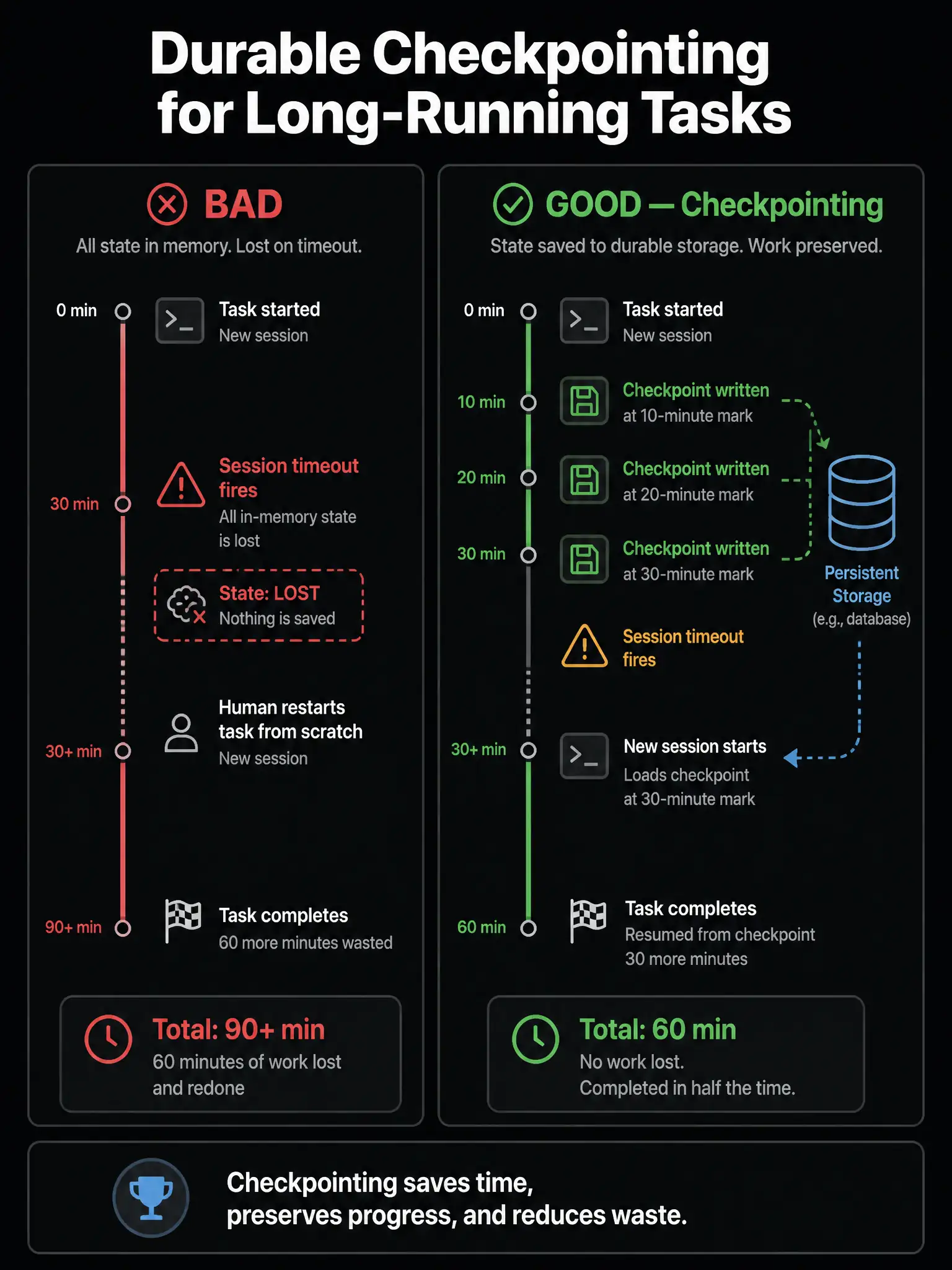
An agent processes large code analysis tasks that typically take 45–60 minutes. The hosting environment enforces a 30-minute session timeout. When a session times out mid-task, all in-progress work is lost and the task must be restarted from scratch by a human. The agent stores all intermediate results only in the current session's working memory. What architectural change would prevent work loss on session timeout?
Select an answer to reveal the explanation.
Short Explanation
You can't trust one session to carry a 60-minute marathon. Durable checkpointing saves your progress to persistent storage, so the next session picks up the baton instead of the starting pistol.
Full Explanation
Session timeouts are a reality in cloud hosting environments, and any long-running agentic task that exceeds the timeout without persisting state will lose all in-progress work. Durable checkpointing is the architectural pattern that makes tasks resilient to session boundaries. The checkpoint is a snapshot of the task's current state written to a persistent store, such as a database, object storage, or filesystem, at regular intervals or at defined milestones, such as after completing each module of the code analysis. The checkpoint captures enough state to reconstruct the working context: which files have been analyzed, partial findings, current position in the task plan, and any intermediate data computed so far. When a session times out, a new session starts, detects the existing checkpoint, loads it, and resumes execution from the last checkpoint position. Work before the checkpoint is preserved; only work since the last checkpoint needs to be redone. Requesting the hosting environment to extend the session timeout to 90 minutes is an operational workaround that does not change the architecture. If a 90-minute timeout is available today, a future 100-minute task will still fail, so this is a fragile dependency on environment configuration. Breaking all tasks into subtasks that each complete within 10 minutes may be appropriate for some workflows but is not always feasible. Code analysis tasks may have sequential dependencies where intermediate state must flow from one subtask to the next, requiring the same architectural persistence that checkpointing provides. Running the agent on a local machine with no session timeout instead of the cloud hosting environment removes the timeout constraint but introduces availability, maintenance, and security concerns that a cloud environment addresses. It is not a scalable architectural solution.