
After a backend team updates an internal MCP server to v2.0, an agent starts returning errors on tool calls that worked correctly before. The error messages indicate that required parameters are missing or have unexpected types. The agent's tool definitions still reference the v1 schema. What is the root cause and the correct fix?
Select an answer to reveal the explanation.
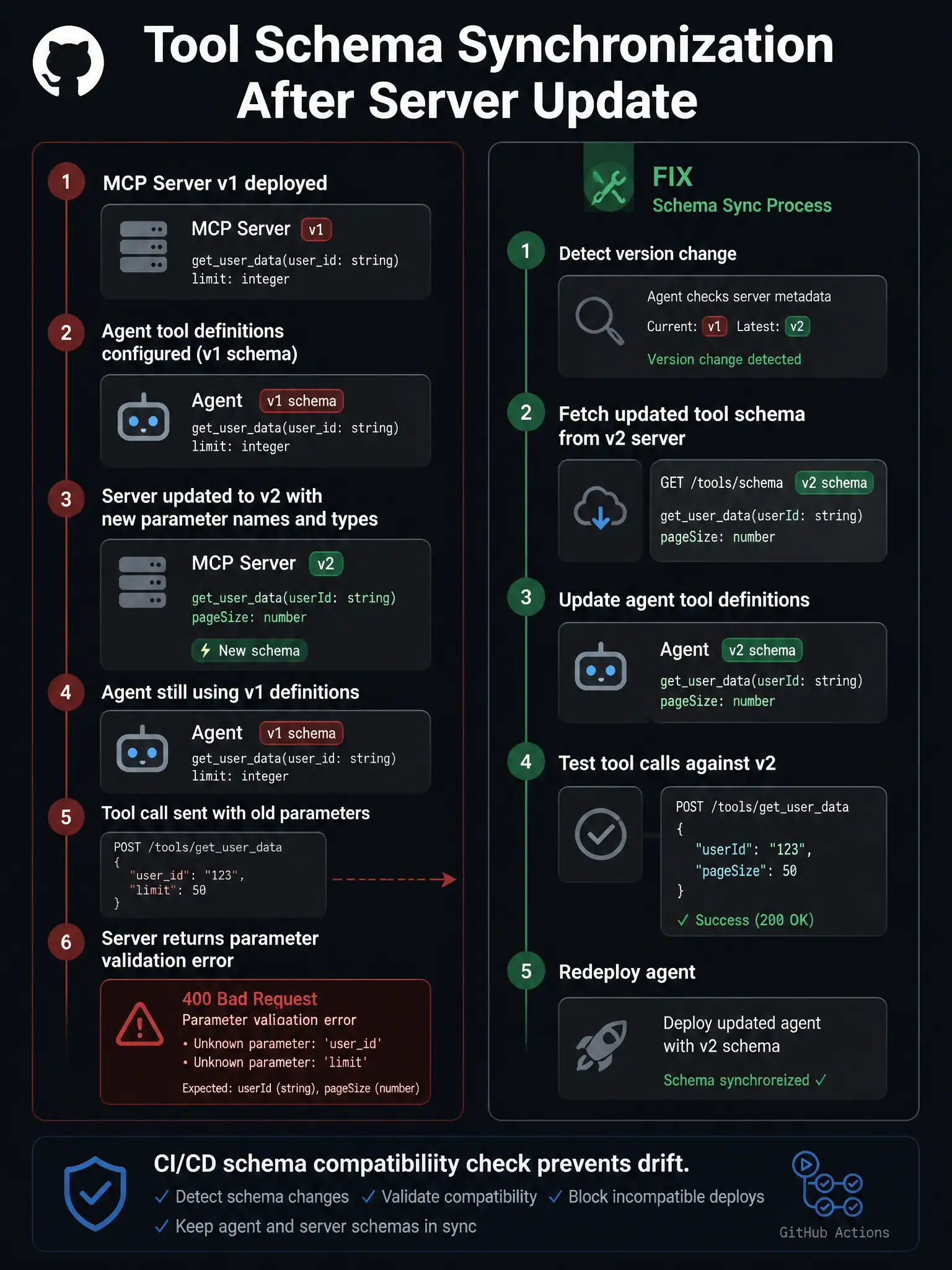
Short Explanation
When an MCP server's schema changes, the agent's tool definitions have to match the new parameter names, types, and required fields. If they don't, you'll get missing or wrong-type parameter errors because the agent is sending orders the updated kitchen no longer accepts. Update the agent's tool definitions to the v2 schema before calling the tools.
Full Explanation
MCP servers expose tool schemas that define what parameters each tool accepts, their types, and which are required. When the agent's tool definitions are registered at startup or configuration time, they capture the server's schema at that moment. If the server is subsequently updated to a new version that renames parameters, changes types, adds required fields, or removes deprecated fields, the agent's cached definitions become stale.
When the agent constructs a tool call based on stale definitions, it may omit new required parameters or pass parameters with old names that the v2 server no longer recognizes, resulting in validation errors.
The correct fix is to synchronize the agent's tool definitions with the updated MCP server schema. This involves fetching the new schema, either manually or via an automated schema-sync process, and updating the agent's tool configuration before the next deployment. Ideally, schema version checks or compatibility tests are added to the CI/CD pipeline so schema drift is caught automatically when server updates are deployed.
The authentication-method-change option would manifest as 401 Unauthorized or connection refused errors, not missing or incorrect parameter errors. Auth errors appear before tool execution.
The bot-account-permission option would similarly manifest as a 403 Forbidden error, not parameter validation errors.
The model-hallucinating-parameter-names option could theoretically occur, but the question states the errors indicate missing or type-mismatched parameters, which is characteristic of schema drift, not hallucination. Hallucination would be more likely with unknown tool names, not structured parameter errors.