
Before deploying a new agent to production, a platform engineer wants to evaluate the execution context to ensure the agent will have the correct permissions, environment variables, and secrets available when it runs. Which approach best accomplishes this evaluation?
Select an answer to reveal the explanation.
Short Explanation
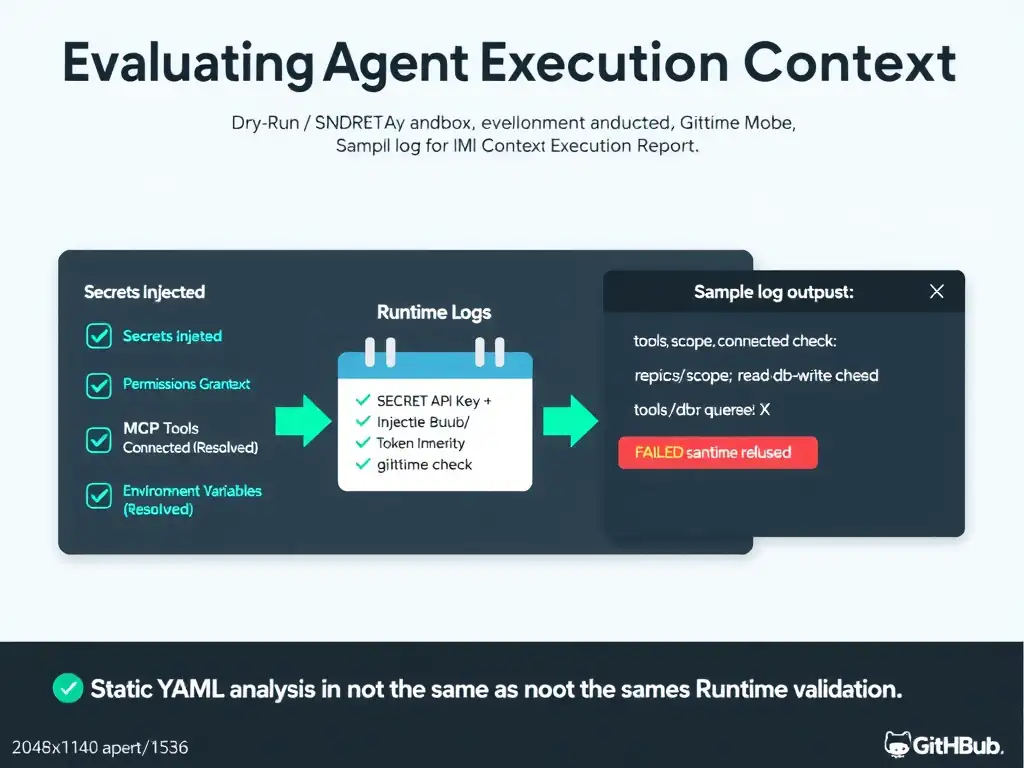
You need to actually run the agent in a dry-run or sandbox and inspect runtime logs. That shows the real resolved context: injected secrets, granted permissions, and initialized tools. Docs or YAML counts only tell you what's intended, not what happens.
Full Explanation
The execution context for an agent includes the runtime environment it operates within: injected secrets and environment variables, granted permissions (repository access, API scopes), initialized tool connections (MCP servers, GitHub API), and the identity/token under which it runs. Evaluating this context before production deployment is a critical quality step.
The approach of running the agent in a dry-run or sandbox mode, then inspecting the runtime logs to verify the resolved context — including which secrets were injected, what permissions were granted, and which tools were initialized — is correct because it is the only way to observe the actual resolved execution context. Runtime logs produced during this test reveal whether environment variables resolved and secrets were successfully injected from the secrets store, what permission scopes the agent token actually has, whether each MCP server connected and completed its handshake, and what tool definitions were discovered. Discrepancies between expected and actual context surface as errors, missing tools, or permission-denied messages in these logs, allowing issues to be caught before they affect production.
Reviewing the agent's model card in GitHub Marketplace to check what environment variables are documented as required is incorrect because GitHub Marketplace model cards may document what an agent is designed to do, but they do not reflect the runtime state of your specific deployment environment. Documentation tells you what should exist, not what does exist in your configuration.
Checking the repository's README.md for the agent's listed prerequisites and concluding that the execution context is correct if all prerequisites are present is incorrect because a README lists what the agent's author says is required. It does not validate that your environment satisfies those requirements. The README might be outdated, incomplete, or describe a different deployment scenario. Only runtime verification confirms the actual state.
Opening the GitHub Actions workflow file and counting the number of env: blocks to determine how many environment variables the agent will receive is incorrect because counting env: blocks in a workflow file tells you how many environment variables are declared, but not whether those variables resolve to valid values, whether referenced secrets exist in the secrets store, or whether the values are correct for the target environment. A variable can be declared in YAML and still be empty or undefined at runtime.
Key concept: execution context evaluation requires runtime observation, not static analysis of configuration files.