
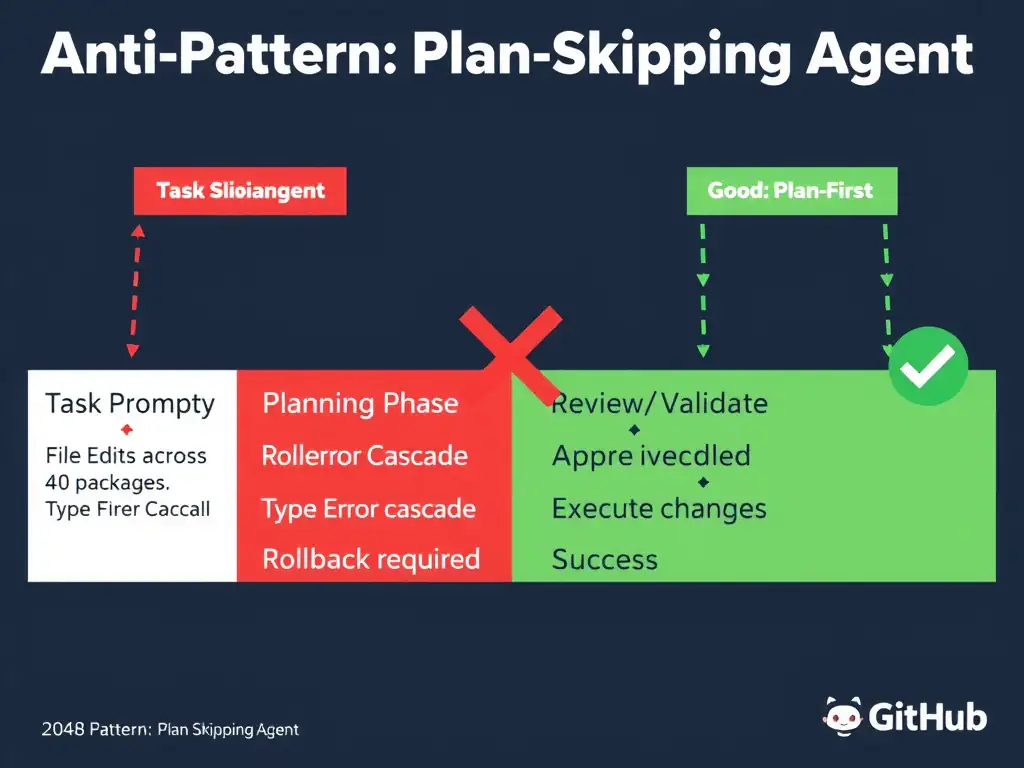
A developer notices that their agent, configured to refactor a monorepo's shared utilities, immediately begins modifying files across dozens of packages as soon as it receives the task prompt — without producing any plan or requesting confirmation. The agent completes several changes before a type error cascade is detected. Which anti-pattern does this behavior represent?
Select an answer to reveal the explanation.
Short Explanation
Imagine hiring a contractor who shows up and starts knocking down walls before looking at blueprints. That's plan-skipping. Your agent needs a plan and approval before it starts editing files.
Full Explanation
The scenario describes plan-skipping, one of the most dangerous anti-patterns in agentic system development. It occurs when an agent receives a task and immediately begins executing actions — file edits, external service calls, state mutations — without first producing a structured plan that can be reviewed or validated.
The correct behavior is the plan-skipping answer: the agent should have entered a planning phase, produced a structured list of intended changes (which files, which packages, in what order), and either awaited human approval or validated the plan programmatically before touching any files. Instead, it acted immediately, propagating changes across dozens of packages before a downstream type error was caught.
The tool-sprawl description is wrong because it describes a configuration problem where too many tools are registered, increasing the risk of inappropriate tool use. While it can contribute to erratic behavior, it does not specifically describe the immediate-execution behavior shown here. The core problem is the absence of a planning phase, not tool count.
The prompt-injection description is wrong because it describes an adversarial attack where external content manipulates the agent's behavior. The scenario shows no indication of malicious input — the agent simply lacked an enforced planning gate in its architecture.
The autonomy-overflow description is wrong because it is a plausible-sounding distractor but is not a standard term in the domain. High autonomy is a configuration choice; the anti-pattern here is architectural — there is no planning phase enforced at all, regardless of autonomy setting.
The exam objective is: 'Identify and mitigate common anti-patterns in agents.' Plan-skipping is mitigated by requiring the agent to output a structured plan as an artifact before any write or destructive tool is callable, and by gating execution behind a validation or approval step.