
An agent that automates dependency updates is designed to output a plan before making changes. Which format is most appropriate for the agent's plan output so that it is both human-readable and machine-parseable for downstream validation steps?
Select an answer to reveal the explanation.
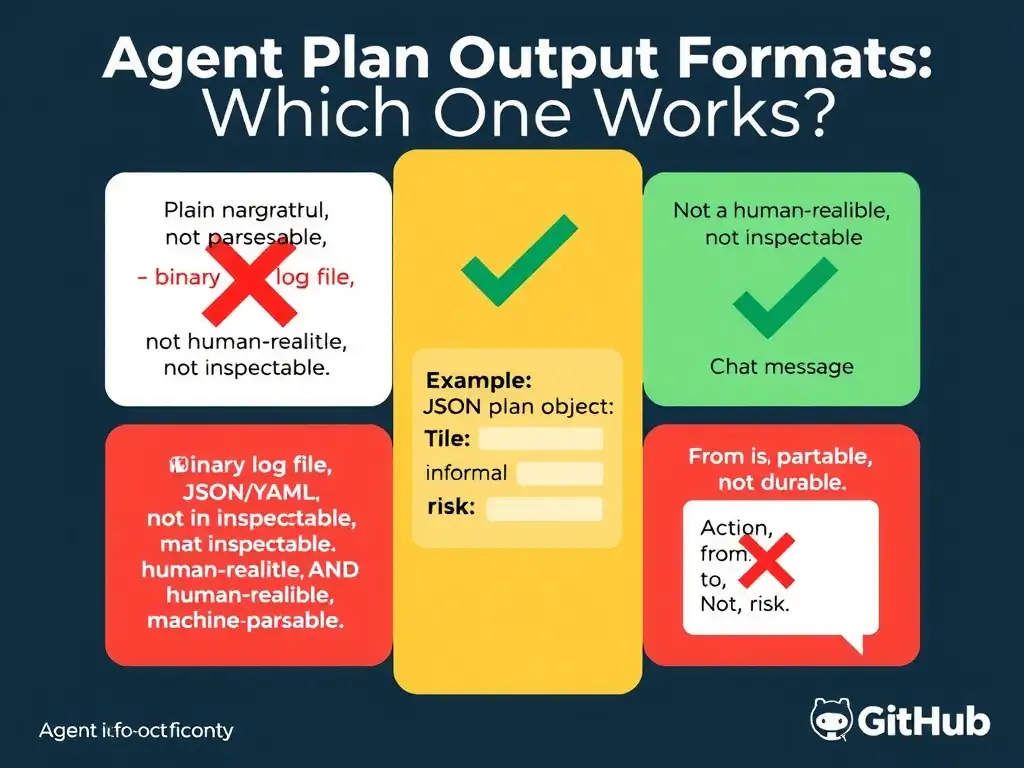
Short Explanation
Flight plans aren't written in haiku — they're structured checklists that every air traffic controller can read and every system can parse. You need structured JSON or YAML because it gives the agent's plan both human readability and machine-parseability, which is exactly what downstream validators need.
Full Explanation
When an agent outputs a plan, that plan needs to serve two audiences: humans who want to review and approve it, and automated systems that need to validate or execute it. A structured format like JSON or YAML satisfies both requirements.
The structured JSON or YAML document listing each intended action, its target file, and its expected outcome is correct because it is human-readable and directly consumable by validation scripts, CI checks, and downstream agents. For example, an entry such as {"action": "update", "file": "package.json", "dependency": "lodash", "from": "4.17.19", "to": "4.17.21", "risk": "low"} is human-readable and directly consumable by validation scripts, CI checks, and downstream agents. It also serves as an audit trail.
The plain English paragraph describing the intended changes in narrative form is wrong because it is human-readable but not machine-parseable. A validation script cannot reliably extract structured intent from free-form text. It also lacks precision — 'update some dependencies' is ambiguous.
The binary log file written to the agent's internal storage is wrong because it is neither human-readable nor inspectable via standard GitHub tooling. It cannot be reviewed in a PR, stored as an artifact, or validated by CI.
The verbal summary posted to a team chat channel for async review is wrong because it is an informal process that does not create a durable, structured artifact. It cannot be version-controlled, cannot be consumed by automated validators, and may be missed or misunderstood.