
A developer is designing a GitHub Copilot agent that will automatically triage incoming issues and assign them to team members. Which sequence correctly describes the fundamental steps an agentic AI system performs?
Select an answer to reveal the explanation.
Short Explanation
Think of an agent like a contractor who first surveys the job site, figures out what needs doing, writes up a work order, then swings the hammer. You need to perceive, reason, plan, then execute; skipping any step leads to rework or disaster.
Full Explanation
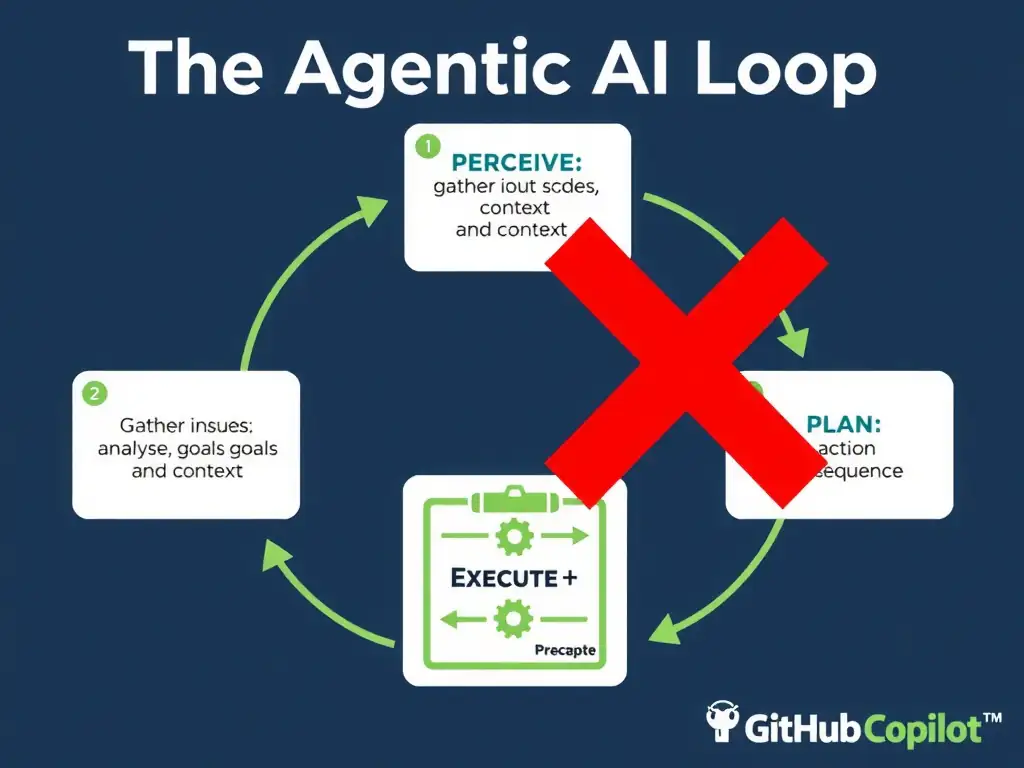
Agentic AI systems follow a structured loop: Perceive (gather inputs from the environment — issues, code, context), Reason (analyze what the inputs mean relative to the agent's goal), Plan (determine a sequence of actions to take), and Execute (carry out those actions and observe the results). This cycle may repeat many times in a single task.
Why the perceive-reason-plan-execute sequence is correct: This is the canonical agent loop described in agentic system design. Separating perception from reasoning from planning from execution gives developers control points at each stage and prevents the agent from acting blindly.
Why the option that says execute actions, then perceive the environment, then reason about next steps is wrong: Executing before perceiving means the agent acts without knowing the current state. This is an anti-pattern that causes agents to make changes based on stale or incomplete information.
Why the option that says reason about goals, execute all available actions simultaneously, then perceive results is wrong: Executing all available actions simultaneously without planning leads to conflicts, wasted compute, and irreversible mistakes. Reasoning must come before execution, and execution should be selective.
Why the option that says receive instructions, store them in memory, and immediately execute without planning is wrong: Storing instructions and executing immediately skips the planning and reasoning stages entirely. This removes the agent's ability to validate its approach, check for conflicts, or adapt to context — all critical for safe agentic operation.