
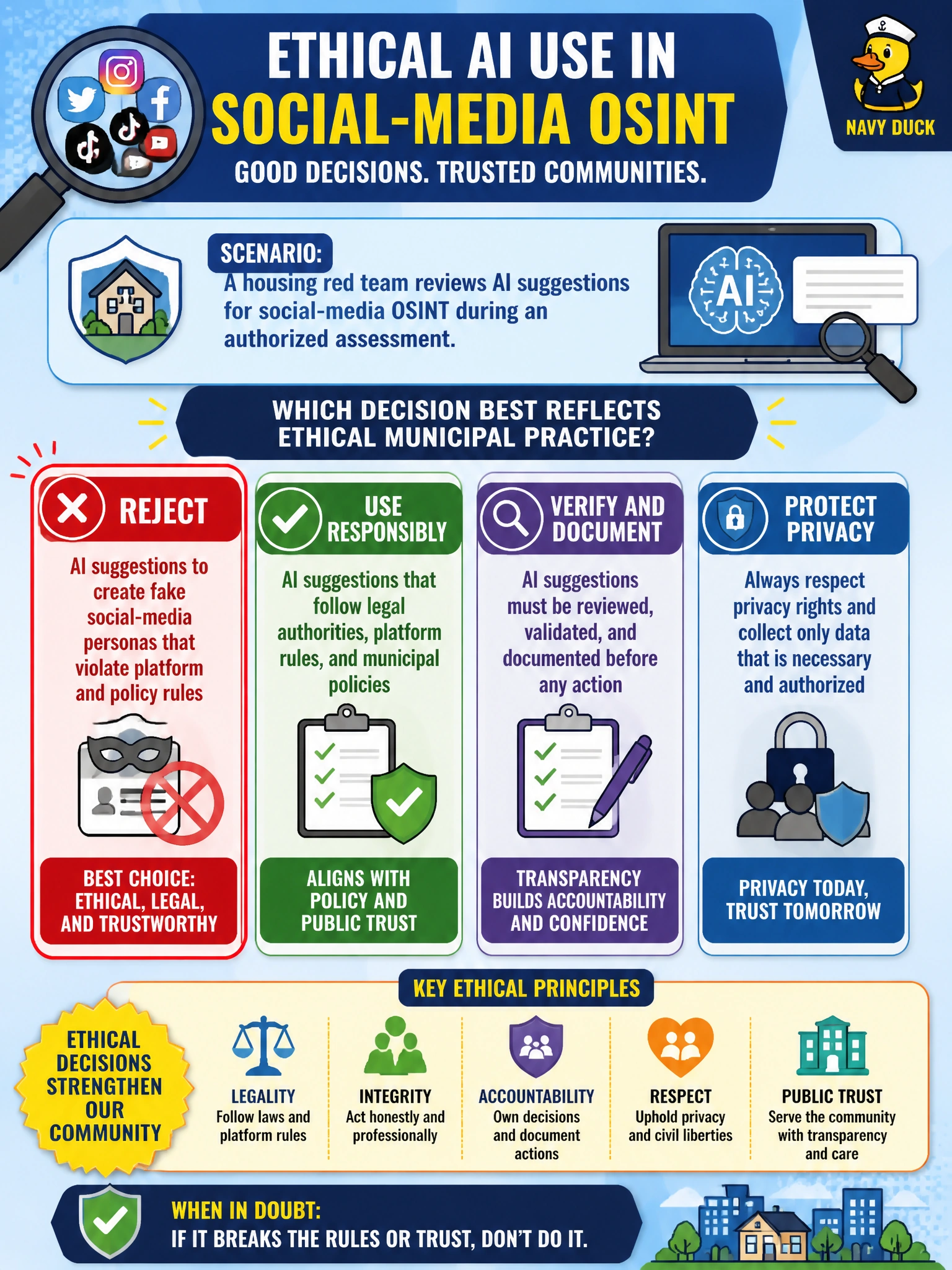
A housing red team reviews AI suggestions for social-media OSINT during an authorized assessment. Which decision best reflects ethical municipal practice?
Select an answer to reveal the explanation.
Short Explanation
When AI suggests fake personas for better OSINT, you can keep the work ethical by rejecting personas that violate platform or policy rules. That’s responsible municipal reconnaissance, not a missed opportunity.
Full Explanation
Ethical municipal AI-assisted social-media OSINT means rejecting AI suggestions to create fake social-media personas that violate platform or policy rules. Sock puppets and deceptive accounts can breach terms of service, undermine public trust, and create legal or investigative complications, even when AI presents them as realistic. Creating fictional accounts whenever AI recommends them fails because AI advice does not override platform rules or agency policy. Ignoring those rules to uncover more staff photos puts collection ahead of compliance. Automating mass fake accounts because AI makes drafting bios easy scales the same violation and increases detection and abuse risk. The ethical decision is to reject the rule-breaking personas and keep authorized collection within lawful, rules-of-engagement-aligned, platform-compliant methods. Exam caveat: Some law-enforcement undercover authorities are separately governed; they are not the default authority for a housing red team’s AI-assisted OSINT. Passive review of public posts differs from interactive deception, and any limited research accounts allowed by policy must be explicit, rare, and controlled—not improvised by AI. Practical check: Document the rejection against platform terms and rules of engagement, limit tooling to public pages and approved accounts, and require a lead to review any account-use request before creation.