
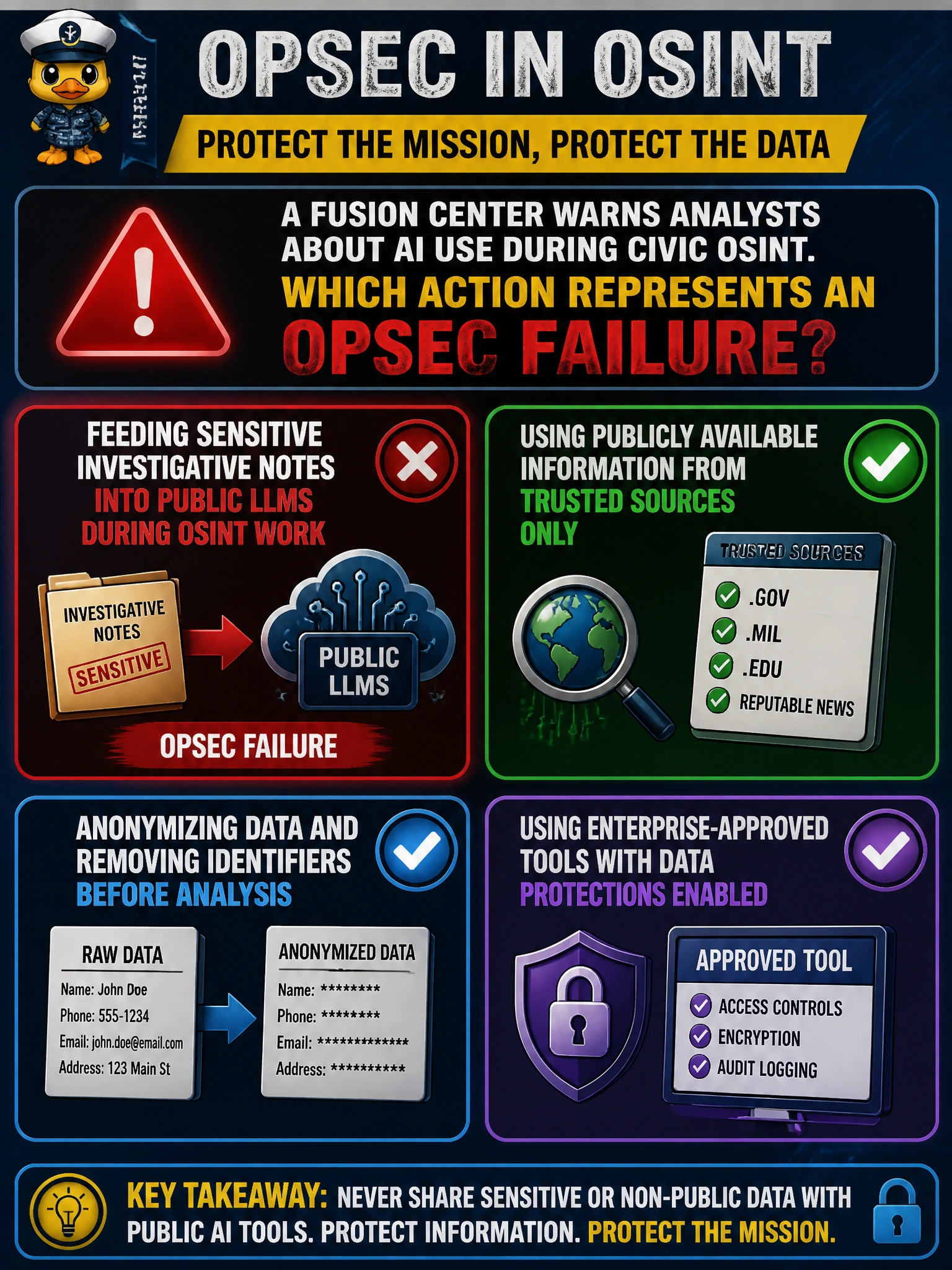
A fusion center warns analysts about AI use during civic OSINT. Which action represents an OPSEC failure?
Select an answer to reveal the explanation.
Short Explanation
Dropping case notes into a public chatbot is like reading the case file on a bus loudspeaker. OPSEC says keep sensitive investigative text out of public LLMs.
Full Explanation
An OPSEC failure in civic AI-assisted OSINT is feeding sensitive investigative notes into public LLMs. Public model services may log, retain, train on, or otherwise expose prompts, which can leak case identifiers, targets, methods, or victim data. Fusion-center and municipal analysts must keep sensitive investigative text out of public AI tools and prefer approved environments with appropriate data-handling agreements.
Using an approved offline summarizer on already-public news clippings is generally aligned with OPSEC when policy allows. Redacting case identifiers before any model-assisted note cleanup is a protective control, not a failure. Preferring agency-approved tools with data-handling agreements is the desired pattern. The failing action is specifically introducing sensitive investigative content into public LLMs.
Exam caveat: Even public source text can become sensitive when combined with case strategy, analyst commentary, or nonpublic conclusions—treat prompts as potentially disclosable. Local or agency-hosted models still need access control and retention rules. OPSEC applies to plugin ecosystems and browser AI helpers that may exfiltrate page context automatically.
Operational check: Inspect analyst workflows for browser AI extensions and public chatbot use; require DLP or policy blocks on pasting case notes; and validate that approved summarization paths either stay offline or run in an accredited tenant with logging and no public training reuse.