
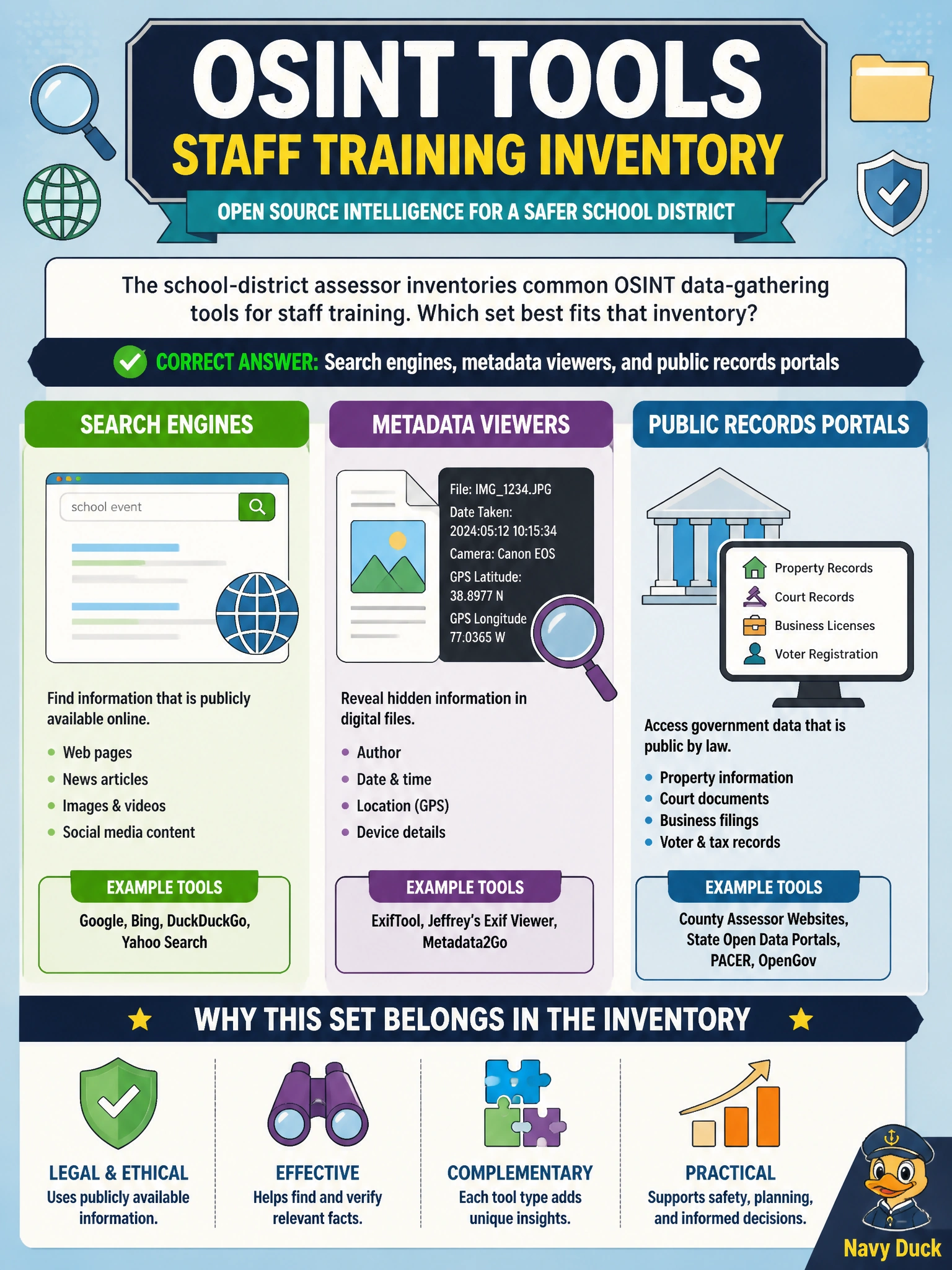
A school-district assessor inventories common OSINT data-gathering tools for staff training. Which set best fits that inventory?
Select an answer to reveal the explanation.
Short Explanation
OSINT starter kit for civic recon is boring on purpose: search engines, metadata viewers, and public records—not wiretaps or ransomware consoles. Know the open toolbox before anything fancier.
Full Explanation
A practical OSINT data-gathering inventory for school-district and municipal staff training centers on ordinary open-source tools: search engines, document metadata viewers, and public records or transparency portals. Those classes teach how exposure happens in civic environments without introducing illegal collection methods. GOAA Domain 9 expects analysts to recognize this legitimate toolbox before discussing advanced or active techniques.
Listing only zero-day exploit kits with no open-source research component fails by concept: exploits are not OSINT gathering tools and skip the recon learning objective. Exclusive reliance on illegal wiretaps as primary OSINT invents a criminal method incompatible with authorized municipal assessment. Ransomware deployment consoles used as reconnaissance instruments confuse malware operations with open-source collection.
Exam caveat: Tool inventory literacy is not authorization to run every tool against production without ROE. Metadata viewers on public PDFs differ ethically from intercepting communications. Commercial OSINT platforms may be in inventory if licensed and policy-approved; the exam point is the legitimate open-source categories versus illegal or purely offensive exploit tooling.
Operational check: Build a training lab checklist that includes a search-engine exercise on public district pages, a metadata review of a posted PDF handbook, and a public-records portal query—then explicitly exclude wiretap and ransomware tooling from the OSINT module materials.