
A municipal SE fundamentals quiz asks why a 'mayor's office' pretext can be unusually effective against staff. Which principle best explains it?
Select an answer to reveal the explanation.
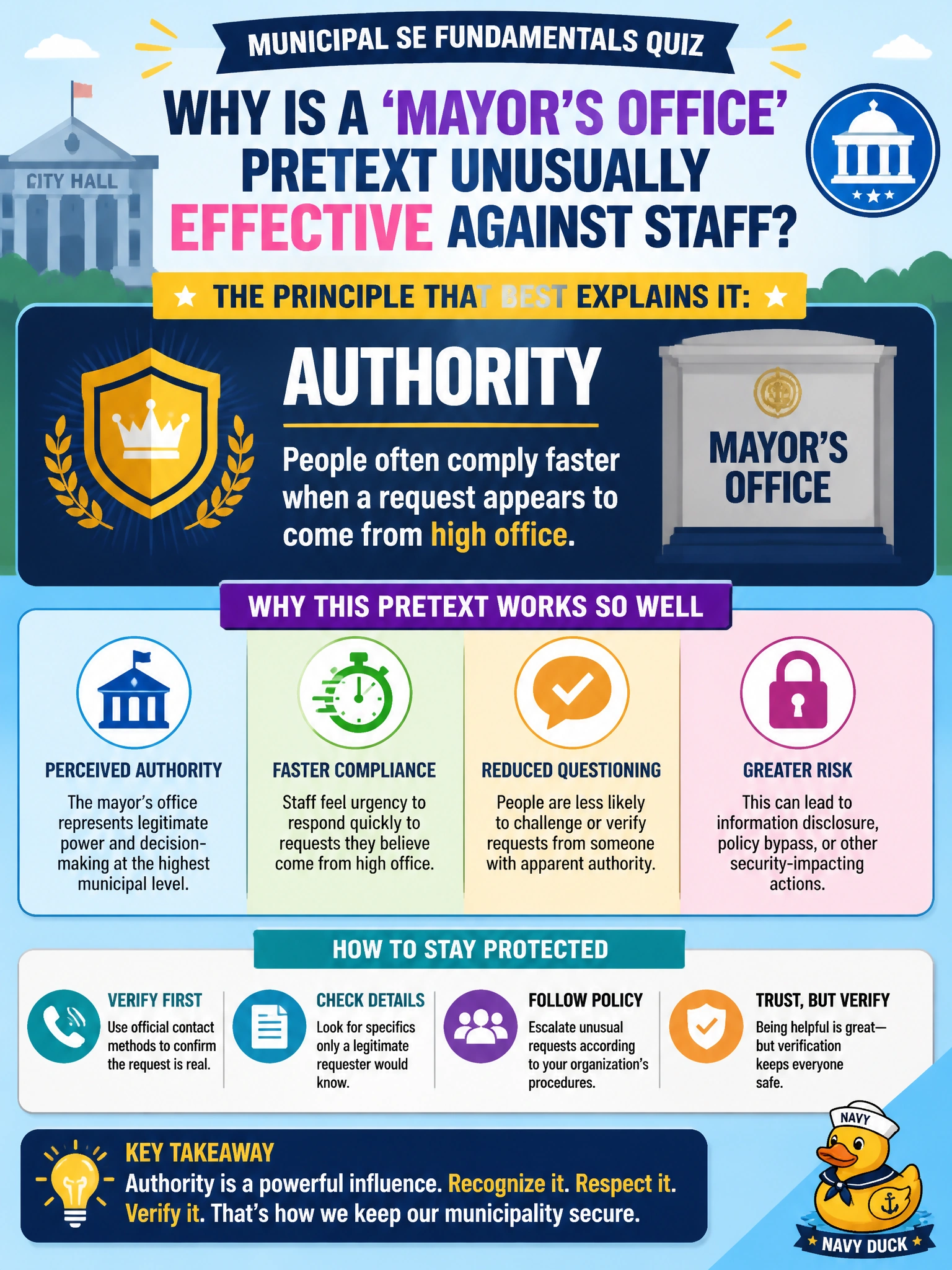
Short Explanation
When the 'mayor's office' calls, lots of folks sit up straighter and click sooner—that's authority doing the heavy lifting. It isn't magic crypto; it's human hierarchy psychology.
Full Explanation
Authority is a foundational social-engineering principle: people often comply faster and with less scrutiny when a request appears to originate from high office, executives, or other powerful roles. A mayor's-office pretext is unusually effective in municipal settings because hierarchical norms, urgency around elected leadership, and fear of political consequences amplify compliance pressure. Awareness programs should teach staff to verify such requests through known official channels rather than reacting to the claimed source alone.
Cryptographic hashing of the mayor's name making a lure unavoidable fails by concept: hashing is unrelated to human compliance psychology and does not force clicks or disclosures. Scarcity of USB ports alone explaining all mayor-themed pretexts misattributes a physical media constraint as the driver of executive-pretext success. Claiming authority never influences government employees by policy denies observable human factors and contradicts SE fundamentals taught for civic defenders.
Exam caveat: Authority cues can be legitimate—real mayor-office requests exist—so training must emphasize verification, not blanket noncompliance that breaks civic operations. Deepfake voice or lookalike domains increase fidelity of authority abuse; controls should include out-of-band confirmation and anti-impersonation email authentication where applicable. Authority often combines with urgency; address both in coaching.
Operational check: Publish a verification path for executive-sounding requests such as callback to a known directory number, ticketed approval, or dual control for sensitive actions. In an authorized drill using an executive pretext, measure whether staff attempt verification before complying, and feed failures into process fixes rather than only into click counts.