
A housing-authority awareness brief must explain common social-engineering technique families at a concept level. Which contrast is most accurate?
Select an answer to reveal the explanation.
Short Explanation
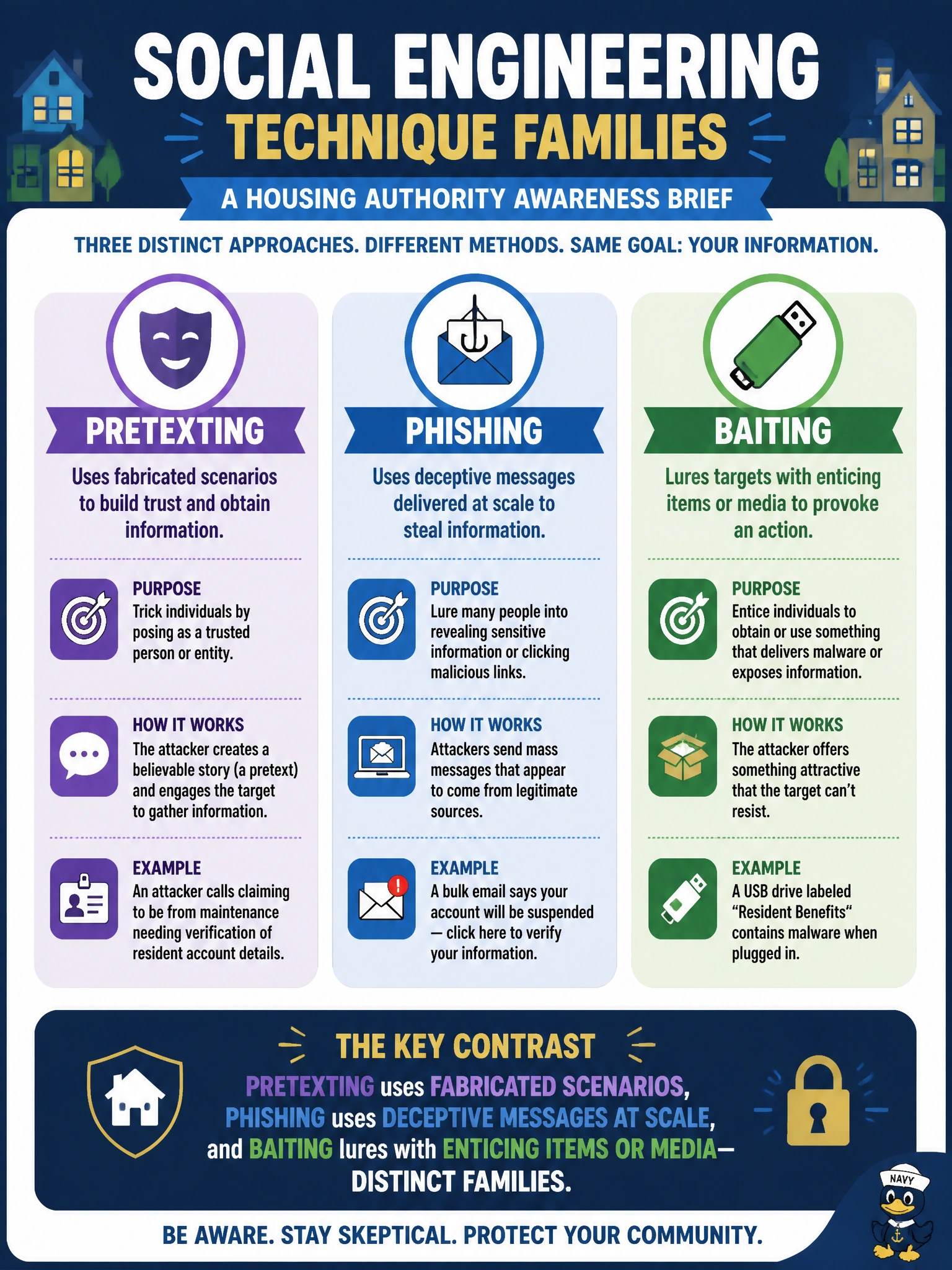
Pretexting is the story, phishing is the deceptive message blast, baiting is the tempting USB-or-download trap. Different families, same human weak spot—not one blob and not 'only malware.'
Full Explanation
A housing-authority awareness brief should teach technique families at concept level: pretexting uses fabricated scenarios, phishing uses deceptive messages at scale, and baiting lures with enticing items or media—distinct families that often combine but are not identical. Staff who can name the family respond with the right habit (verify the story, report the message, avoid the lure) instead of treating all influence as one vague email problem.
Calling pretexting, phishing, and baiting identical labels for the same email template collapses distinct tradecraft and weakens training specificity. Saying only malware droppers count as social engineering while human influence does not reverses the definition—SE is fundamentally about influencing people; malware may be a payload, not the whole category. Claiming baiting always requires SQL injection while pretexting always requires deepfake video invents mandatory technical dependencies that those families do not require.
Exam caveat: definition contrasts are common. Know families by primary mechanism (scenario, deceptive message, lure) rather than by a single technical exploit requirement.
Operational check: in housing-authority briefings, give one civic example per family (false inspector story; rent-portal phish; USB in a common area), map each to a reporting action, and quiz staff on distinguishing the families without requiring exploit trivia.