
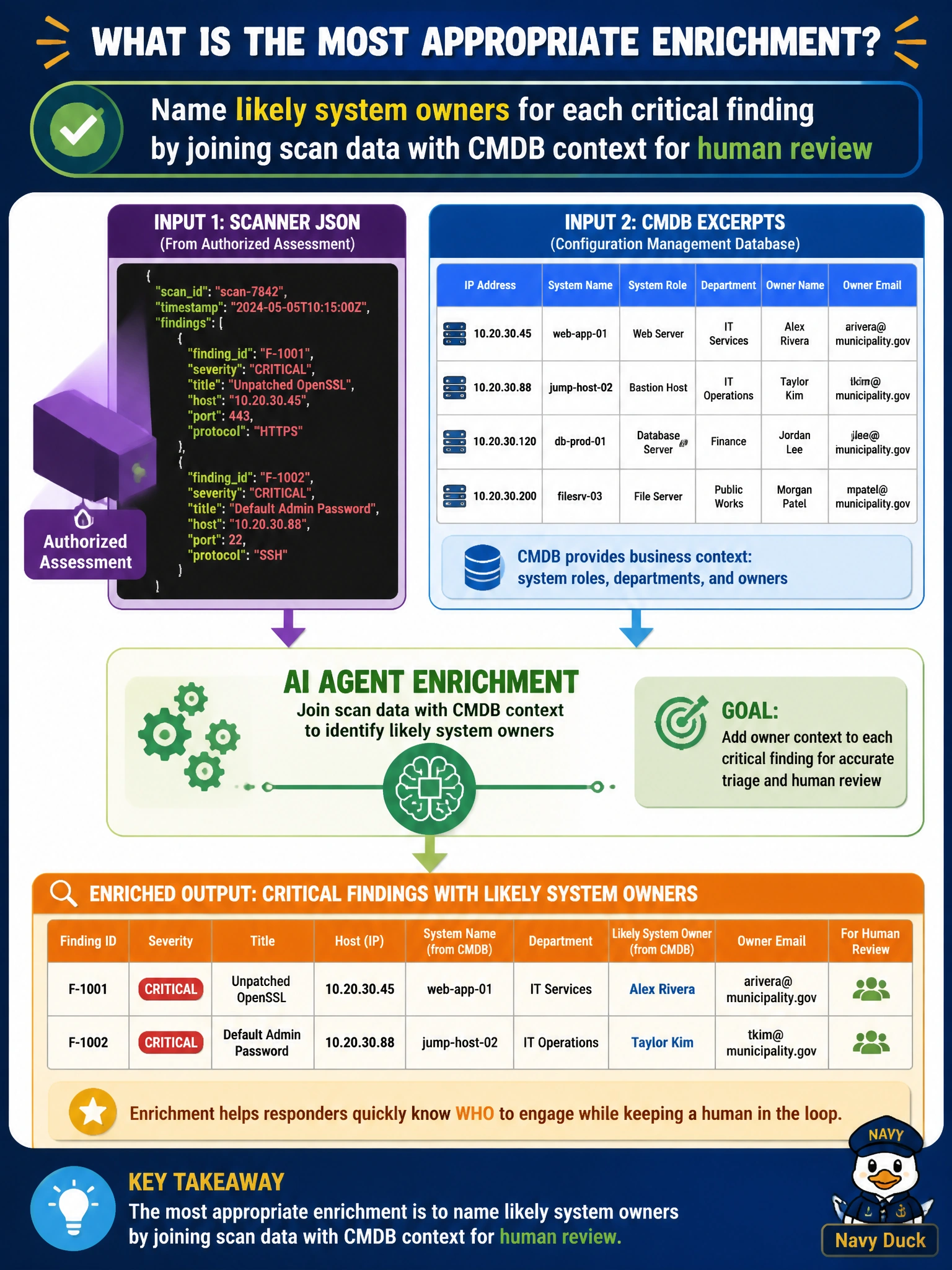
A municipal AI agent receives scanner JSON plus CMDB excerpts during an authorized assessment. What enrichment is most appropriate?
Select an answer to reveal the explanation.
Short Explanation
Join the scanner hits to the CMDB so tickets land on the right desk. Inventing executives, randomizing severity, or hiding unmatched criticals just makes the mess worse.
Full Explanation
When a municipal AI agent receives scanner JSON plus CMDB excerpts during an authorized assessment, appropriate enrichment names likely system owners for each critical finding by joining scan data with CMDB context for human review. That join accelerates ticket routing to the correct civic desk without inventing people or altering severity science. Humans still confirm ownership before assignment because CMDB records can be stale on contractor or swing gear.
Fabricating executive names not present in CMDB to pressure patch owners faster creates false accountability and can harass the wrong officials. Overwriting scanner severity fields with random scores to normalize reports destroys comparable risk signal and breaks prioritization. Dropping critical findings that lack a CMDB match so dashboards stay empty hides real risk precisely where asset data is weakest—often the most dangerous municipal blind spot.
Exam caveat: enrichment should add context, not fabricate entities or suppress unmatched criticals. Unmatched criticals deserve escalation for asset-management repair as well as security response.
Operational check: implement joins as suggestions with confidence and CMDB source fields; queue unmatched criticals for CMDB stewardship; prohibit agent writes that alter raw severity or invent person entities not in authoritative directories.