
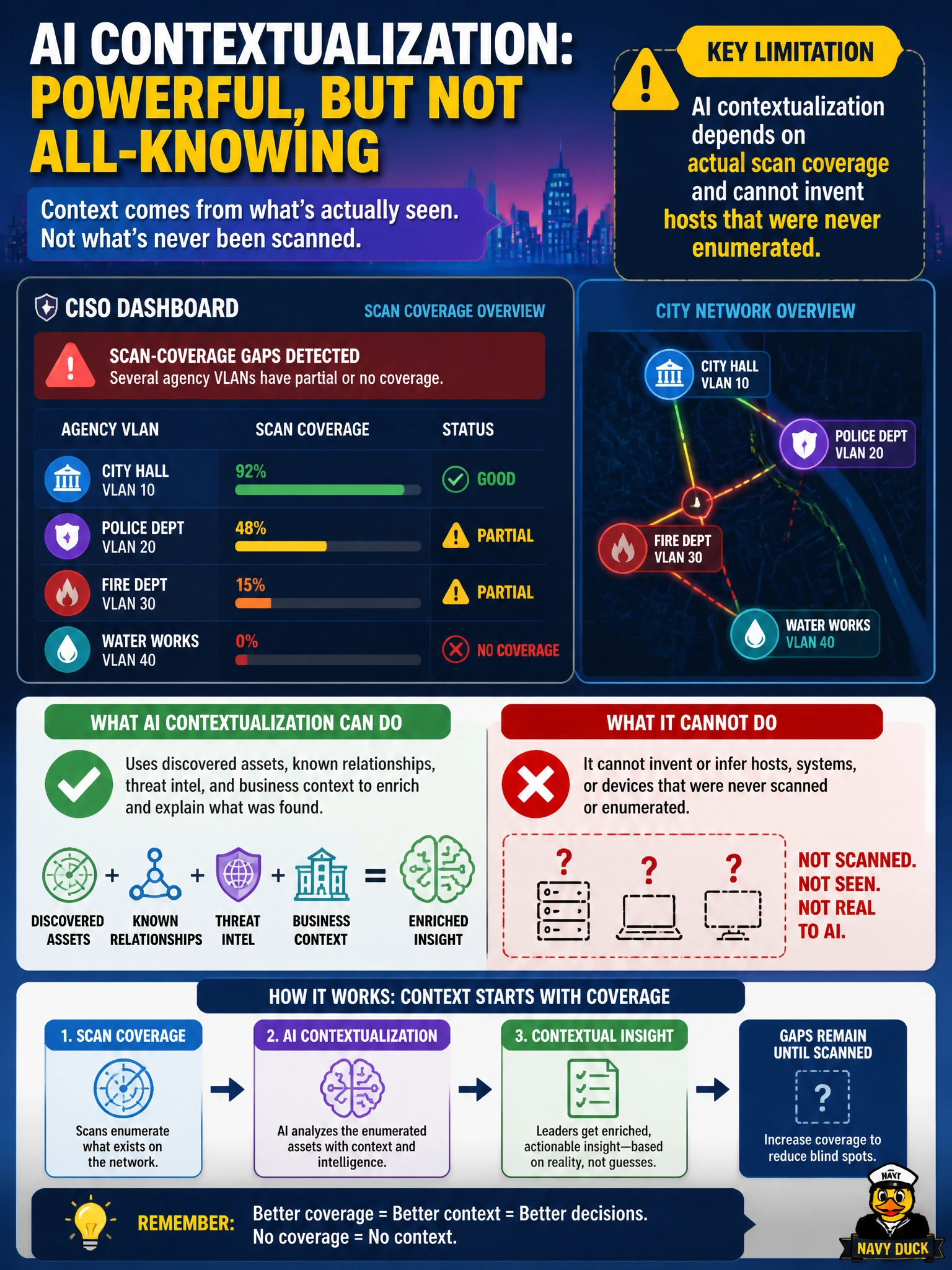
A city CISO dashboard shows scan-coverage gaps on several agency VLANs. What limitation should leaders remember about AI contextualization?
Select an answer to reveal the explanation.
Short Explanation
If the scanner never walked that hallway, the AI cannot magically list the furniture. Coverage gaps stay gaps. Invented hosts with scary severity stickers just create busywork.
Full Explanation
A city CISO dashboard that shows scan-coverage gaps on agency VLANs highlights a hard limit of AI contextualization: it depends on actual scan coverage and cannot invent hosts that were never enumerated. Leaders should treat AI narratives as interpretations of observed evidence. Missed VLANs remain unknown attack surface until discovery and scanning occur—no amount of fluent summarization closes that gap.
Claiming generative agents can reliably invent complete host inventories for any missed VLAN invents false assurance and can hide real shadow IT on agency segments. Saying coverage gaps do not matter if the AI assigns critical severity to imaginary assets prioritizes dramatic scores over truth and pollutes municipal risk registers. Treating enumeration as optional once an LLM has read the city's marketing website confuses public web content with internal network discovery.
Exam caveat: coverage versus contextualization is a deliberate trap. AI makes existing evidence more usable; it does not substitute for enumeration on networks never touched.
Operational check: pair every AI-prioritized dashboard with a coverage map (scanned vs. authorized VLANs); open remediation for real findings and separate tickets for scan-enablement on gap VLANs; reject inventory claims that lack enumeration provenance.