
A public-health assessment wants fewer false positives on clinic kiosk inventories. Which scanning choice best addresses that goal?
Select an answer to reveal the explanation.
Short Explanation
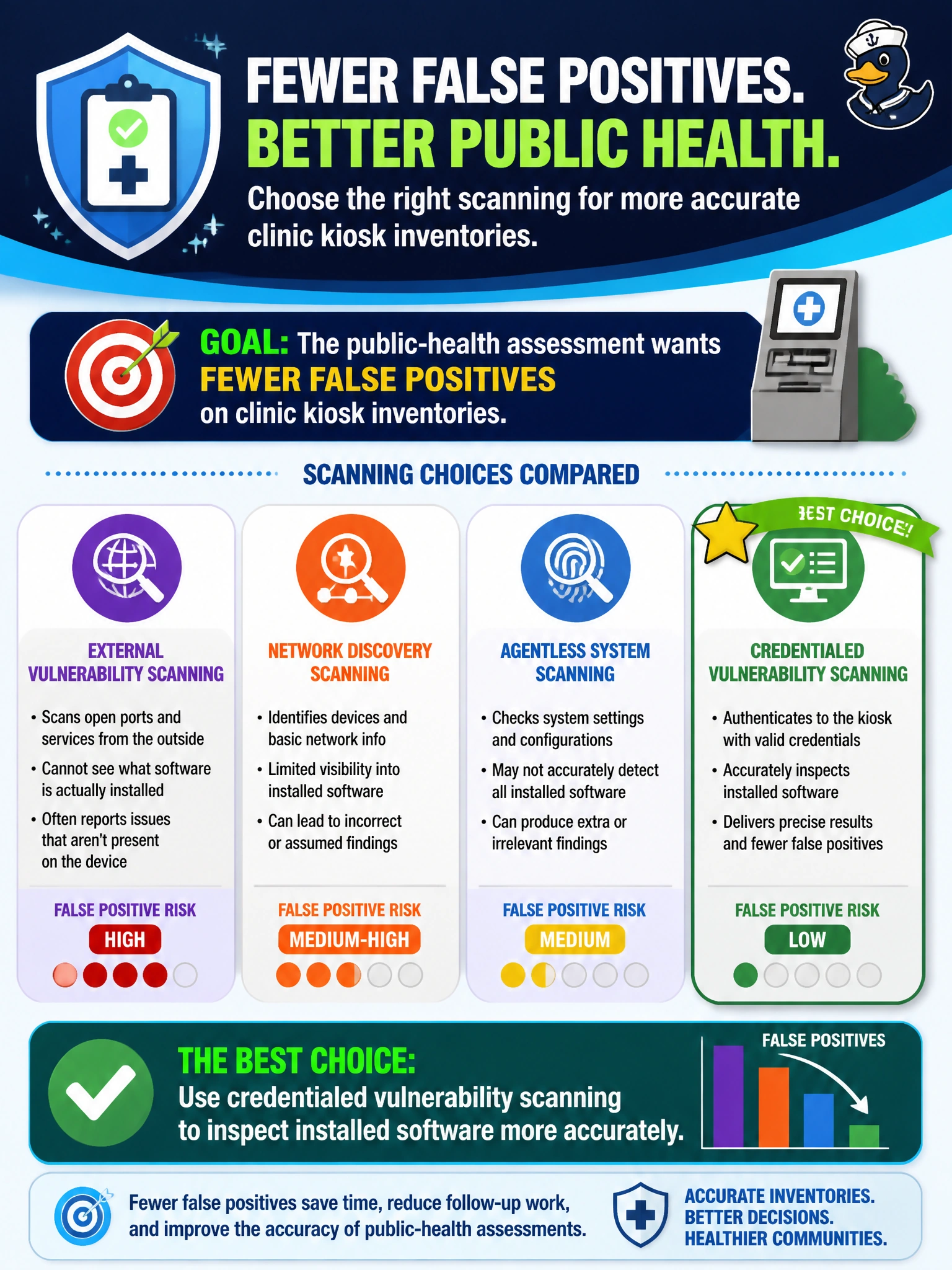
Logged-in scans see what is really installed on the kiosk—fewer 'maybe vulnerable' ghosts. Guessing from banners alone, inventing patch levels, or reading floor plans is how clinics drown in false alarms.
Full Explanation
Public-health clinic kiosk inventories suffer when assessments rely on shallow, unauthenticated signals. Credentialed vulnerability scanning inspects installed software more accurately—patch levels, local configurations, and products that banners cannot reliably expose—so false positives and unknowns drop relative to banner-only methods. For municipal clinics, fewer false positives means scarce IT time goes to real kiosk risk rather than chasing ghost findings.
Relying only on unauthenticated Internet-wide banners and skipping local credentials maximizes ambiguity: banners lag, are spoofable, and miss local-only software common on kiosks. Asking an AI model to invent patch levels without connecting to any kiosk fabricates compliance state and is not an assessment method. Disabling all scanning and estimating risk solely from clinic floor plans confuses physical layout with software vulnerability evidence.
Exam caveat: credentialed versus unauthenticated trade-offs are a recurring exam theme. Credentialed scans improve accuracy when credentials are authorized, vaulted, and scoped; they are not a license for uncontrolled privileged access.
Operational check: use vaulted clinic-approved credentials, limit scan accounts to least privilege, compare credentialed results against a sample of manually verified kiosks, and track false-positive rate before/after credentialed policy enablement.