
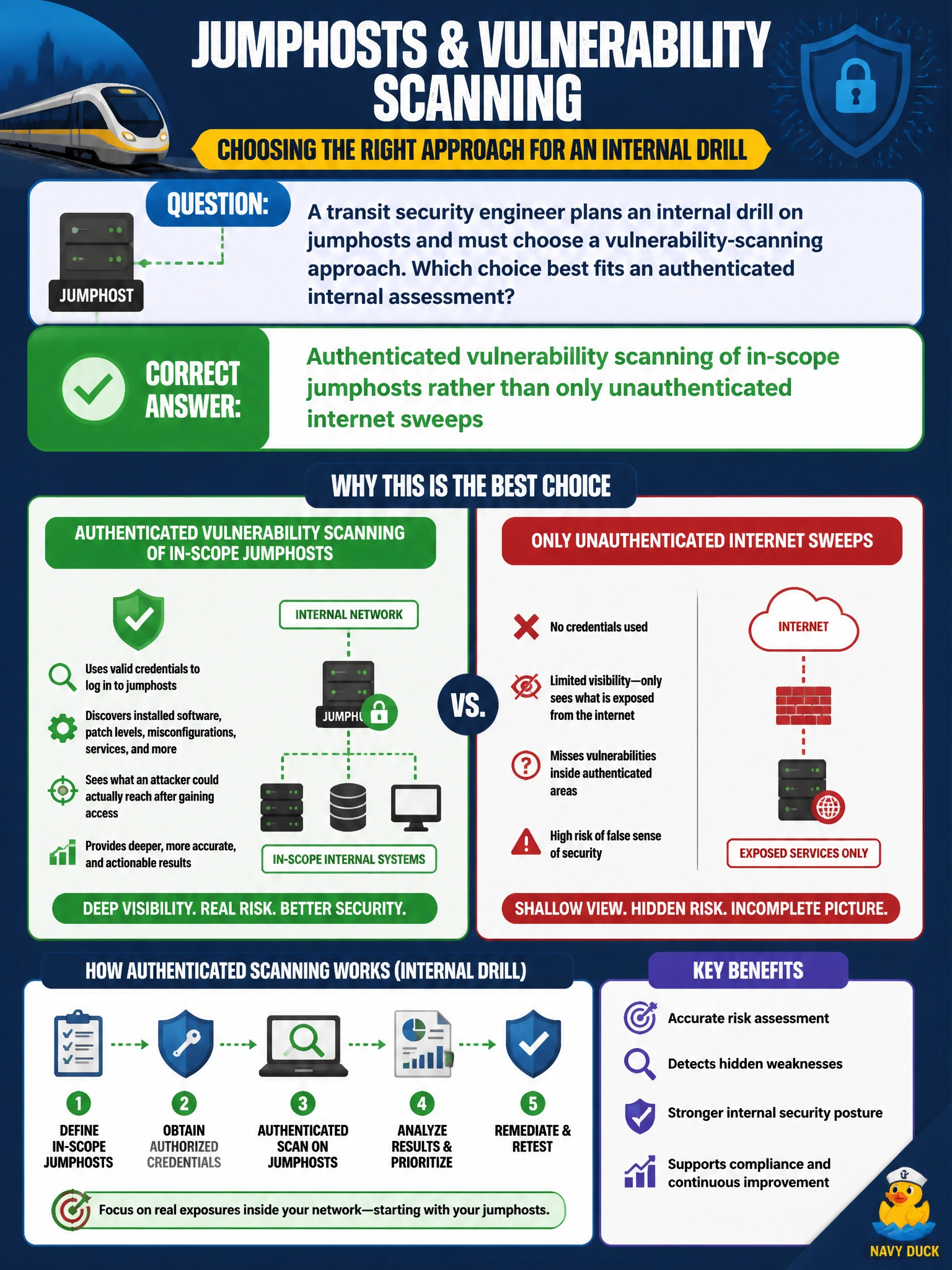
A transit security engineer plans an internal drill on jumphosts and must choose a vulnerability-scanning approach. Which choice best fits an authenticated internal assessment?
Select an answer to reveal the explanation.
Short Explanation
Internal jumphost drills want credentialed eyes on the real boxes—not random internet sightseeing. Authenticated scanning sees missing patches that unauthenticated peeks miss. Transit charters also say hands off forbidden OT—listen.
Full Explanation
Authenticated vulnerability scanning of in-scope jumphosts is typically more appropriate for an internal municipal drill than unauthenticated internet-only sweeps of unrelated assets, because credentials reveal missing patches and misconfigurations that external peeks miss. A transit security engineer planning an internal drill on jumphosts should choose authenticated scanning of those in-scope jumphosts rather than only unauthenticated internet sweeps—and must still honor charter forbids such as hands-off OT train-control PLCs. Matching scanning approach to civic scope is the Domain 7 methodology takeaway.
Only unauthenticated scans of unrelated public websites outside ROE fails scope and misses the internal jumphost goal. No scanning while relying solely on AI to invent CVEs fails evidence standards; invented CVEs are not findings. Scanning OT train-control PLCs despite an explicit forbid violates the charter and can endanger safety systems.
Exam caveat: ‘authenticated vs unauthenticated’ and ‘in-scope vs forbidden’ are both tested. Internal jumphost drills want credentialed, bounded scanning—not OT violations or AI fiction.
Operational check for transit: use approved credentials only on listed jumphosts, document scan windows with operations, exclude train-control PLCs and other forbidden OT, review results with humans, and ticket real missing patches—never substitute model-invented CVE lists for scanner output.