
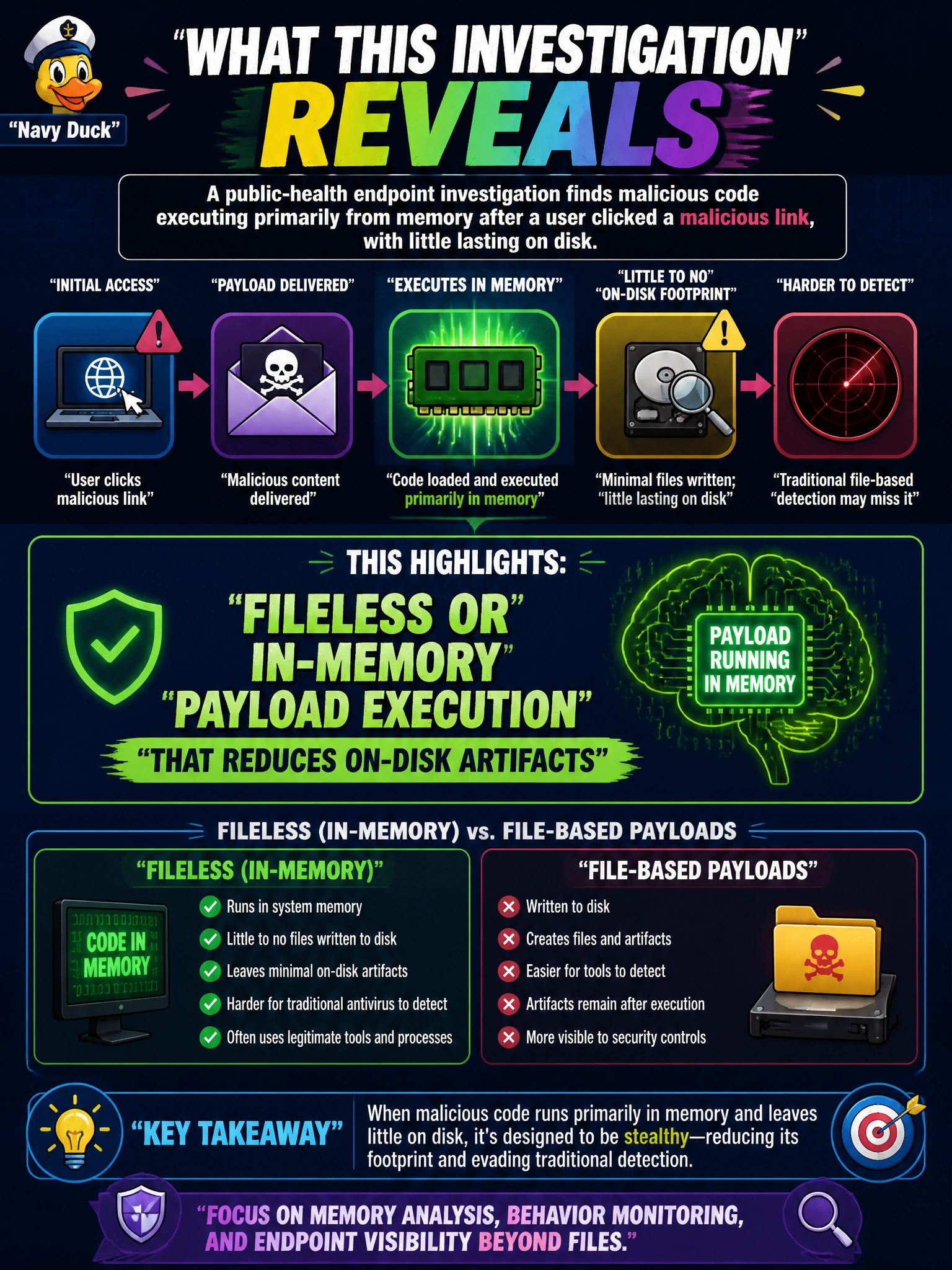
A public-health endpoint investigation finds malicious code executing primarily from memory after a user clicked a malicious link, with little lasting on disk. Which characteristic does that highlight?
Select an answer to reveal the explanation.
Short Explanation
If the bad stuff mostly lives in RAM after the click, you’re in fileless territory—fewer breadcrumbs on disk. Public-health IR still hunts memory and process weirdness, not just files. Disk-clean doesn’t mean host-clean.
Full Explanation
Fileless or in-memory payload execution emphasizes malicious code that runs primarily from memory after initial delivery, leaving fewer durable on-disk artifacts for traditional file scanning. A public-health endpoint investigation that finds malicious code executing mainly from memory after a user clicked a malicious link, with little lasting on disk, highlights that characteristic: disk-clean triage is insufficient, and responders must consider process, memory, script host, and living-off-the-land telemetry. Clinic and public-health estates still need rapid isolation and memory-aware hunting even when file system scans look quiet.
Mandatory USB-only propagation across clinic kiosks fails because the stem describes post-click in-memory execution, not USB-forced spread as the defining trait. Authenticated Nessus scanning of vaccine-inventory servers fails because vulnerability scanning is an assessment activity, not the malware execution characteristic under investigation. Custom GPT assistants scoped to outbreak playbooks fail as an answer class; AI assistant scoping is unrelated to fileless/in-memory malware behavior on an endpoint.
Exam caveat: ‘fileless’ does not mean zero evidence—it means fewer classic file drops. Delivery may still begin with a link or document; the highlighted trait is where the payload runs afterward.
Operational check for public-health IR: isolate the endpoint, collect volatile memory and process listings per playbook, review browser/script-host child processes tied to the malicious link, hunt peers for the same in-memory patterns or parent-child trees, and rebuild or remediate with the understanding that wiping visible files alone may miss RAM-resident activity still present before reboot.