
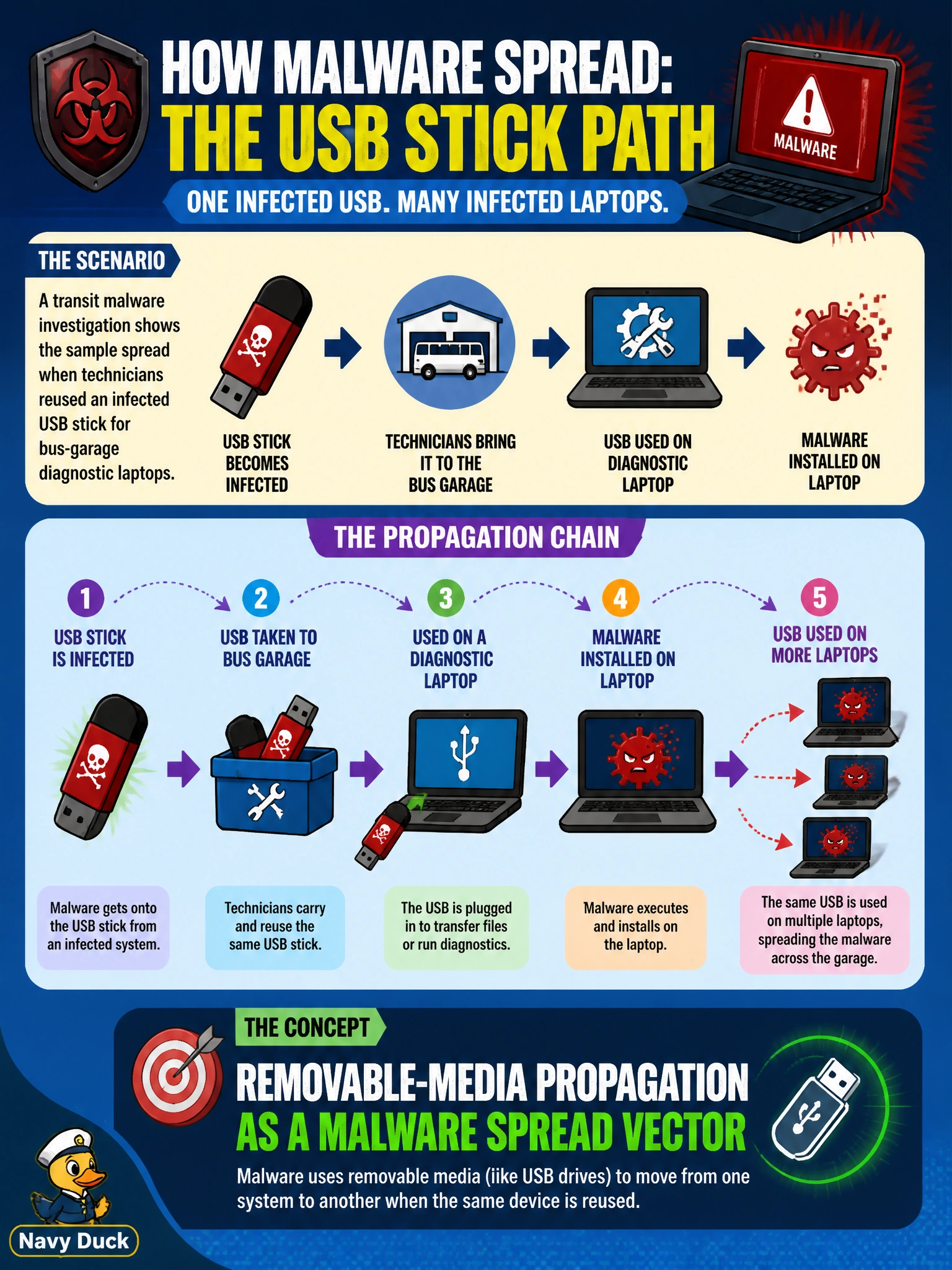
A transit malware investigation shows the sample spread when technicians reused an infected USB stick for bus-garage diagnostic laptops. Which concept does that illustrate?
Select an answer to reveal the explanation.
Short Explanation
Garage techs pass around USB sticks like coffee cups—and malware hitchhikes. That spread path is removable-media propagation, not some fancy memory-only trick. Label the vector so transit hardening targets the right habit.
Full Explanation
Propagation vectors describe how malware moves from one host to another. In a transit malware investigation where the sample spread because technicians reused an infected USB stick across bus-garage diagnostic laptops, the illustrated concept is removable-media propagation—physical media carrying the infection between systems that may not share continuous network trust. OT-adjacent municipal garage environments commonly reuse diagnostic sticks; labeling that vector correctly steers hardening toward media controls, host USB policy, scanning stations, and technician workflow changes rather than unrelated controls.
In-memory fileless execution fails because that concept emphasizes scarce on-disk artifacts and RAM-resident code, not physical USB transfer between garage laptops. Authenticated vulnerability scanning of OT controllers fails because scanning methodology is an authorized assessment activity, not a malware spread path observed in the investigation. WMI event-subscription persistence on domain controllers fails because persistence keeps malware alive on a host across restarts; the stem is about how infection jumped between diagnostic systems via USB, not how it survived reboot on a DC.
Exam caveat: do not confuse propagation (how it spreads) with persistence (how it stays), delivery lure content, or assessment tooling. Civic transit stems often highlight USB and shared-drive realities that differ from purely network worm narratives.
Operational check for transit SOC/IR: quarantine the implicated USB media, image or hash known-bad sticks, inventory which garage diagnostic laptops mounted them, scan and rebuild affected hosts as policy requires, enforce allow-listed or scanned media workflows, and brief technicians so reuse of untrusted sticks stops before the next maintenance window.