
A city malware-analysis unit chooses how to use AI on opaque scripts. Which use best matches defensive municipal practice?
Select an answer to reveal the explanation.
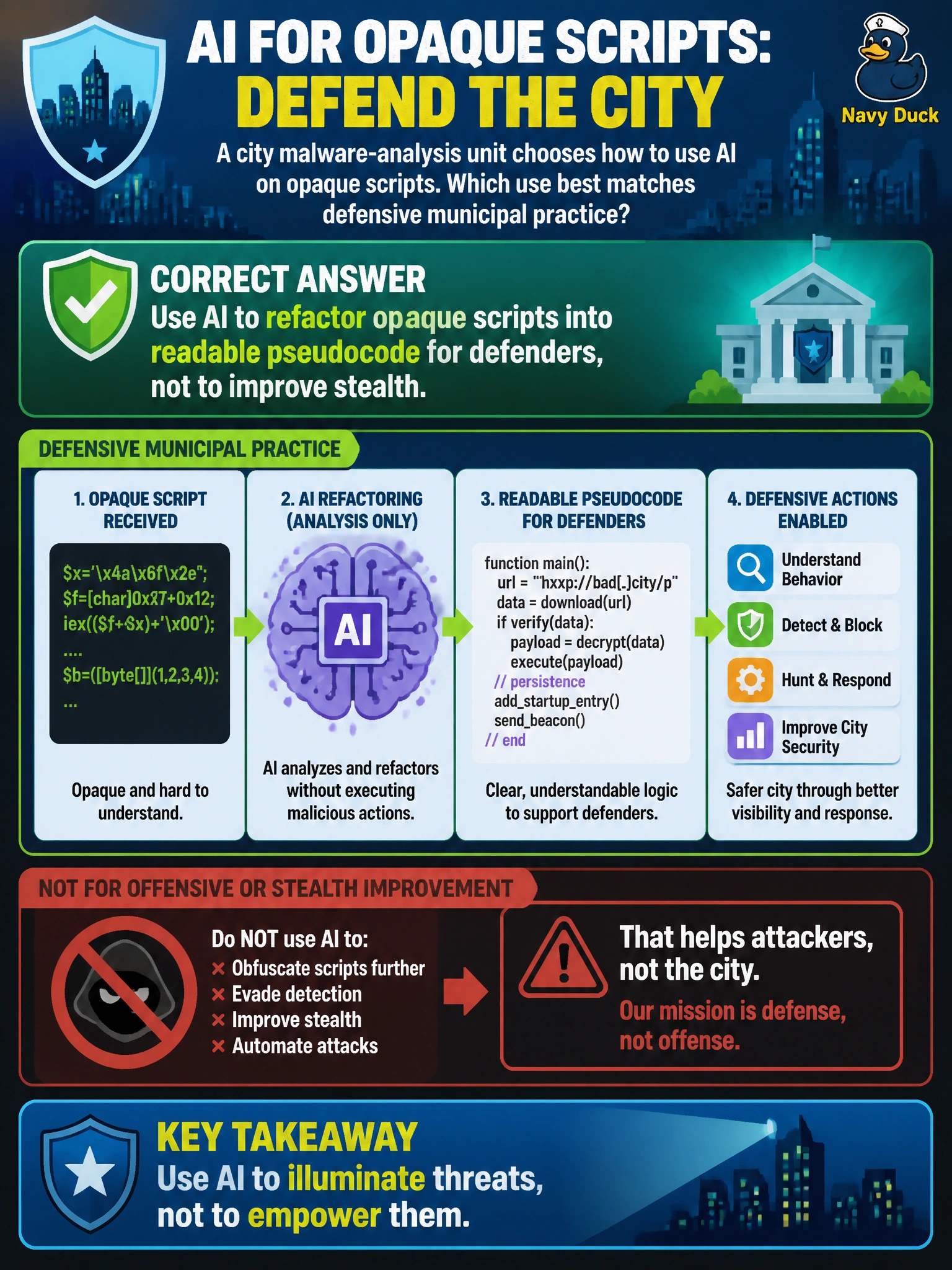
Short Explanation
Shine a flashlight on the spaghetti—AI that turns opaque scripts into readable pseudocode helps defenders. Using AI to make samples stealthier or to spray them onto clerk PCs is the wrong movie.
Full Explanation
A city malware-analysis unit using AI on opaque scripts best matches defensive municipal practice when AI refactors those scripts into readable pseudocode for defenders—not when AI improves stealth. The defensive goal is comprehension: clarify control flow, identify IOCs, map behaviors to detections, and brief responders. Refactoring for readability accelerates analysis without increasing the sample's evasion capability against city sensors.
Using AI primarily to harden samples for greater stealth against city sensors turns analysis tooling into an offense amplifier outside typical malware-analysis mission. Stripping safety comments to make scripts harder to audit harms transparency. Auto-deploying refactored scripts onto production clerk workstations is an unauthorized change and contamination of production.
Exam caveat: defensive municipal practice is readability/pseudocode for analysts—not stealth hardening, anti-audit edits, or production auto-deploy.
Operational check: define AI-assisted reverse-engineering playbooks that output annotated pseudocode into the case ticket, prohibit prompts that ask to evade municipal sensors, keep originals and AI notes in the analysis sandbox, and never push refactored code to clerk endpoints without a separate, approved software-change process.