
A city authorized pentest lab considers asking an LLM to draft a benign proof-of-concept dropper skeleton. Under what condition is that use aligned with ethical municipal practice?
Select an answer to reveal the explanation.
Short Explanation
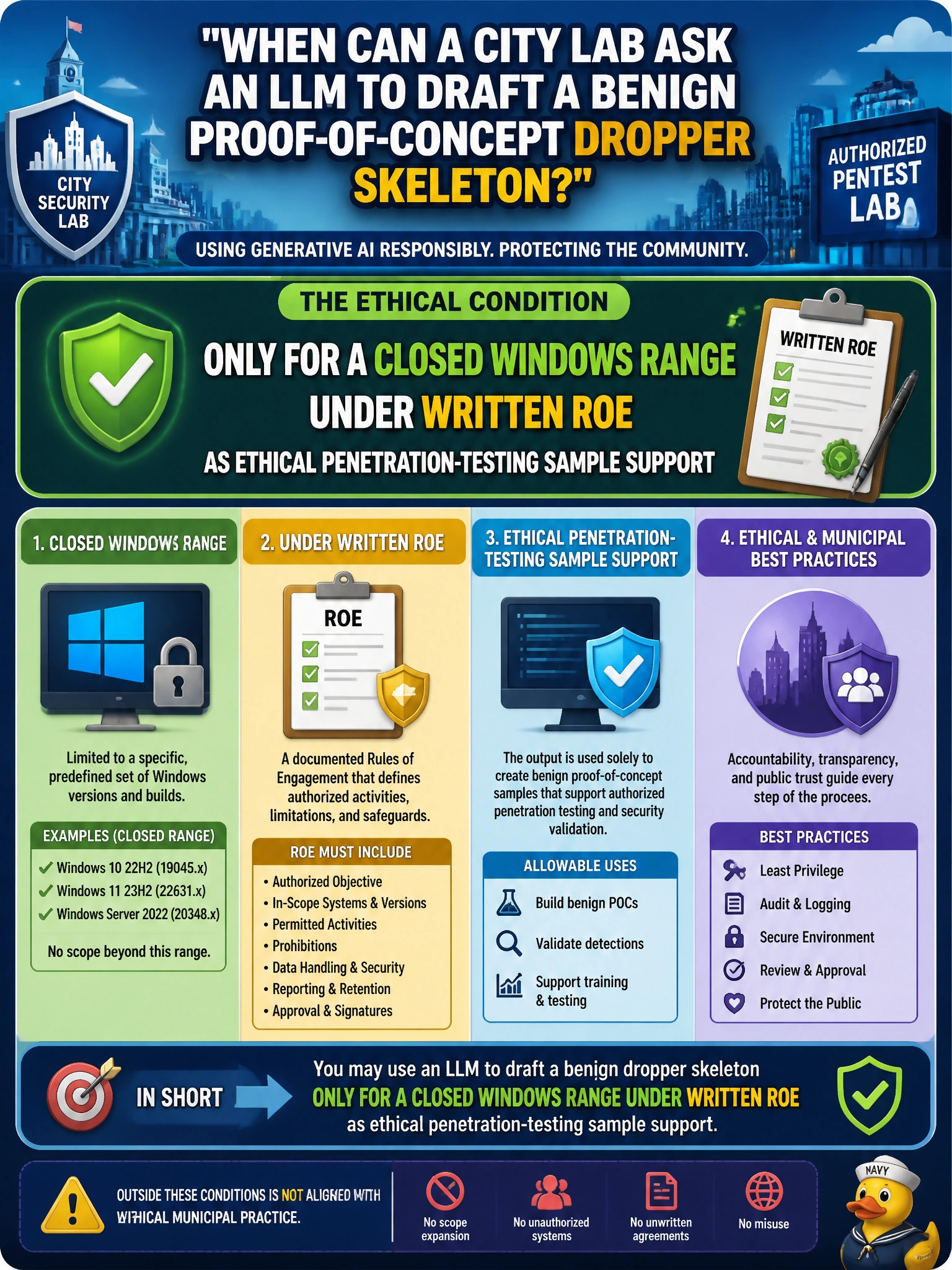
Curious is not a charter. AI-drafted dropper skeletons belong on a closed city range with written ROE—ethical pentest samples, not 911 console toys or social-media trophies.
Full Explanation
Ethical municipal practice for asking an LLM to draft a benign proof-of-concept dropper skeleton is narrow: only on a closed Windows range under written rules of engagement as ethical penetration-testing sample support. Isolation, authorization, sample custody, and destruction requirements keep the artifact from becoming a production hazard or an uncontrolled leak. Curiosity alone is not a charter; civic AI and offensive-lab policies require documented scope.
Allowing any employee to generate such skeletons with no ROE or isolation fails acceptable use and chain-of-custody expectations. Generating or running them on production 911 consoles is dangerously out of scope for life-safety systems. Posting generated samples to social media for 'peer review' distributes potentially dual-use code and violates typical municipal confidentiality and ethics rules.
Exam caveat: alignment hinges on closed range + written ROE + ethical pentest sample support—not curiosity, production 911 validation, or social posting.
Operational check before any LLM-assisted dropper skeleton: confirm written ROE language covering AI-generated samples, use air-gapped or tightly controlled lab networks, log custody, ban production targets including emergency consoles, and destroy artifacts after the test per city policy.