
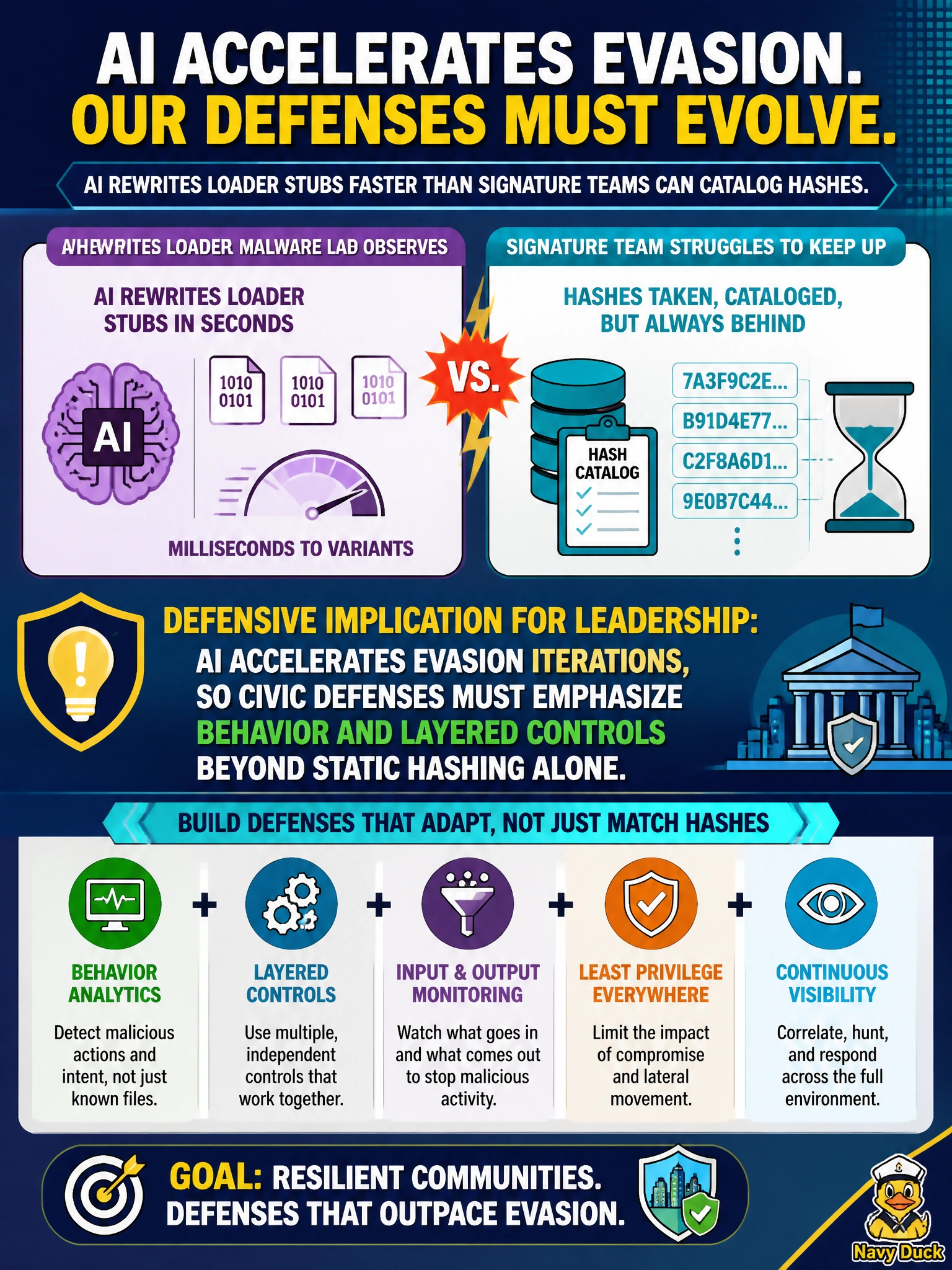
A municipal malware lab notes AI can rewrite loader stubs faster than signature teams can catalog hashes. What defensive implication should leadership take away?
Select an answer to reveal the explanation.
Short Explanation
AI can remix loader stubs like a DJ spinning new tracks all night—hash lists cannot keep up alone. Cities need behavior and layered defenses, not a monthly stamp collection. Quitting endpoint protection is not the takeaway.
Full Explanation
Municipal malware labs observing that AI rewrites loader stubs faster than signature teams can catalog hashes should brief leadership on a defensive implication, not a product cancellation. AI accelerates evasion iterations: new stub variants appear continuously, breaking static hash and simple pattern catalogs. Civic defenses must therefore emphasize behavior analytics, ASR-style rules, application control, network egress monitoring, and other layered controls that still catch risky actions when the loader's bytes change. Hash lists remain useful but are insufficient as a sole strategy.
Monthly signature catalog updates will not 'always stay ahead' of AI rewrite speed; that claim contradicts the lab observation in the stem. Abandoning endpoint protection because AI is fast leaves municipal hosts exposed and ignores behavioral layers that still work. Claiming loader stubs cannot be mutated by AI is factually wrong and undermines readiness planning.
Exam caveat: leadership takeaway is to invest in behavior and layered controls beyond static hashing—not to quit endpoint protection or pretend monthly hash dumps solve AI-paced polymorphism.
Operational check for city leadership reviews: measure detection rates on AI-mutated lab loaders with hash-only versus hash-plus-behavioral stacks under ROE; report residual risk; fund tooling and playbooks that prioritize process behavior, script control, and rapid IOC sharing across municipal agencies rather than hash inventory size alone.