
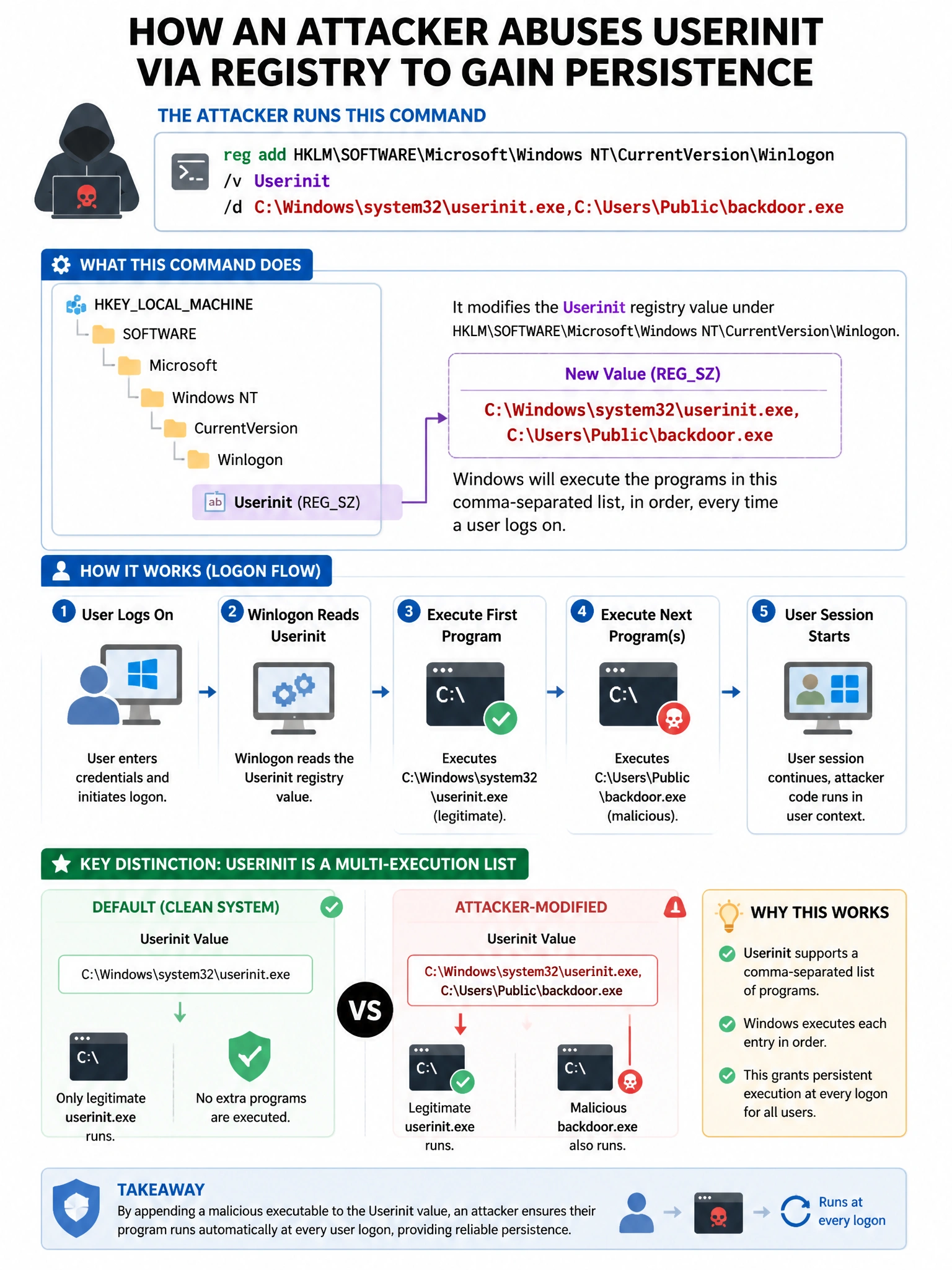
An attacker uses the command reg add HKLM\SOFTWARE\Microsoft\Windows NT\CurrentVersion\Winlogon /v Userinit /d C:\Windows\system32\userinit.exe,C:\Users\Public\backdoor.exe. What persistence mechanism is being established?
Select an answer to reveal the explanation.
Short Explanation and Infographic
Here's the deal — b is correct because the Winlogon Userinit registry value specifies what processes run during user logon; appending a malicious executable to the comma-separated list causes it to launch with SYSTEM context on every user login, a well-known persistence technique. A is wrong because service installation uses different registry keys (HKLM\SYSTEM\CurrentControlSet\Services), not Winlogon.
Full explanation below image
Full Explanation
B is correct because the Winlogon Userinit registry value specifies what processes run during user logon; appending a malicious executable to the comma-separated list causes it to launch with SYSTEM context on every user login, a well-known persistence technique. A is wrong because service installation uses different registry keys (HKLM\SYSTEM\CurrentControlSet\Services), not Winlogon. C is wrong because RDP is enabled through the fDenyTSConnections registry key, not Winlogon\Userinit. D is wrong because scheduled tasks use a completely different data store (XML files in C:\Windows\System32\Tasks and the Task Scheduler registry key), not Winlogon.