
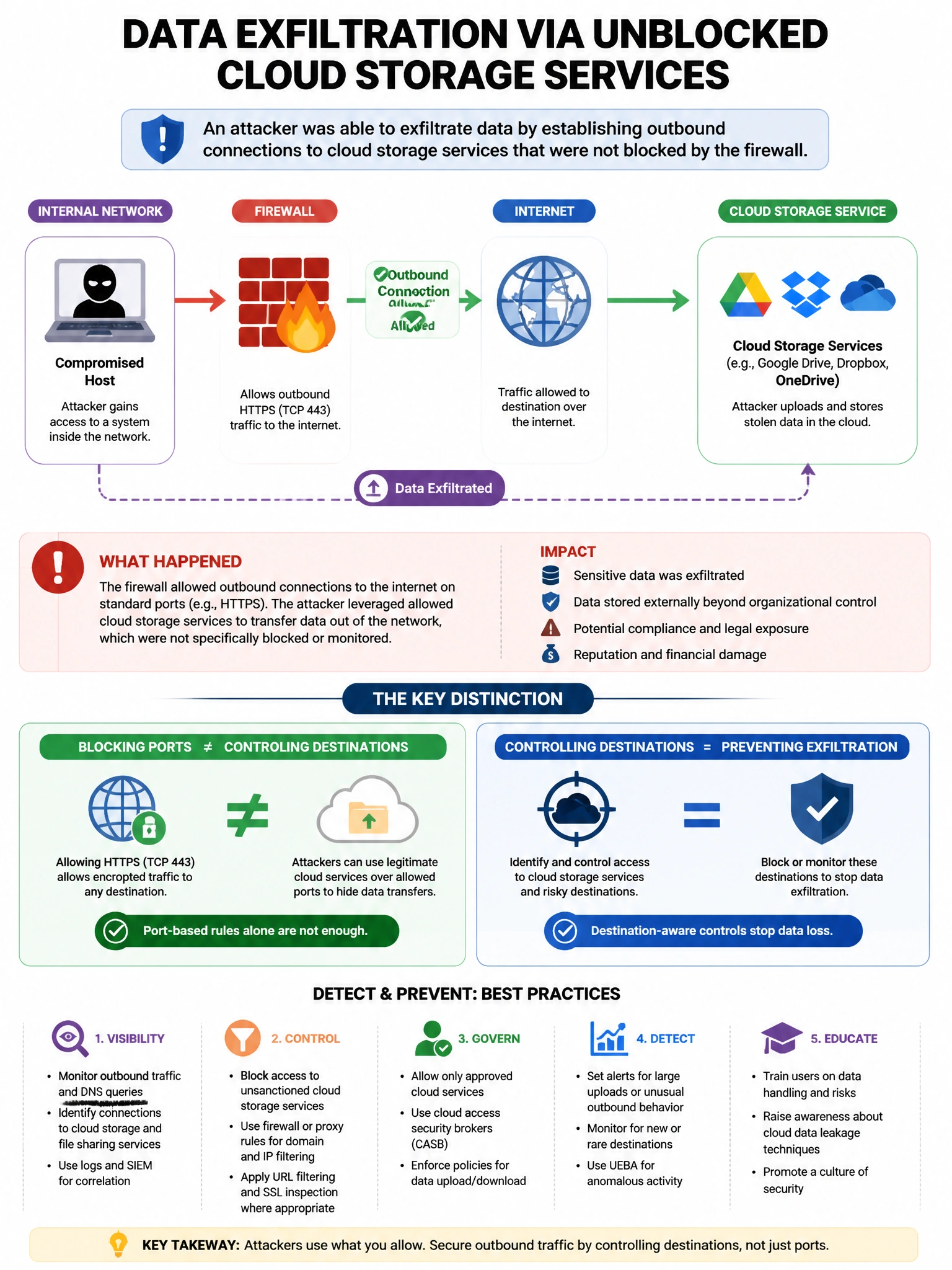
An organization discovers that an attacker was able to exfiltrate data by establishing outbound connections to cloud storage services that were not blocked by the firewall. What specific control gap does this represent?
Select an answer to reveal the explanation.
Short Explanation and Infographic
Here's the deal — b is correct because cloud storage services use dynamically changing IPs and shared infrastructure; effective control requires SSL inspection to see inside HTTPS traffic and application-aware NGFW rules that identify the service by application signature rather than IP address. A is wrong because blocking cloud IPs at the firewall is ineffective because cloud provider IP ranges are vast, shared, and constantly changing.
Full explanation below image
Full Explanation
B is correct because cloud storage services use dynamically changing IPs and shared infrastructure; effective control requires SSL inspection to see inside HTTPS traffic and application-aware NGFW rules that identify the service by application signature rather than IP address. A is wrong because blocking cloud IPs at the firewall is ineffective because cloud provider IP ranges are vast, shared, and constantly changing. C is wrong because antivirus signatures detect malware files; they do not prevent application-layer data transfers to cloud services. D is wrong because VLAN tagging is a network organization control, not a mechanism for blocking specific application destinations.