
An organization's security policy requires that all network devices use encrypted management protocols. Which statement correctly distinguishes Telnet from SSH for device management?
Select an answer to reveal the explanation.
Short Explanation and Infographic
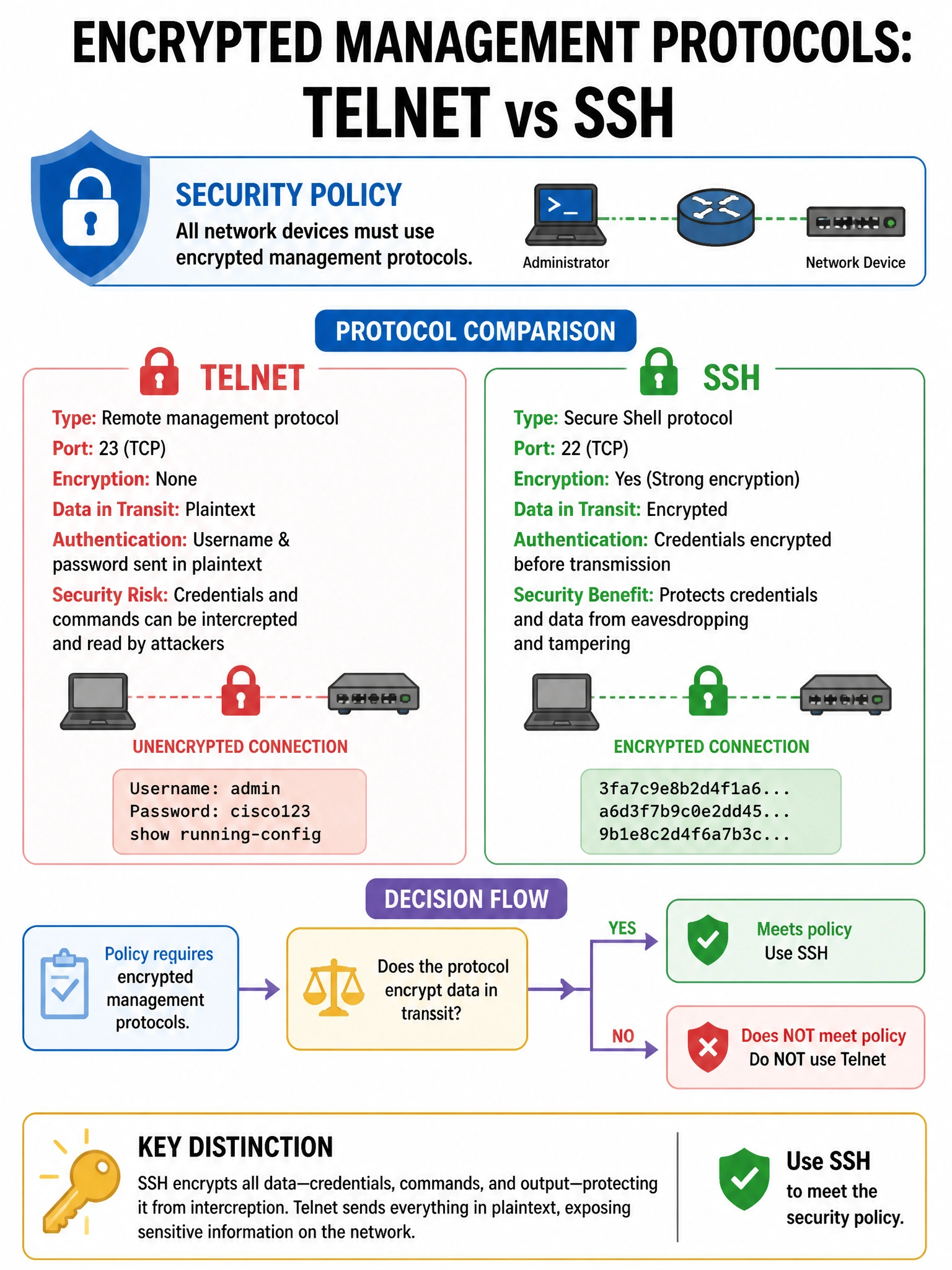
Here's the deal — b is correct because Telnet transmits all data including usernames, passwords, and commands in cleartext — anyone with network access can capture credentials via packet sniffing; SSH encrypts the entire session including credentials using public-key cryptography. A is wrong because Telnet encrypts nothing; it is a plaintext protocol from credentials to every typed character.
Full explanation below image
Full Explanation
B is correct because Telnet transmits all data including usernames, passwords, and commands in cleartext — anyone with network access can capture credentials via packet sniffing; SSH encrypts the entire session including credentials using public-key cryptography. A is wrong because Telnet encrypts nothing; it is a plaintext protocol from credentials to every typed character. C is wrong because Telnet does not encrypt data; this is the fundamental security difference. D is wrong because Telnet is still supported on many devices; it is deprecated for security reasons but not removed from all equipment.