
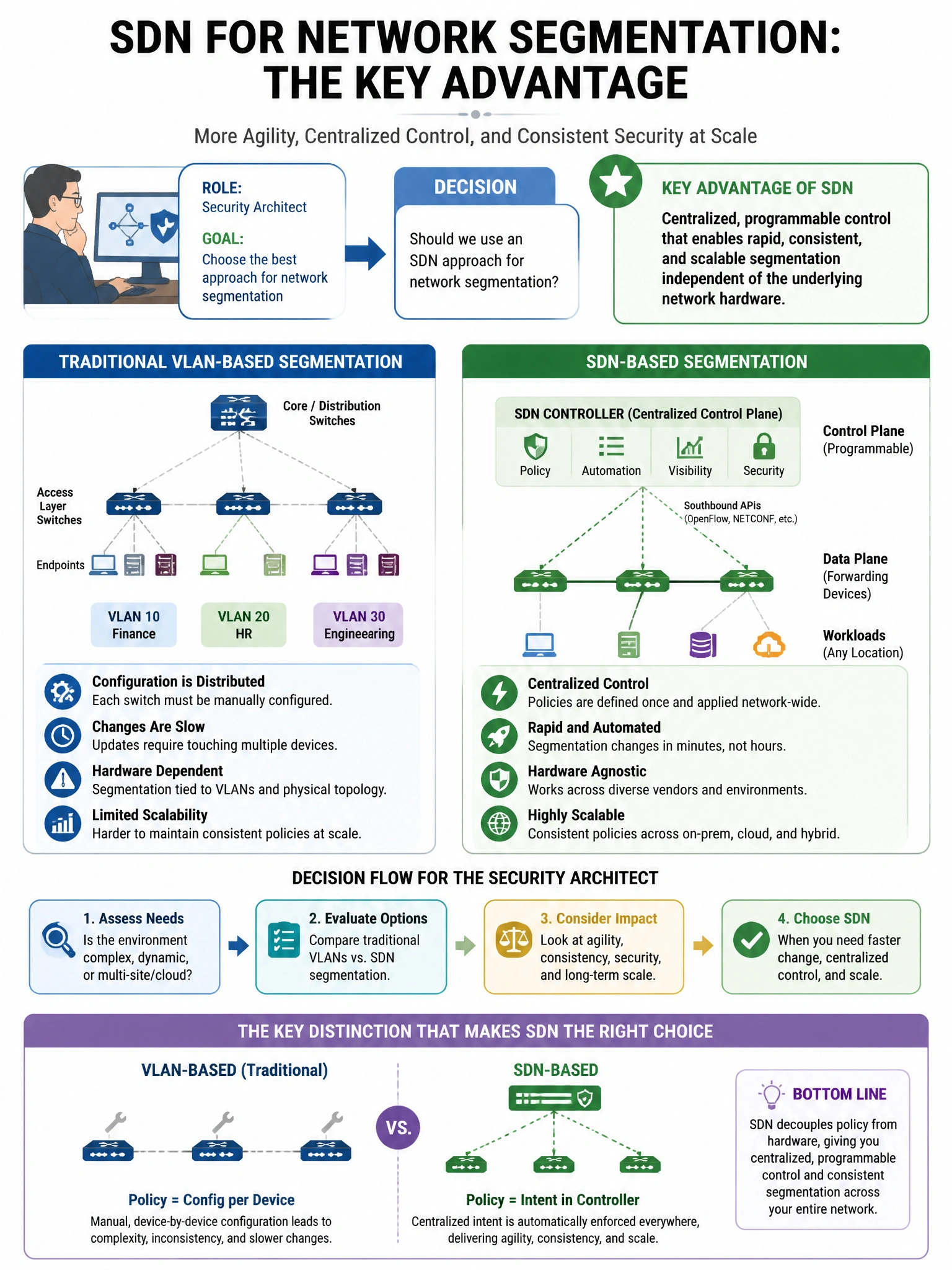
A security architect is evaluating whether to use a Software-Defined Networking (SDN) approach for network segmentation. What key advantage does SDN provide over traditional VLAN-based segmentation?
Select an answer to reveal the explanation.
Short Explanation and Infographic
Here's the deal — b is correct because SDN decouples the control plane from the data plane, allowing centralized policy management and dynamic micro-segmentation based on workload identity, security posture, or application context — far more granular than static VLAN assignments. A is wrong because SDN still runs on physical hardware; it abstracts control, not physical infrastructure.
Full explanation below image
Full Explanation
B is correct because SDN decouples the control plane from the data plane, allowing centralized policy management and dynamic micro-segmentation based on workload identity, security posture, or application context — far more granular than static VLAN assignments. A is wrong because SDN still runs on physical hardware; it abstracts control, not physical infrastructure. C is wrong because SDN adds a control plane abstraction layer; while it can optimize routing, it does not inherently remove routing overhead. D is wrong because SDN is a network architecture concept; antivirus is a separate endpoint security function.