
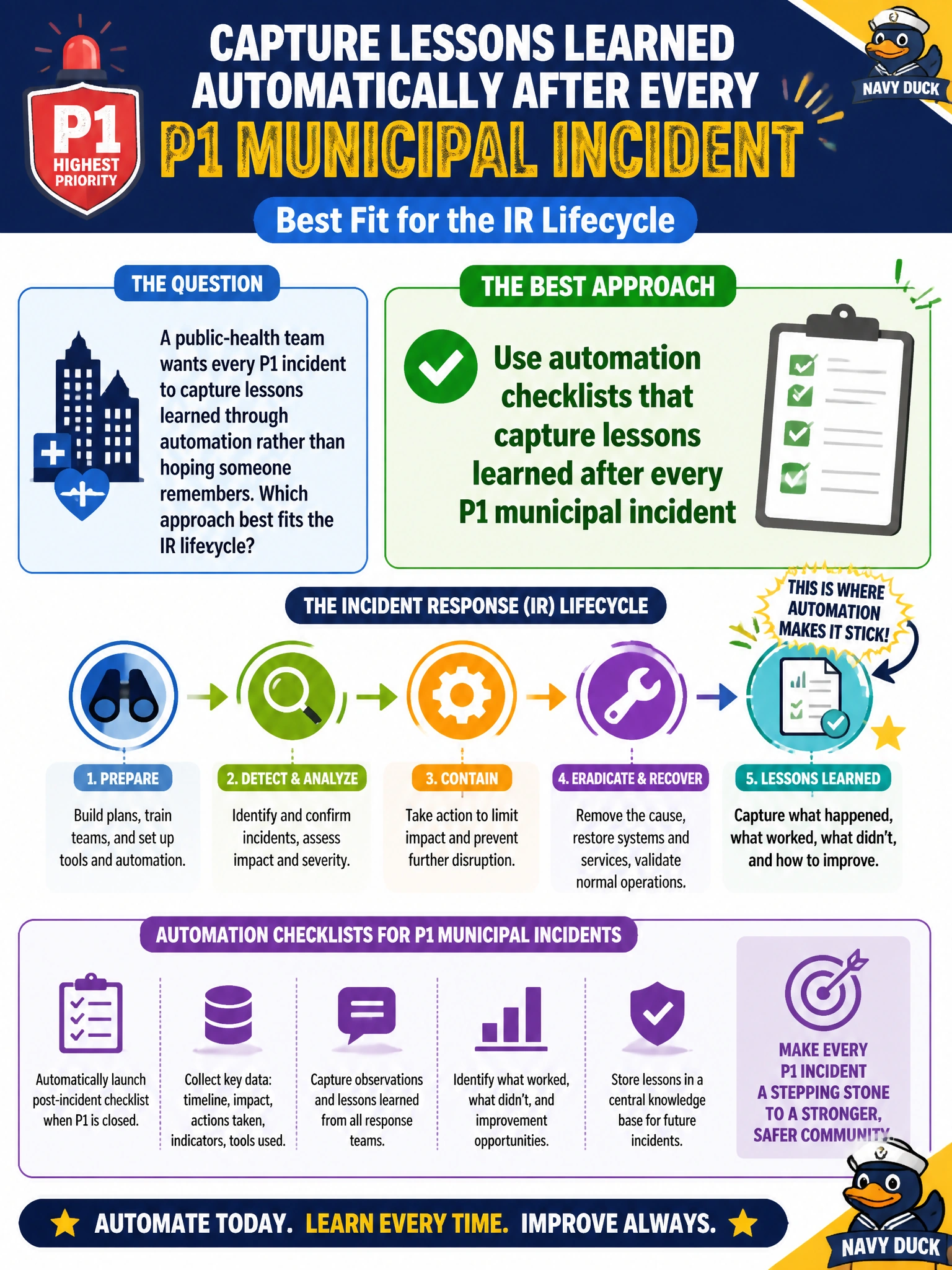
A public-health team wants every P1 incident to capture lessons learned through automation rather than hoping someone remembers. Which approach best fits the IR lifecycle?
Select an answer to reveal the explanation.
Short Explanation
You'll want automation that captures lessons after every real P1, because capturing them during the incident pulls you out of response and misses the full picture. Exercise-only checklists and restoration timelines won't give you what failed and what to fix, so you'll repeat the same outage twice. Civic IR closes the loop on purpose.
Full Explanation
A public-health team that wants every P1 incident to capture lessons learned through automation rather than hoping someone remembers should use automation checklists that capture lessons learned after every P1 municipal incident. Lessons learned close the IR loop: what failed, what worked, which detections lagged, and which playbook gaps remain. Embedding checklist capture in SOAR or IR tooling after P1 closure turns after-action into a repeatable civic control instead of an optional memory exercise during a busy outbreak or clinic-outage week.
Why the other options fail by concept: Use automation checklists that capture lessons learned during every P1 municipal incident tries to capture lessons while response is still underway, which distracts from containment and misses the post-incident perspective the public-health team specifically wants automated. Use automation checklists that capture lessons learned after every P1 municipal exercise limits automated capture to drills and simulations, so real P1 incidents still won't get the automated after-action the team wants. Use automation checklists that log restoration timelines after every P1 municipal incident records when service returned, but it doesn't capture what failed, what worked, or which playbook gaps remain, so the team still won't get lessons learned after every P1.
Exam caveat: automated checklists still need concise, actionable entries—not essay dumps—and owners assigned to remediate items with due dates. Operational check: require a completed lessons-learned checklist field before P1 case closure in the municipal IR platform, review open remediation items in the weekly public-health security huddle, and verify that recurring themes feed detection and playbook backlog.
Prefer to study offline? Printable PDF study book + test engine ($7.50, unofficial). These questions stay free here.