
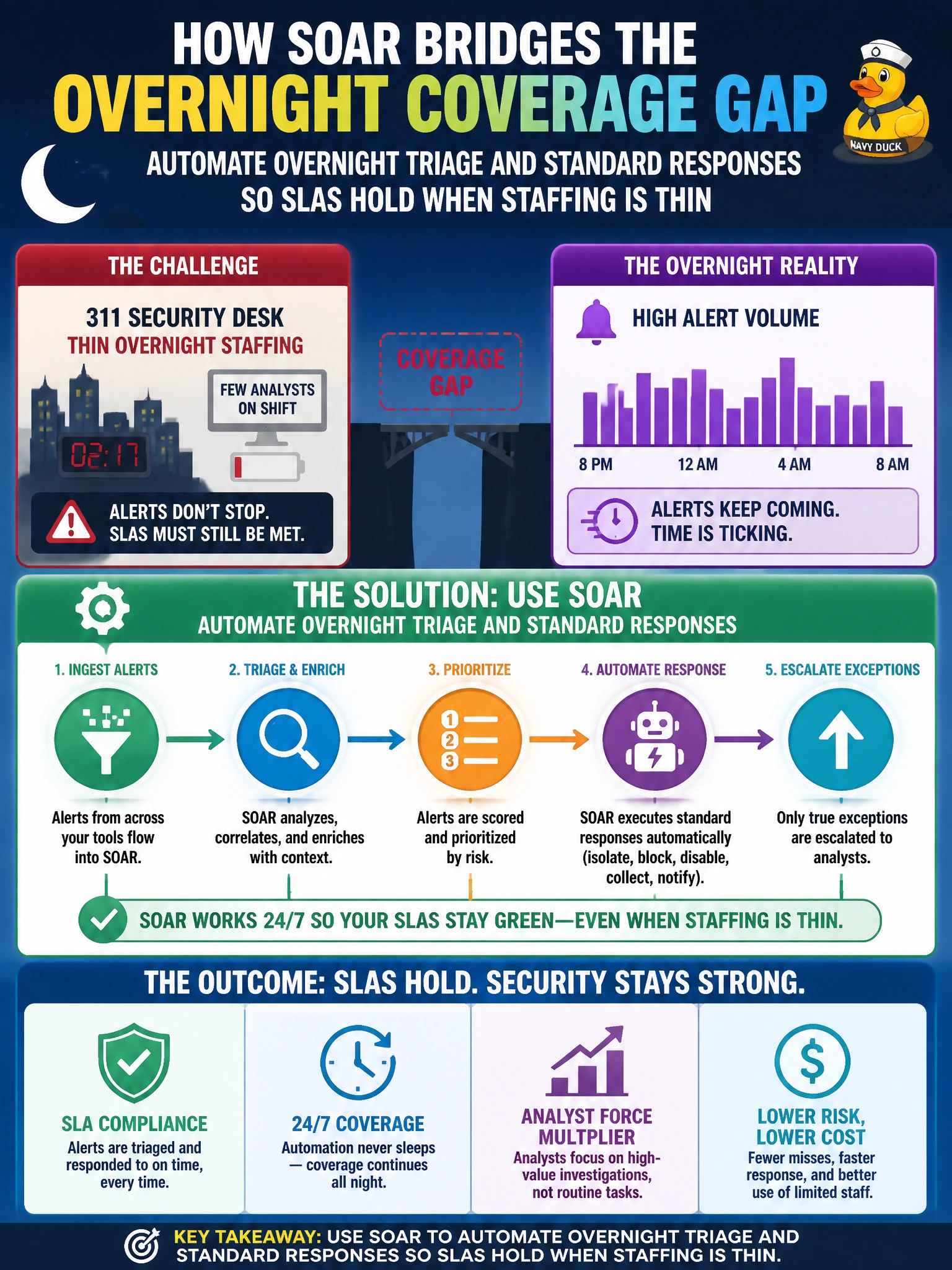
A 311 security desk has thin overnight staffing and still must meet alert SLAs. How should SOAR be used to address that coverage gap?
Select an answer to reveal the explanation.
Short Explanation
Thin overnight shifts still need a night clerk—SOAR can do the routine triage so SLAs do not nap until Monday. Just enriching alerts and queueing tickets, running playbooks that stall waiting for approval, or testing triage in simulation mode still leaves alerts untriaged while you let the SLA clock run—that's time you don't have. Automation covers the staffing gap without abandoning civic response times.
Full Explanation
A 311 security desk with thin overnight staffing that must still meet alert SLAs should use SOAR to automate overnight triage and standard responses so those SLAs hold when humans are scarce. Orchestration can enrich alerts, apply known-benign suppressions, open cases with required fields, notify on-call only when thresholds trip, and execute approved low-risk response steps—preserving service-desk coverage without pretending a full overnight SOC exists. The civic outcome is continuity: residents and operators still get timely handling while the day shift inherits structured cases instead of an unread queue.
Why the other options fail by concept: Configuring SOAR to enrich overnight alerts and queue tickets so SLAs hold when staffing is thin still only adds context and queues work—enrichment plus queueing without automated triage and standard response leaves alerts unprocessed, so the SLA clock keeps running regardless. Using SOAR to run overnight triage playbooks in approval mode so SLAs hold when staffing is thin still waits on a human click to proceed—with thin overnight staffing those approvals sit unhandled, so triage stalls and the SLA clock expires while staffing remains thin. Using SOAR to test overnight triage using simulation mode so SLAs hold when staffing is thin only dry-runs the workflow instead of handling the alert queue—simulations do not triage incoming alerts or deliver standard responses, so they are not a substitute for timed, auditable triage.
Exam caveat: overnight automation must stay inside pre-approved action boundaries—high-impact containment or irreversible changes still need human tokens even at 02:00. Operational check: map overnight alert types to SOAR playbooks with explicit SLA timers, dry-run a thin-staffing night, and verify that priority cases meet municipal SLA targets without unauthorized write actions.
Prefer to study offline? Printable PDF study book + test engine ($7.50, unofficial). These questions stay free here.