
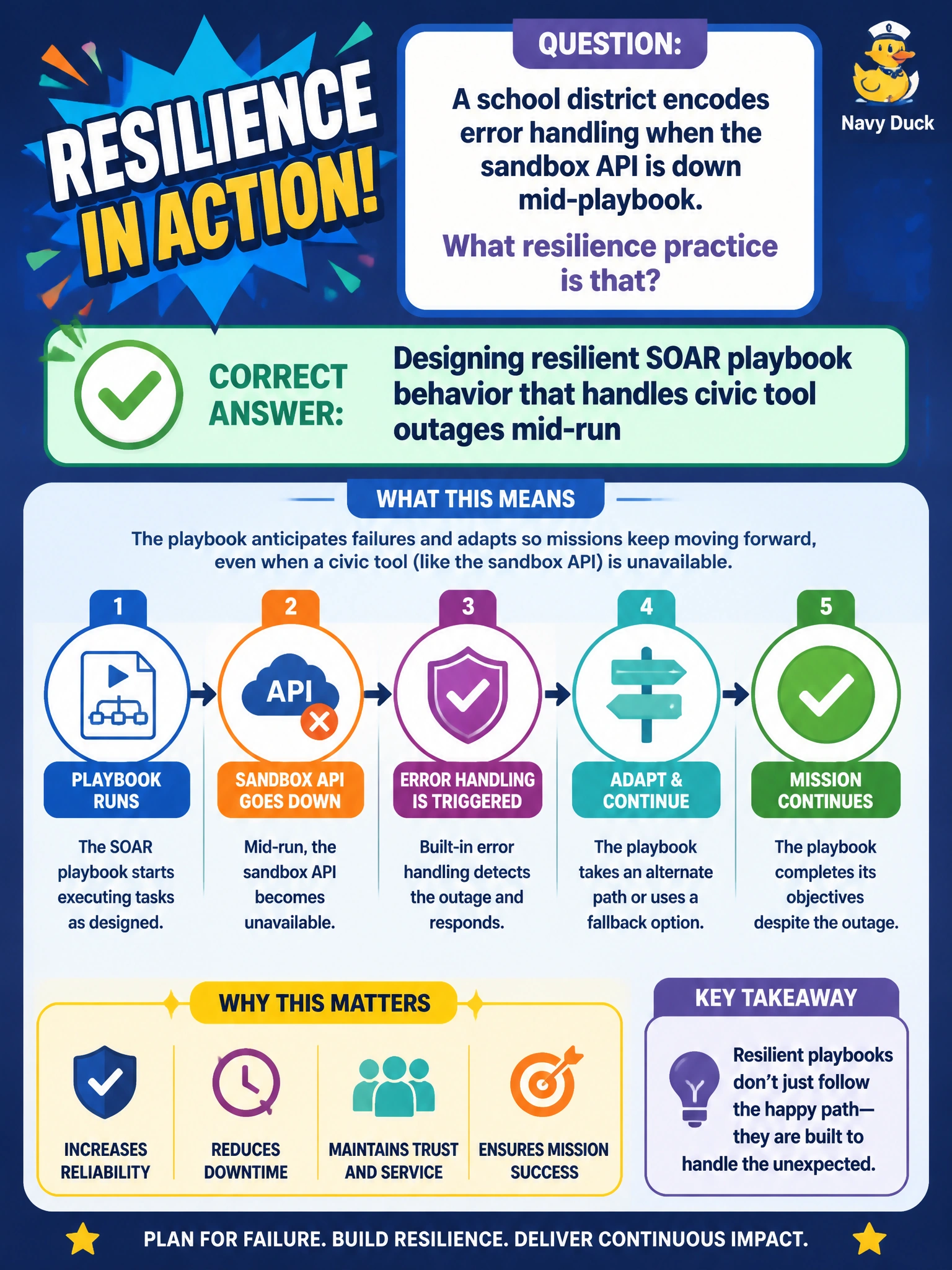
A school district encodes error handling when the sandbox API is down mid-playbook. What resilience practice is that?
Select an answer to reveal the explanation.
Short Explanation
When the sandbox naps, you'll still stall if you've only coded handling for SIEM forwarding errors, ticketing sync delays, or mid-run credential rechecks. Encode timeouts, fallbacks, and sane errors. Resilient SOAR keeps school IR moving when a tool blinks.
Full Explanation
A school district that encodes error handling when the sandbox API is down mid-playbook is designing resilient SOAR behavior for civic tool outages. External sandboxes, intel APIs, and identity connectors fail; handling SIEM forwarding errors, handling ticketing sync delays, or revalidating deployment credentials mid-run do not handle a sandbox outage mid-run and leave the playbook stuck when the sandbox goes dark. Explicit timeouts, retries with backoff, fallback enrichments, and escalate-to-human paths keep student and staff incident handling moving when a dependency naps during the school day.
Why the other options fail by concept: Handling SIEM forwarding errors mid-run builds resilience for a different downstream dependency, but it provides no timeout, fallback, or error path when the sandbox API itself is down mid-playbook. Handling ticketing sync delays mid-run keeps case creation moving when the ticketing system lags, but it assumes enrichment already succeeded and does nothing to keep the playbook moving during a sandbox API outage. Revalidating deployment credentials mid-run rechecks setup secrets during execution, not runtime resilience for an outage; it cannot recover a playbook when the sandbox API fails mid-execution.
Exam caveat: Resilience patterns must balance fail-open and fail-closed carefully—some safety systems should not fail open, but handling SIEM forwarding errors is resilience for downstream log delivery, not a runtime fail-open or fail-closed decision for the sandbox dependency error. Operational check: define timeout, retry, fallback, and escalation for each external call; simulate sandbox downtime in staging; and verify cases land with analysts through real-time error handling rather than relying on SIEM-error handling, ticketing-delay handling, or mid-run credential revalidation alone.
Prefer to study offline? Printable PDF study book + test engine ($7.50, unofficial). These questions stay free here.