
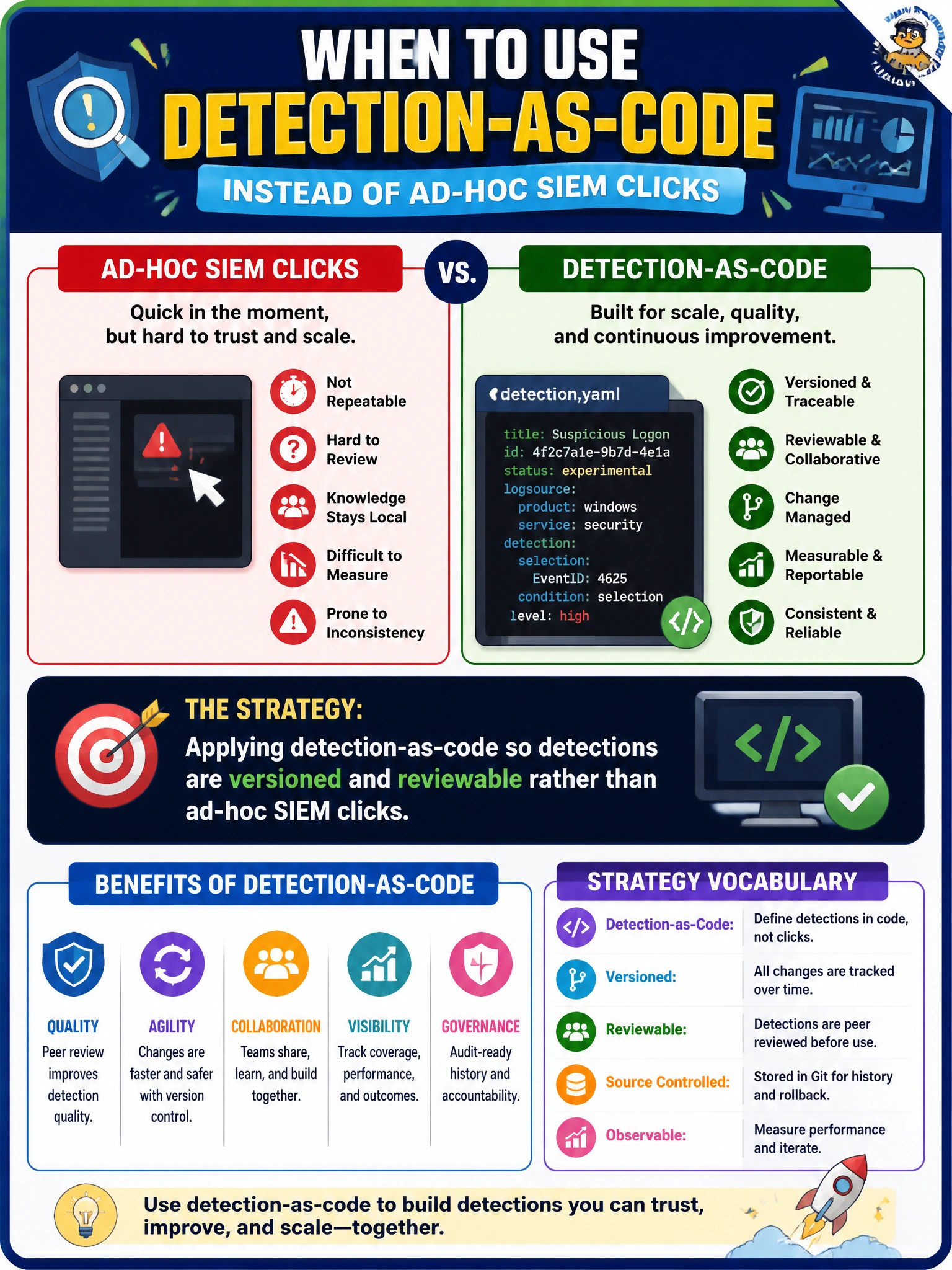
A county security lead asks when to use detection-as-code instead of ad-hoc SIEM clicks. What strategy vocabulary applies?
Select an answer to reveal the explanation.
Short Explanation
Versioning wiki pages won't help you because you're versioning docs, not the detection queries and rules you'll actually run and test. Detection-as-code means the county can review, version, and roll back. Versioning sensor agents leaves your central logic unreviewed despite ditching ad-hoc clicks, and keeping versions in notebooks you'll review only after ad-hoc SIEM clicks means bad rules go live before review.
Full Explanation
A county security lead asking when to use detection-as-code instead of ad-hoc SIEM clicks should apply detection-as-code so detections are versioned, reviewable, and testable. Encoding detections in reviewed artifacts (queries, rules, tests) under change control lets municipal teams peer-review logic, roll back bad rules, and prove to auditors how a detection evolved. Ad-hoc console clicks may be fine for emergency hotfixes, but they do not scale as the durable strategy for a county detection program.
Why the other options fail by concept: Applying detection-as-code so wiki pages are versioned and reviewable rather than ad-hoc SIEM clicks versions the wrong artifact, because wiki documentation lacks executable queries, automated testing, and enforceable pull-request review that versioned detections provide. Applying detection-as-code so sensor agents are versioned and reviewable rather than ad-hoc SIEM clicks versions the wrong layer, leaving the actual SIEM detection queries outside version control and unreviewed. Applying detection-as-code so detections are versioned and reviewable in notebooks after ad-hoc SIEM clicks inverts the lifecycle, because review must happen before deployment through pull requests, not after personal notebooks are already live from clicks.
Exam caveat: Detection-as-code still requires runtime validation in the SIEM or XDR; versioned files that never deploy help nobody. Operational check: take one ad-hoc county detection, export it into the detection-as-code repo with owner and test case, deploy through review, and confirm the SIEM rule matches the reviewed artifact hash or version tag.
Prefer to study offline? Printable PDF study book + test engine ($7.50, unofficial). These questions stay free here.