
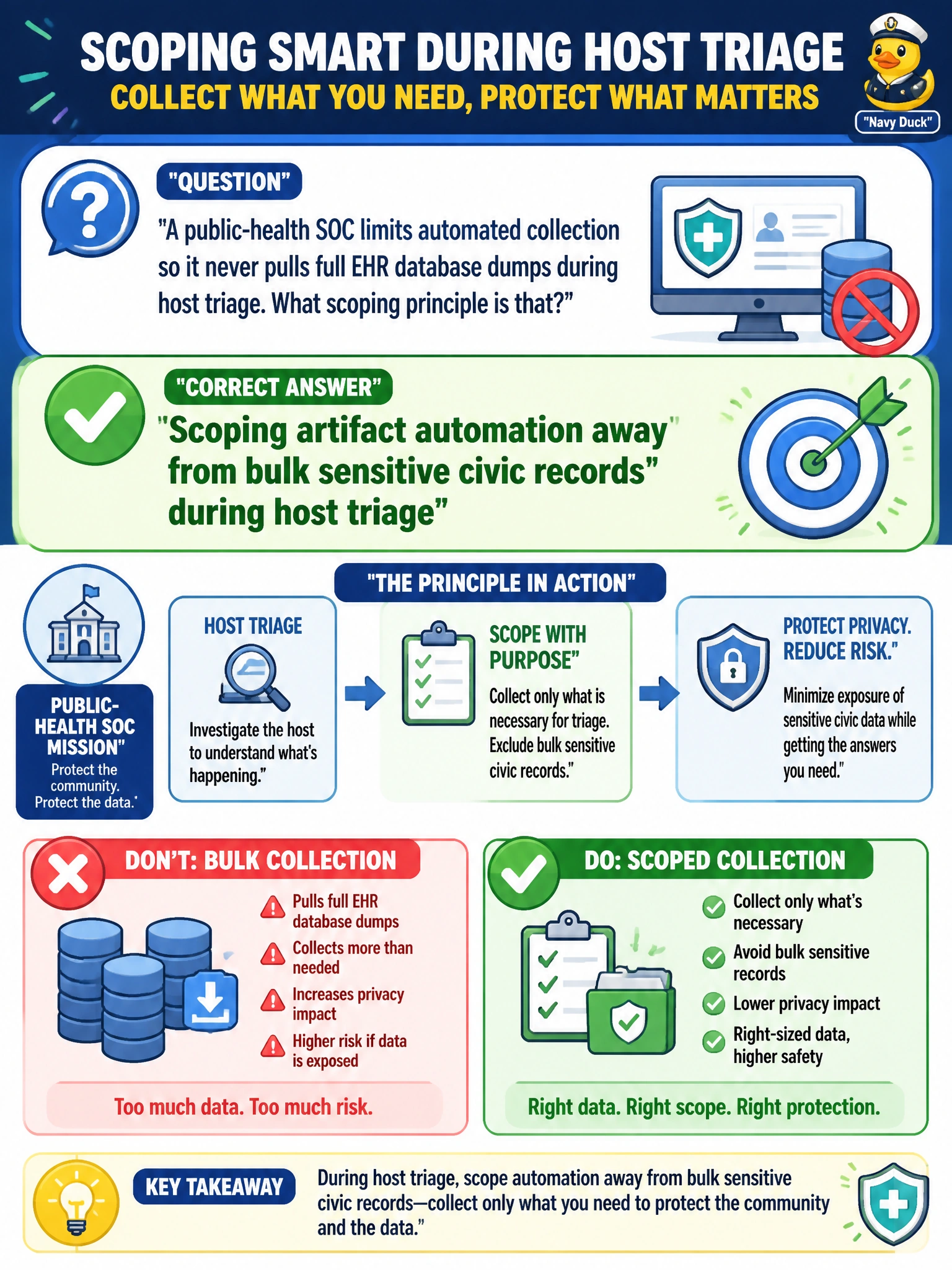
A public-health SOC limits automated collection so it never pulls full EHR database dumps during host triage. What scoping principle is that?
Select an answer to reveal the explanation.
Short Explanation
Host triage is a spotlight, not a floodlight on the whole clinic. You're collecting what you'll need on that host, not scoping containment automation away from bulk sensitive civic records during host triage. Scope keeps privacy and storage from melting down.
Full Explanation
A public-health SOC that limits automated collection so it never pulls full EHR database dumps during host triage is scoping artifact automation away from bulk sensitive civic records. Host triage needs endpoint artifacts—process lists, logs, browser state, selected files—not wholesale clinical tables. Encoding that boundary in automation protects patient privacy, HIPAA-aligned handling expectations, and storage capacity while still letting responders investigate phishing or malware on a clinic workstation.
Scoping detection automation away from bulk sensitive civic records during host triage gets the data boundary and phase right but names the wrong automation family, since detection governs finding and alerting on potential threats while this principle governs artifact automation that limits what is collected during host triage to protect patient privacy. Scoping enrichment automation away from bulk sensitive civic records during host triage gets the data boundary and phase right but names the wrong automation family, since enrichment adds context to already-collected alerts and artifacts while this principle governs artifact automation that limits collection to keep full EHR dumps out of this workstation investigation. Scoping containment automation away from bulk sensitive civic records during host triage gets the data boundary and phase right but names the wrong automation family, since containment governs isolation and blocking while this principle governs artifact automation that limits what is collected to protect patient privacy. Host-level triage is a spotlight on that endpoint's process and file activity, not a floodlight on the entire clinic. The principle of proportional response means triage scope must match incident scope; collect only what the investigation on that host requires. Scoping containment automation away from bulk sensitive civic records during host triage confuses isolation with collection, so it fails to define the triage collection rule and would still risk regulatory exposure, wasted storage, and privacy harm instead of explicitly scoping artifact automation away from bulk sensitive dumps.
Exam caveat: Define your collection scope per incident class. A malware-on-clinic-workstation is different from a suspected data-breach-in-medical-records; let the incident class inform what is collected.
Operational check: Document your host-triage artifact scope (e.g., process tree, event logs, browser cache, MFT); encode that scope in automated collection rules; verify that collection agents run under minimal privileges (read-only, scoped to endpoints for host triage, not scoping enrichment automation away from bulk sensitive civic records during host triage which is a separate context-adding function); and measure storage consumed by collections to confirm they are endpoint-focused, not data-warehouse-scale.
Prefer to study offline? Printable PDF study book + test engine ($7.50, unofficial). These questions stay free here.