
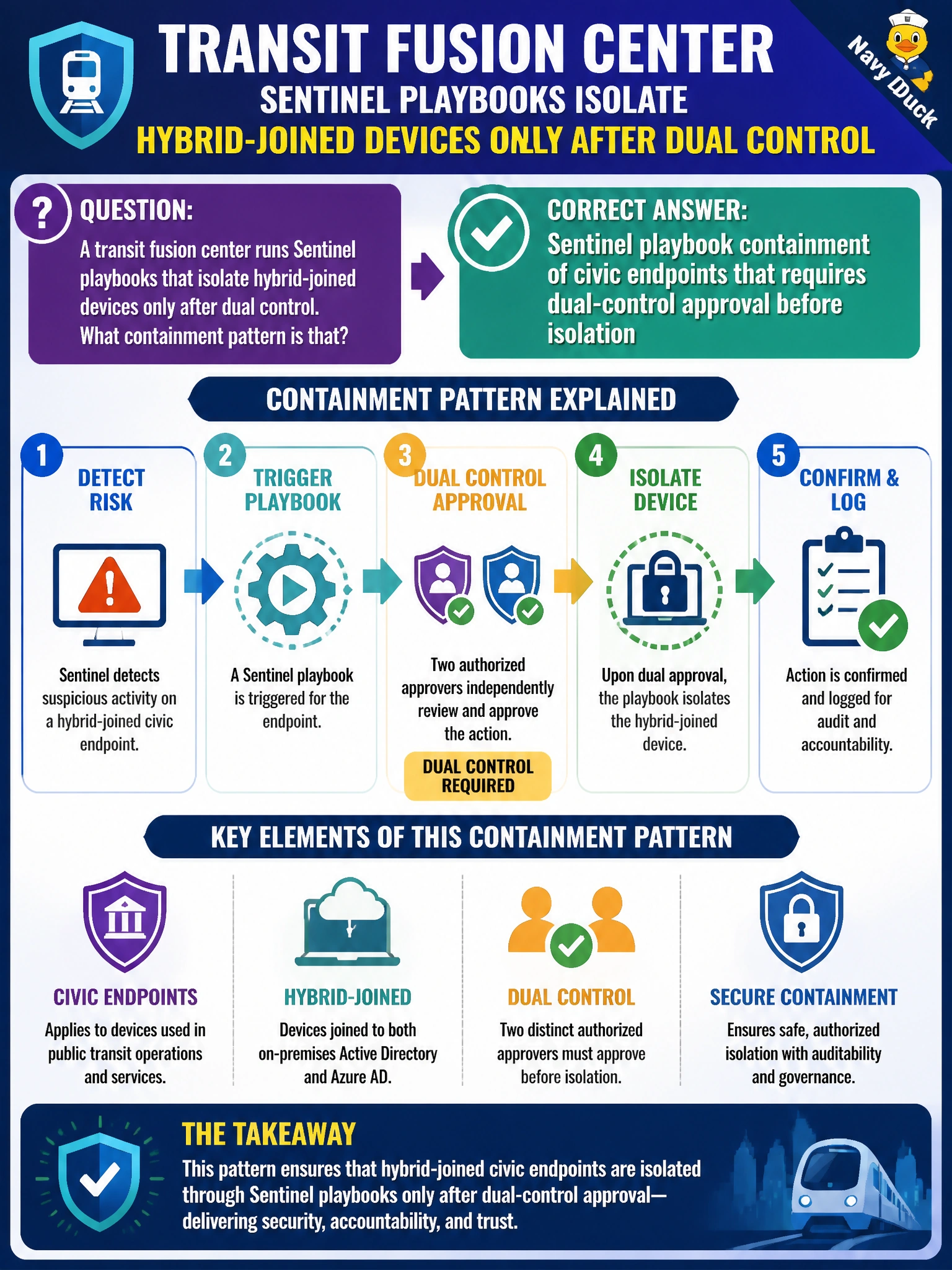
A transit fusion center runs Sentinel playbooks that isolate hybrid-joined devices only after dual control. What containment pattern is that?
Select an answer to reveal the explanation.
Short Explanation
Isolation is a big red lever on transit endpoints—Sentinel can pull it, but dual control keeps accidental lockouts from stranding operators. Single-admin approval won't give you dual control, after-isolation approval won't gate it in time, and notification alone won't approve anything for you. Approve, then contain.
Full Explanation
Running Sentinel playbooks that isolate hybrid-joined devices only after dual control is containment with affirmative human gates for civic endpoints. Isolation (network contain via Defender for Endpoint or similar) is high-impact: it can take a fare-system laptop or ops workstation offline. Dual control—two authorized approvers or an approver plus automated high-confidence criteria—reduces mistaken isolation from noisy alerts while still enabling rapid response once approval is recorded. Transit fusion centers cannot risk losing their own infrastructure because a Sentinel rule misfired.
Sentinel playbook containment of civic endpoints that requires single-admin approval before isolation misses the dual-control gate, so a single admin acting alone does not satisfy the two-approver requirement for isolating hybrid-joined devices. Sentinel playbook containment of civic endpoints that requires dual-control approval after isolation gets the timing wrong, so approving after isolation does not provide an affirmative human gate before hybrid-joined devices are taken offline. Sentinel playbook containment of civic endpoints that requires dual-control notification before isolation lacks an approval gate, so merely notifying reviewers does not require dual-control approval before isolating hybrid-joined civic devices. Dual-control approval—human review plus another human or strong automated criteria—ensures that isolation decisions during crisis are intentional, not automatic side effects of tuning.
Exam caveat: Isolation speed and protection must be balanced. Prefer playbooks that offer SOC leads rapid approval buttons (one-click dual-control) rather than workflow delays, or that automate isolation only when two independent detections agree.
Operational check: Scope isolation playbooks to hybrid-joined civic endpoints and fare systems; configure them to require dual approval (e.g., SOC lead + CISO automation rule, or two distinct approvers); build test cases with known benign signals and confirm the playbook requires approval before isolation; and measure approval latency so containment can still happen within SLA.
Prefer to study offline? Printable PDF study book + test engine ($7.50, unofficial). These questions stay free here.