
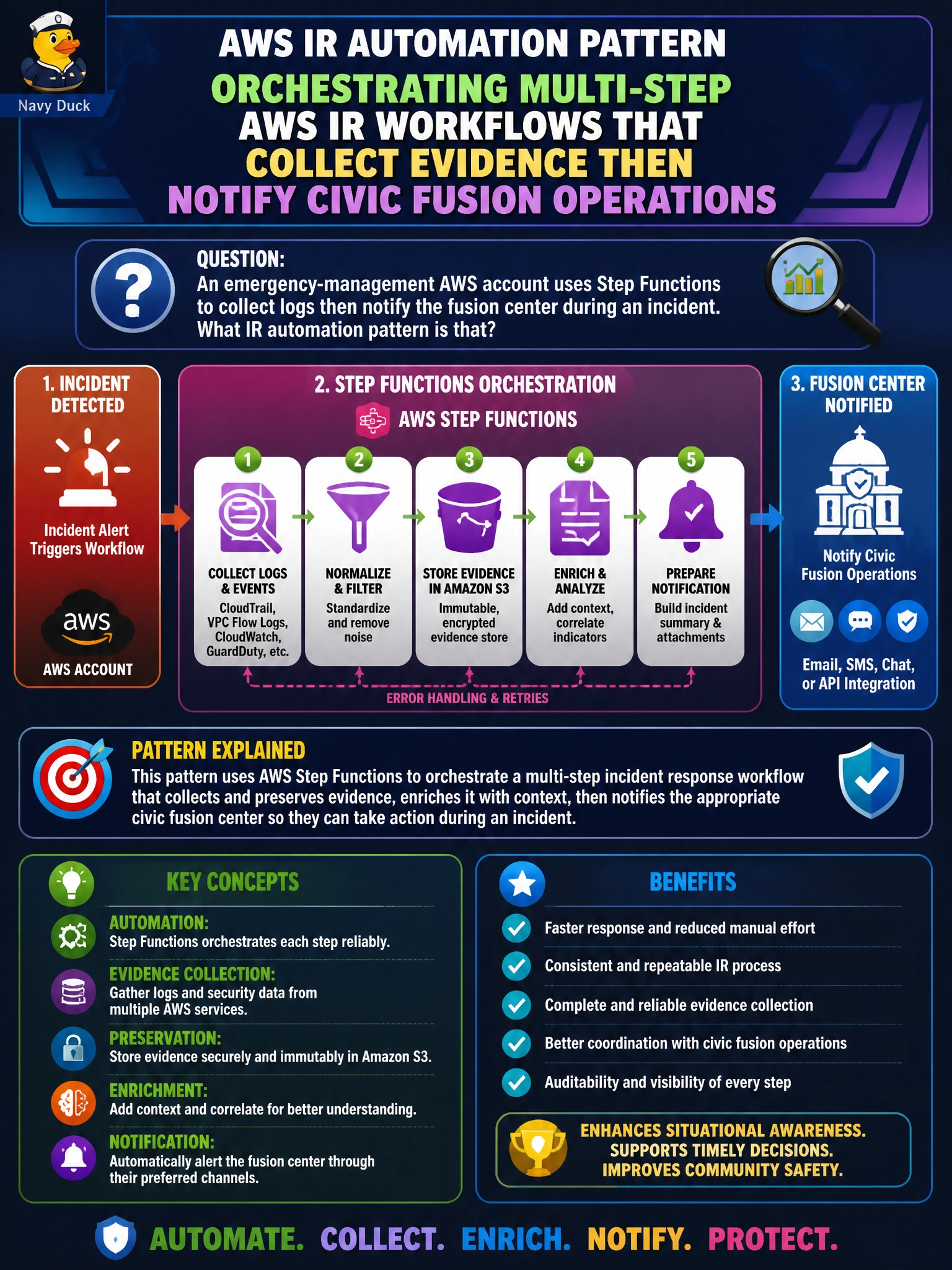
An emergency-management AWS account uses Step Functions to collect logs then notify the fusion center during an incident. What IR automation pattern is that?
Select an answer to reveal the explanation.
Short Explanation
Step Functions is your incident conductor: you grab the logs, then ring the fusion center—order matters. Single-step Step Functions tasks, multi-step Step Functions monitors, and multi-step Step Functions alerts don't sequence collection before notification like multi-step orchestration does — you'll lose order, retries, and tracking if you pick them. Orchestrate the steps.
Full Explanation
Orchestrating multi-step AWS IR workflows that collect evidence then notify civic fusion operations sequences emergency-management response so log collection and packaging happen before fusion-center alerting. Step Functions (or equivalent orchestration) encodes that order, retries, and state tracking, while orchestrating single-step Step Functions tasks that collect evidence then notify civic fusion operations understates that coordination to a single task, which cannot sequence log collection then fusion-center notification with retries and state tracking the way the multi-step evidence-collection-then-alert sequence the stem describes requires. Collect-then-notify produces actionable packages for fusion operations instead of orchestrating multi-step Step Functions alerts that collect evidence then notify civic fusion operations, because alerts only distribute notifications and cannot orchestrate log collection with retries and state tracking, which matters when emergency-management AWS accounts support time-critical civic coordination.
Orchestrating single-step Step Functions tasks that collect evidence then notify civic fusion operations fails by concept because a single task executes once without sequencing, and it does not ensure logs are gathered and packaged with retries and state tracking before alerting. Orchestrating multi-step Step Functions monitors that collect evidence then notify civic fusion operations fails because monitors only observe and detect conditions and do not orchestrate the multi-step evidence collection and packaging required before fusion-center notification. Orchestrating multi-step Step Functions alerts that collect evidence then notify civic fusion operations fails because alert distribution without workflow orchestration does not sequence the preceding evidence package and forces fusion staff to chase context instead of acting on prepared municipal IR artifacts.
Exam caveat: Multi-step orchestration that collects evidence then notifies is the pattern when stems mention Step Functions and fusion-center notification. Order matters: evidence before notify; single-step Step Functions tasks, multi-step Step Functions monitors, and multi-step Step Functions alerts that misattribute multi-step workflow orchestration are distractors.
Operational check for emergency-management cloud IR: execute the Step Functions workflow in staging, confirm log collection tasks complete and attach artifacts to the case before notification tasks run, measure end-to-end duration against municipal IR targets, and do not let orchestrating single-step Step Functions tasks that collect evidence then notify civic fusion operations replace the Step Functions collect-then-notify path in production.
Prefer to study offline? Printable PDF study book + test engine ($7.50, unofficial). These questions stay free here.