
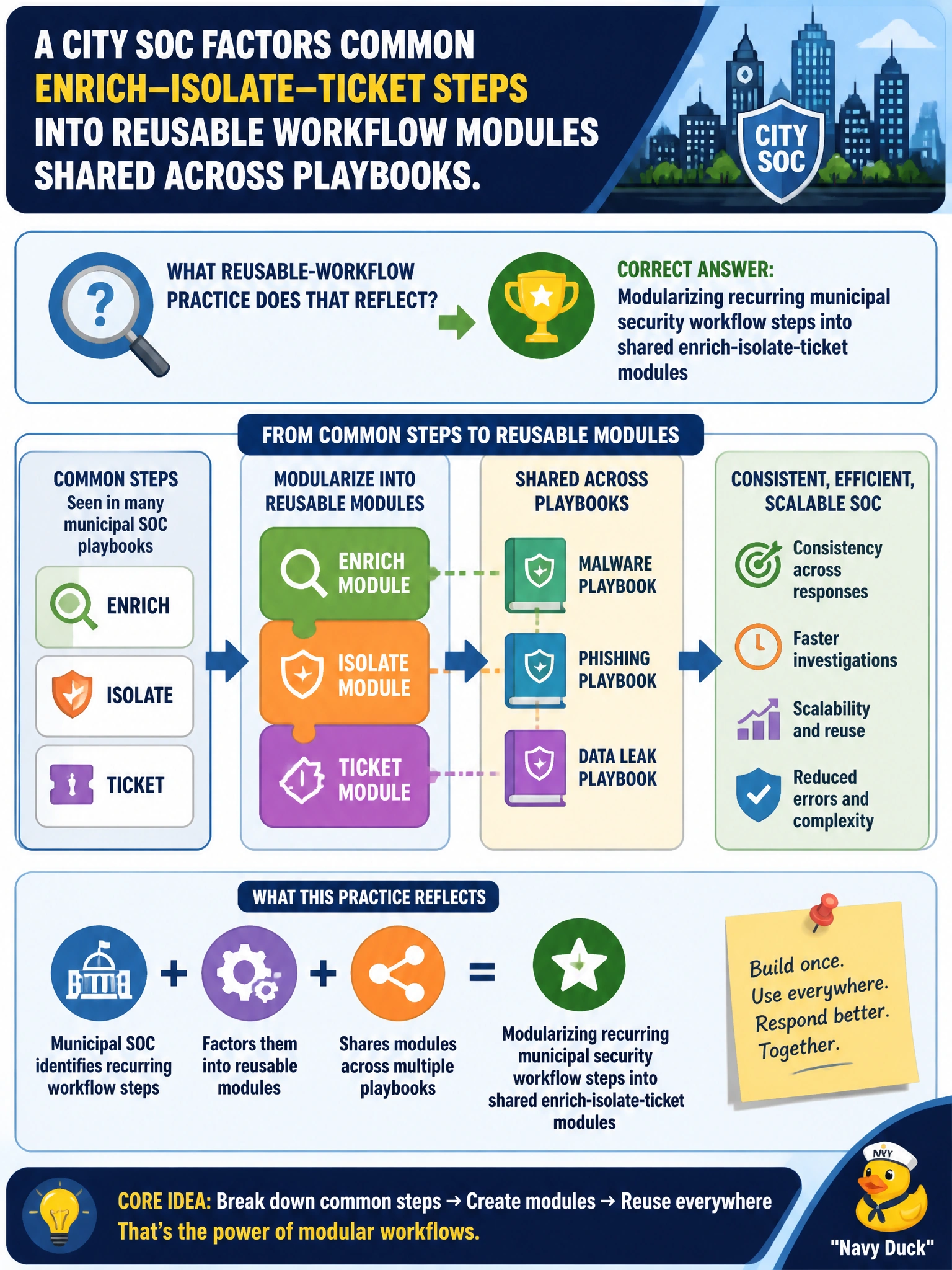
A city SOC factors common enrich-isolate-ticket steps into reusable workflow modules shared across playbooks. What reusable-workflow practice does that reflect?
Select an answer to reveal the explanation.
Short Explanation
Think Lego bricks for the SOC: enrich, isolate, ticket once as modules, then snap them into many playbooks. Versioning them won't give you one callable build you'll reuse, standardizing them won't factor the steps you'll call, and cloning them is how drift sneaks in. Reuse the good bricks.
Full Explanation
Modularizing recurring municipal security workflow steps into shared enrich-isolate-ticket modules lets a city SOC maintain one reviewed implementation of common incident actions and call that implementation from many playbooks. Enrichment, isolation, and ticketing recur across malware, account-takeover, and other civic tickets; factoring those steps into reusable modules reduces copy-paste drift, keeps procedure language consistent for on-call staff, and concentrates testing and change control on the shared components rather than on dozens of one-off scripts. That design supports maintainable civic automation where the same SOC must protect permitting, public-safety adjacent systems, and other city workloads with limited engineering time. Versioning recurring municipal security workflow steps into shared enrich-isolate-ticket modules fails by concept because it governs revision history, not how common enrich-isolate-ticket steps are factored into callable shared modules; a city SOC still lacks one reviewed implementation that many playbooks can invoke. Cloning recurring municipal security workflow steps into shared enrich-isolate-ticket modules still produces a separate copy in each playbook instead of one shared module—cloning duplicates what each playbook holds, but a fix to the enrich-isolate-ticket logic still has to be copied into every playbook by hand rather than updating a single reusable component. Standardizing recurring municipal security workflow steps into shared enrich-isolate-ticket modules fails by concept because it enforces uniform procedure language, not how common enrich-isolate-ticket steps are factored into callable shared modules; consistent standards alone cannot replace the single reviewed implementation that keeps enrich-isolate-ticket behavior consistent across playbooks. Exam caveat: GASAE automation questions often distinguish modularizing into reusable shared modules from versioning, cloning, or standardizing into shared modules. Prefer answers that preserve shared, reviewed workflow components across municipal playbooks rather than uniqueness for its own sake. Operational check for a city SOC: inventory playbooks that still embed inline enrich-isolate-ticket logic, migrate those steps into versioned shared modules, require peer review before module promotion, and verify in a staging ticket that multiple playbooks invoke the same module revision and produce consistent enrichment fields, isolation actions, and ticket updates.
Prefer to study offline? Printable PDF study book + test engine ($7.50, unofficial). These questions stay free here.