
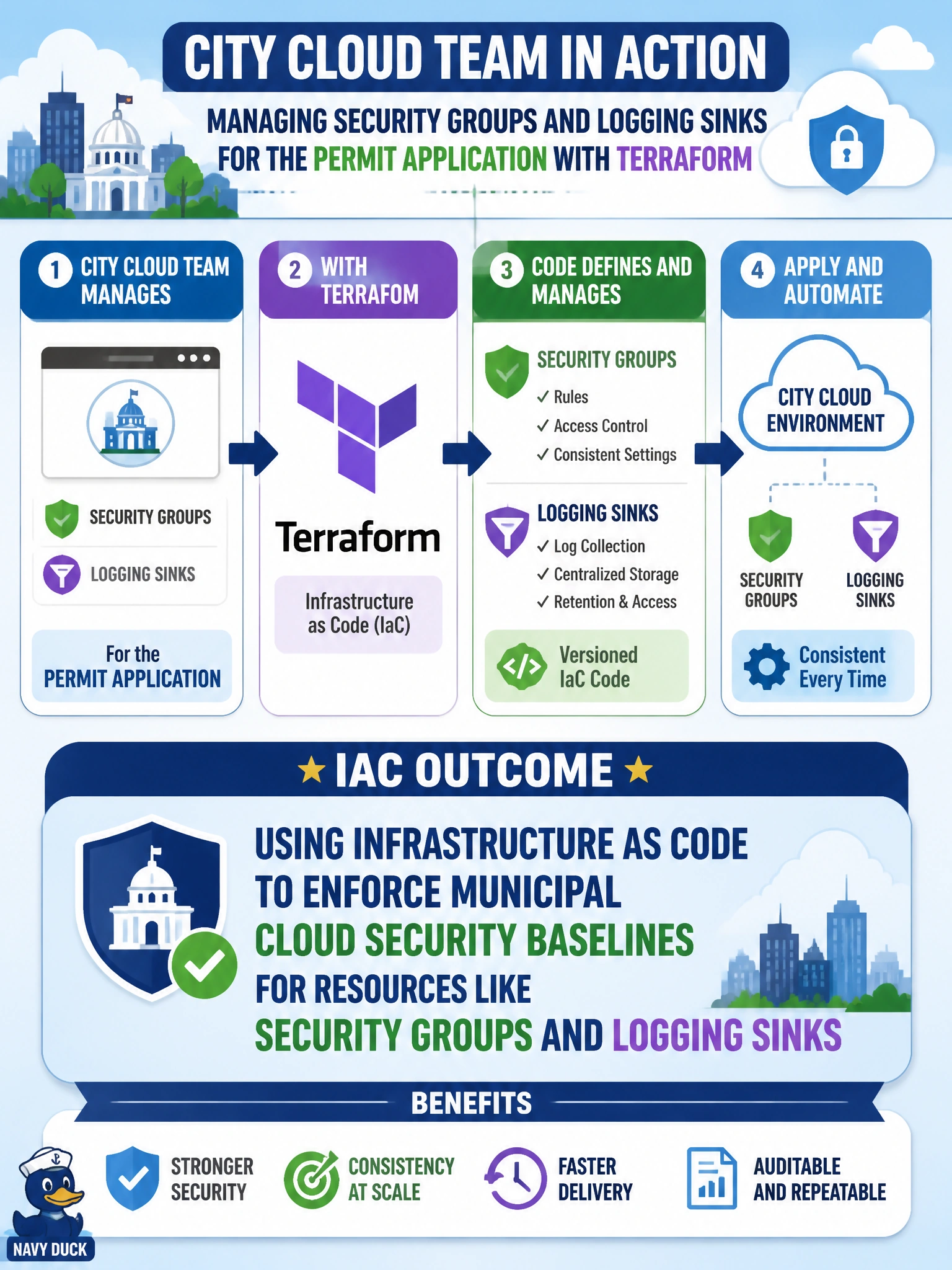
A city cloud team manages security groups and logging sinks for the permit application with Terraform. What IaC outcome does that support?
Select an answer to reveal the explanation.
Short Explanation
Terraform keeps your permit app's security groups and logging sinks honest — you're enforcing baselines as code, not just documenting them for audit records in deployment pipelines. Detecting drift for dashboards or versioning for change history won't enforce the municipal baseline like codified controls do. Code the guardrails.
Full Explanation
Using Infrastructure as Code to enforce municipal cloud security baselines for resources like security groups and logging sinks is the IaC outcome a city cloud team achieves with Terraform for the permit application. Codified security groups and sinks make baselines reviewable, repeatable, and auditable, replacing silent console drift with pull-request visibility. For citizen-facing permit systems, that consistency protects network exposure controls and ensures logging needed for investigations remains present.
Using Infrastructure as Code to document permit-app security groups and logging sinks for audit records in deployment pipelines provides visibility without enforcement—documentation records what is deployed but does not enforce municipal baselines or prevent insecure security groups and missing logging sinks. Using Infrastructure as Code to detect drift in permit-app security groups and logging sinks for compliance reporting dashboards identifies deviation after the fact, but detection alone does not enforce municipal cloud security baselines or restore required controls. Using Infrastructure as Code to version permit-app security groups and logging sinks for change history in source control supports traceability, but version history alone does not enforce municipal cloud security baselines or ensure that security groups and sinks conform to required controls.
Exam caveat: IaC enforces what is coded—wrong baselines in Terraform still deploy wrong security; policy-as-code and peer review remain necessary. Operational check: terraform plan the permit stack, confirm security group and logging sink resources match the municipal baseline, and verify remote state ACLs are private to the cloud team roles only.
Prefer to study offline? Printable PDF study book + test engine ($7.50, unofficial). These questions stay free here.