
A county SOC uses Python notebooks to enrich phishing headers from 311-related mailbox incidents. What scripting practice does that reflect?
Select an answer to reveal the explanation.
Short Explanation
Python notebooks are the county's workbench for peeling phishing headers from 311 mailboxes—fast, repeatable enrichment. You'll miss the threat if you're doing service-request enrichment or PII enrichment handling, since neither one parses phishing headers for email threats. You'll also miss the header work if you're building civic threat-portal enrichment, since it's focused on portal records, not phishing-header analysis.
Full Explanation
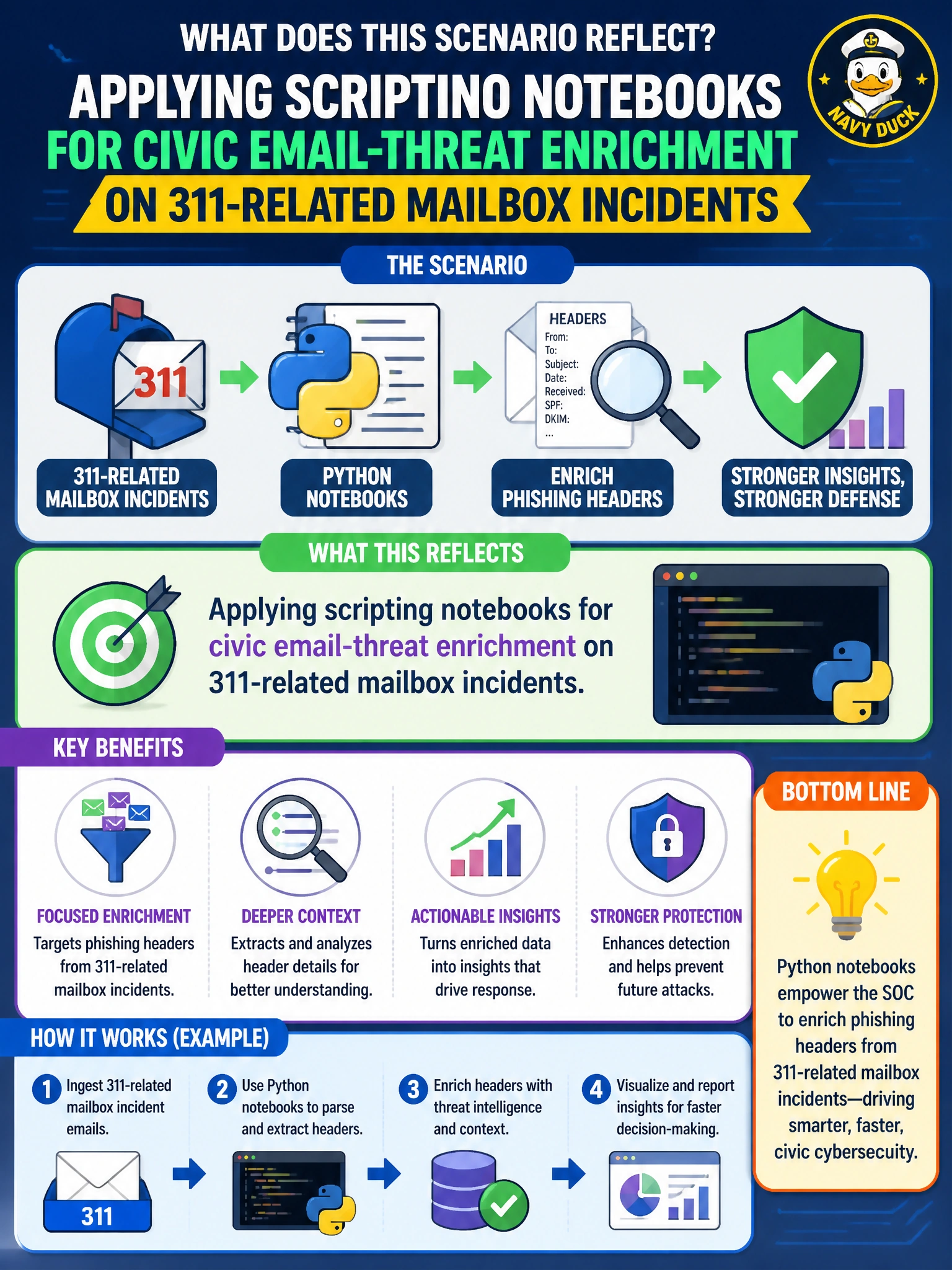
Applying scripting notebooks for civic email-threat enrichment on 311-related mailbox incidents reflects sound SOC scripting practice. Python notebooks let county analysts parse phishing headers, extract authentication results, pivot on sending infrastructure, and document enrichment steps in a reproducible artifact that others on the bridge can re-run. For 311-related mailboxes—high-visibility citizen communication channels—reproducible enrichment reduces missed indicators and speeds consistent disposition.
Applying scripting notebooks for civic service-request enrichment on 311-related mailbox incidents fails by concept: enriching service-request details adds ticket context such as request category or location and does not parse phishing headers for SPF/DKIM/DMARC and sending infrastructure as the scenario requires. Applying scripting notebooks for civic PII enrichment handling on 311-related mailbox incidents fails by concept: handling PII enrichment centers on identity attributes and privacy handling and does not extract phishing-header authentication results and routing evidence for email-threat enrichment. Applying scripting notebooks for civic threat-portal enrichment on 311-related mailbox incidents fails by concept: formatting enrichment for a threat-portal feed centers on portal records and sharing structure and does not perform reproducible phishing-header parsing for email-threat disposition.
Exam caveat: notebooks are not a substitute for secure malware detonation controls; keep samples in approved sandboxes and scrub secrets before sharing notebooks broadly. Operational check: open a 311 phishing notebook run, verify it retains original headers, produces structured enrichment fields, and stores output in the SOC case system as email-threat enrichment rather than as civic threat-portal enrichment.
Prefer to study offline? Printable PDF study book + test engine ($7.50, unofficial). These questions stay free here.