
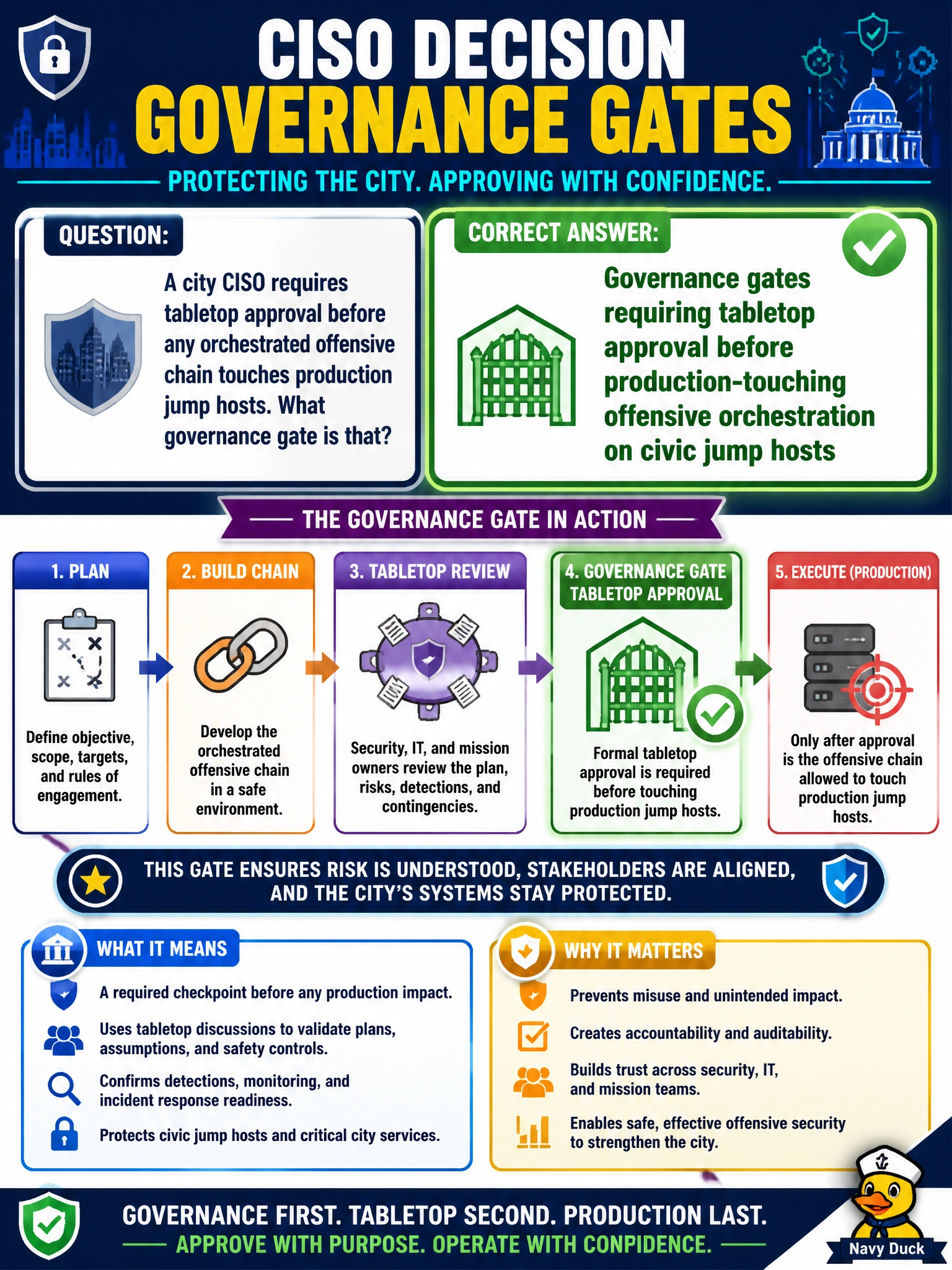
A city CISO requires tabletop approval before any orchestrated offensive chain touches production jump hosts. What governance gate is that?
Select an answer to reveal the explanation.
Short Explanation
Before the automated chain kisses a production jump host, the CISO wants a tabletop thumbs-up—like a parade permit before the floats roll. You'll miss with joint tabletop approval because you've added a joint sign-off the CISO never asked for, and delegated tabletop approval won't work because you've let someone else give the thumbs-up the tabletop itself must give. Standing tabletop approval isn't enough either because it's a blanket pre-ok and you'll still need that fresh tabletop check for your production run.
Full Explanation
Governance gates requiring tabletop approval before production-touching offensive orchestration on civic jump hosts are what a city CISO is imposing. Jump hosts often sit on privileged paths into municipal systems; automated chains that touch them can look like—and become—real compromise if unreviewed. A tabletop gate forces scope, abort criteria, detection expectations, and stakeholder awareness before orchestration is allowed to proceed, which is appropriate change control for production-adjacent purple work.
Governance gates requiring joint tabletop approval before production-touching offensive orchestration on civic jump hosts fails by wording: joint adds a multiple-party co-approval requirement the question never stated, so it is stricter than the tabletop approval the CISO required. Governance gates requiring delegated tabletop approval before production-touching offensive orchestration on civic jump hosts fails by authority: delegated means the approval was handed off, which is not the direct tabletop approval specified before a production jump host is touched. Governance gates requiring standing tabletop approval before production-touching offensive orchestration on civic jump hosts fails by timing: standing implies a blanket pre-authorization, not the specific tabletop approval required before production-touching orchestration is allowed to proceed.
Exam caveat: tabletop approval is necessary but not sufficient; technical guardrails (allowlists, rate limits, abort hooks) must still enforce what the tabletop authorized. Operational check: require a signed tabletop record naming jump hosts, techniques, window, and abort owner before the orchestration system will accept a production-touching run token.
Prefer to study offline? Printable PDF study book + test engine ($7.50, unofficial). These questions stay free here.